Surprise! We are already back with a new Story Sheets! Bet you didn't expect one quite so soon, but it was obvious it was coming, wasn't it?
After our last entry, it only made sense to jump right into the next one this week. As you well know, there are two stories (naturally) included in the collection Two Adventure Across Eternity, and you already know about "Duel On Dalpha" and the story behind that one, but what of the second story? Well, let us get into it.
As you might have guessed from just the title of today's story, this isn't another space opera tale of gun fights and mecha battles like the last one. No, it's very much the opposite. This is a story of swords, sorcery, and cursed lands. So why is it even here, being paired in a collection with a seemingly very different story? Well, I will explain that part a bit later on. For now, let us concentrate on the tale itself. What is "Three Gifts of the White Wolf" and where did it come from?
Believe it or not, it's actually a pretty old story I recently edited myself to completion. Since I was a much improved writer by the time I wanted to publish it, I sharpened this older tale up a good deal, though nothing in the piece itself has changed. That said, since this was never published before or looked at by other eyes, it is the readers who get to dive into this one fresh. Therefore I spent a good deal of time tempering this one up.
Anyway, enough of the technical details. What about where it came from? That is actually a very simple question to answer.
What happened is something that occurs every now and then where I will be writing or editing a story, novel, or even blog post, and I will be struck with an idea and have to put everything aside to write it down on the spot. For example, when I was editing Two Adventures Across Eternity to get it out by the end of 2023, I found myself in this same predicament. There was another piece I just had to write, so I dove into said story and came right back to editing again afterwards. When that story releases, I'll share the culprit that nearly delayed the collection. Either way, it happens more to me than I'd like to admit. I am not an organized writer in the slightest.
The problem with today's entry is mostly that I don't remember quite when exactly I wrote "Three Gifts of the White Wolf" because as soon as I was done I put it aside for later. I don't even think I properly self-edited it at the time. The reason for this is that, much like "Duel On Dalpha" and a few other stories I've written, there isn't much of a market for tales that fall in that novelette groove between novella and short story. Most magazines are desperate for space and the cost of eBooks makes selling them on their own against longer pieces look like a bad value proposition. So I decided to put aside until an opportunity arose where I could finally give it to readers.
And now you've got it!
I'm happy to finally get this one out because it marked a bit of a shift in how I consider writing stories. I believe I wrote it after reading a bunch of Andrew Lang's Red Fairy Book because I wanted to write a tale in that vein but, obviously, not quite so short. That ended up being the story we are discussing as today's subject. Since then I tend to have a lot of fairy tale influence in everything I do, whether I intend to or not.
Custom cover similar to the one for "Duel On Dalpha"
As it might be evident from the above art, a classic painting used for the cover (the art is actually used for the back cover for the paperback version!) sets the tone for the story. For those curious, the painting in question is Eugene Boudin's "Coast of Brittany" work from 1870, only a bit darker and more twisted than the original piece was intended to be. This is because the setting for "Three Gifts of the White Wolf" is the same as an earlier story, "Inside the Demon's Eye" which ran in StoryHack Issue Three a while back, and the location is the same as that one.
You might be wondering if this means the stories take place in Brittany--why else would the cover be like this, after all--but that's not quite the case. No, these stories don't even really take place in the past.
I'll have to explain this the best I can.
I have to be careful here, because a lot of what the Black Lands are, the setting of these two stories, is properly revealed in this very piece, because it is the lynchpin to the tale itself. Please be patient if any of the following explanation sounds vague, as I like to avoid spoilers in this entries if I can. I'm assuming not everyone has read the subject of today's post yet and are perhaps deciding on reading them afterwards.
"Three Gifts of the White Wolf" is about a dying warrior named Sagest wandering the lands, searching for a place to die. His time is up, and he only wishes to stop his suffering and move on from this place where only horrors roam. What he meets along the way are challenges he did not expect and revelations he never considered, all before ending his quest in a way the Black Lands never would have allowed. It's a quest of a different sort.
I've not been very subtle in the past as to what I consider the true name of the Nameless Kingdom, (which has been mentioned in stories outside of these two) or where it comes from, but this tale reveals it all, so I will leave that bit of trivia for readers to discover for themselves. Regardless, the titular "gifts" are meant to be permanent, always there, even if not visible to the naked eye, and are obtainable by those who are willing to seek them out. There are always answers and paths we might not have thought of in our lives that can lead us the strangest of places. All we have to do is keep alert and always get up again. There's always another way out.
"Three Gifts of the White Wolf" is part fairy tale and part sword and sorcery story, but I don't consider those things all that separate from each other in the first place. Mainly, this is a story that needed to be told, and I'm glad I was finally able to finish it and deliver it to readers. As mentioned before, I'd been waiting for my chance for a while. The idea for this release thankfully came to me in a way that gave both these stories proper exposure to readers. And in this story's case, you can read it for yourself for the first time ever!
The original painting of the "Coast of Brittany" by Eugene Boudin, 1870
As for why this story was specifically chosen to be in a package with "Duel On Dalpha" instead of anything else, such an explanation is not quite so obvious on the surface. However, I can assure you that the two of them have connections under the surface.
Aside from the endings having much in common with each other, and both dealing with certain epic events of history that happened long before either protagonist were even born, each story is also about the fact that mistakes of the past, some of which said protagonists had no control over, will always roll out to affect the present in unexpected ways. How we deal with those mistakes also carries on into what the future will be like for those who come after us.
I am very proud of both of these adventures, and am more than pleased that I found a way to release them to readers in a unique package. For the longest time, it felt like I would be sitting on them forever. Thankfully, you can now not only get them in eBook form, but also in the unfortunately rare Pocket Paperback edition. Now anyone can finally enjoy two tales taking place across eternity from the other, yet both with the same general ethos and sense of place. All in all, I'm fortunate to have been given the inspiration to write them at all in the first place.
As for the Black Lands themselves, they might very well return in another story in the future, but the stories set in it aren't a proper series like say, the Galactic Enforcer or Night Rhythms stories are. They are, after all, hinted at in other tales I've written. Perhaps even in the first book I ever published. It is just a setting that may potentially be visited again in the future.
For now, however, we shall leave them behind.
Don't let this release or these entries fool you into thinking that I don't have plenty of material on the way. There are a few more pieces on the side, in production, and waiting in the pipeline still to be jotted down. I've got a lot to put out even still.
With the Star Wanderers publication coming in the near future in tandem with a tale in Cirsova issue #20, as well as other projects yet to be revealed, I am looking to having had put out around 25(!) total short stories by the end of 2024. This does not even include the novels still backlogged in the process. Suffice to say, I have many more on the way even after these, but I still have to get back to them and get them ready for you. That said, obviously more Story Sheets entries will be on the way when I do finally put them out. I look forward to sharing more stories with you when the time comes. This series is always a fun time.
That's all for today! Thank you for all your support and for reading these stories in the first place. It is only thanks to you that I can keep it up.
So lets reach even higher. Next time we'll stretch out touch the stars themselves. It'll be quite the journey, just you wait and see!
Finally I'm free from the doldrums of January for a few moments! I don't know what else to say except there is a reason I try to put more uplifting and hopeful posts out this month because it tends to be a very lousy time both weather and morale-wise. So today we are going to talk about something a little different than we have recently.
I just realized in the last week that it's been awhile since I've talked about stories themselves around here. Mostly it's because I've been distracted writing about other things and dealing with current WIP projects, but that doesn't mean I can't spare some time to talk about a tale I've never really gotten around to discussing even though most of you are very familiar with it by now.
It's time to bring back "Story Sheets," my post series focused on the stories I've written. It's more than due.
What better story to restart this series with than the recently re-released "Duel On Dalpha" in the collection Two Adventures Across Eternity that I put out as a bonus at the tail end of 2023? Discussing this one has been a long time coming.
Unfortunately, I'm not so certain I can reveal a whole lot beyond the surface level. It's honestly just a really cool story that I think more people should read.
To be real, I actually don't know why I never wrote a piece like this on "Duel On Dalpha" before. It must have either entirely slipped my mind, or maybe it was the fact I didn't want to spoil it for non-subscribers to the newsletter back then. It could be anything.
But that's enough of that, let us get into the heart of it. Where did this story come from and why exactly does it exist?
For that, we have to go back to 2020!
The original release, cover by ArtAnon
Those who have read any of the short stories I've written know that I tend to set them in obscure places in the corner of nowhere starring regular people. I frequently choose bizarre places one might never come across outside of their imagination, or maybe somewhere they do but never consider for anything other than what it is on the surface. I do this because it's fun to highlight that the incredible, the weird, and the amazing, can truly happen anywhere.
"Duel On Dalpha" is like that, but was a bit more ambitious for me at the time. If I recall correctly, I believe this was the first story I'd written that takes place on another planet. It hasn't been the last, but it definitely set the blueprint for the type of intergalactic tale I enjoy writing.
As a reminder, it was recently re-released in the $0.99 collection Two Adventures Across Eternity, due to the fact that I had no other outlet left to give it out to subscribers. Also, I wanted to get it in print properly.
But, back in 2020 (Wow, it's been almost half a decade), I put "Duel On Dalpha" exclusively out for subscribers. It ended up being very popular among subscribers, but it's also been nearly half a decade. It is time to both give it a proper look back and make it more readily available.
I said this about it in this post at the time it was first released:
"I was inspired to make this via many different sources. Mainly I liked the idea of a western horror in a swamp with aliens and giant robots. There's plenty of action, of course. Don't think that I don't know what my readers enjoy.
"To explain where this came from is a bit tough. Most ideas I have for stories are just ones that come to me when I least expect them. This is one I had a while back but had to put on the back-burner while writing so many other things last year. As I let it simmer I had more and more of an idea what it was to be about."
Even at the time, it was difficult to describe the origins of this story. Usually in "Story Sheets" I go through the entire process of what lead the tale to its final state, but there was no clear process here. The long and short of it is that it just came to me one day in a dream, as the saying goes. To be serious though, I just had the story pop into my brain one say and decided to write it.
The only thing I really remember about where this story came from was that I was listening to a specific track from the PC Engine Ys IV soundtrack and for some reason this setting came to mind. The game itself doesn't contain this location, it's just what arrived in my brain as I was listening to it. Inspiration can be difficult to describe, in this case it's more or less the entire background of the tale.
I saw a backwater planet, swamps, hidden temples, and a tucked away treasure deep inside the bowels of the world that was . . . alive? What the story eventually turned into, however, is still one barnburner of an action piece that still has those more eerie elements I first imagined. It was definitely different for me at the time, but the pieces of my older work are still quite visible.
"Duel On Dalpha" is one of the most straightforward stories in my style that I've ever written. Shootouts, monsters, mecha, and mystical weirdness, all packed together in the tale of one old sheriff who is running low on time to do the job he needs to do. At the same time, the world he knows isn't quite what it seems--and neither is he.
You might be wondering why I didn't submit this to a magazine or anthology. To understand that would have to realize that state of the market in 2020, four years ago. "Duel On Dalpha" is a full-on novelette, and there was just no market for those at the time. Much as I enjoyed writing this story, I didn't know how else to get it out to readers.
Unless your story was either sub 9k works or short novel length (40k words), any story that slides in that giant chasm just had no market to exist in. Even now I'm not quite sure there is one. Stories of novelette and novella length are too long for the short story market and too short for the eBook crowd. So, writers are kind of stuck here.
As I continued in that old post:
"I never submitted it anywhere, but I knew one thing for sure: nobody would buy this story. It is too long for the markets I usually submit to, and there is too much action for any of the other outlets to give a second glance to. This is pure entertainment, and doesn't exist to lecture the audience about anything. There wasn't any way to sell it, despite how much I love this story. That's just a reality of the modern market. Only certain types of stories are profitable, ones that fall in a specific formula, other types are simply out of luck. There is nothing normal about Duel On Dalpha, but I still wanted to get it out there."
You see, while "Duel On Dalpha" is normal for me, it's still not very normal for the market. Not that I am the most unique writer out there, but I do not write industry standard fare. Nothing I've written would be looked at twice by OldPub, and even smaller publishers would not appreciate the fact that I don't really write standard novel series. That's why this story could only really exist and be presented to you thanks to the way NewPub is now. If you want to know why I am more positive about the state of things than a lot of my peers are, it is because I've lived through this change in the market and see it more clearly now.
Believe it or not, selling action stories was a lot harder back then than it is today. I was also still new enough at the short story game that I didn't have that much experience with how it worked at the time. This led to me releasing it as a bonus for newsletter subscribers. Hey, I had to give it to them somehow, and what better way than as a thank you for their support? The only reason I'm doing this is thanks to them, after all.
After finally getting this tale cobbled out, I got Brian Niemeier to edit it for me and ArtAnon to do the cover, selling it as if it was on par with my normal size books, even though it was for free.
And I still think it is on par with my other works. When editing it over one last time for Two Adventures Across Eternity I was amazed at how well it turned out even back then, and it's still a blast to read today. In fact, I might say this would be the story to read if you've never read any of my stories before. And now you can get it with a bonus story packaged in.
"Duel On Dalpha" holds up very well, but I never managed to put it out in print and after moving my newsletter to Substack I also didn't have much reason to keep an older story like that up as a bonus. But I also didn't just want to start charging for something that was free before, therefore I bundled it with a new story (which I will talk about in another post) in order to justify the $0.99 it would cost on Amazon, as well as give me the opportunity to try out the pocket paperback option on Lulu. So now there are more ways to read it than ever before.
All that to get it out again and make it more easily accessible to readers again.
The theme that originally inspired the story
There isn't much to talk about behind the creation to "Duel On Dalpha" because there wasn't any rational path or logic behind its creation. The story is based on a feeling, a notion, an emotion, and glimpse of a world far beyond this one that I want to catch in a passing moment in my mind. I'd like to think I did just that. When you read this one, you are transported to an alien place where things aren't quite where they seem and danger lurks about every corner. It's a glimpse of a world hidden just out of reach, but one we can find traces of if we squint hard enough.
The 2010s was not a very imaginative decade, in fact it was very bleak overall. One of the things I wanted to do with my writing was push through the darkness encroaching on everything and bring readers to those lands of the imagination that make life so very much worth living. A land of light beyond the black lands.
In fact, now that I think about it, this story is probably the one that most resembles where I would like to take my writing in the future, tone-wise. It's a sign of things to come. For now, however, I have other projects to get to. But that doesn't change how much "Duel On Dalpha" means to me as a story. It's why I wanted to put it out for readers again so badly, after all.
The setting is one I will probably return to for other tales in the future, too. The idea of legendary knights at the end of time that were actually giants fighting forces of decaying darkness across the entire galaxy is not one that will go unused, I tell you. There are more knights than Gawain, after all. Though, again, it'll probably be awhile.
Regardless, the world of "Duel On Dalpha" is one of wonder and mystery, danger around every bend. Come visit it and see for yourself.
Welcome to Holy Week! I hope you're having a good spring so far. Let us help make things a little warmer for you on this Monday. It is time for a new Story Sheets! We haven't had one in a bit. Strap in, because this one is a ride.
It is hard to believe I've been published and publishing for so long and yet I have yet to get tired of it. Writing stories is simply one of the few things that make me feel whole when I engage in the process of doing so, and even now I am grateful to still have new ideas pumping out of my brain to share with readers years after starting. It's been a good run so far, and it doesn't seem likely to stop anytime soon. I am certainly thankful for that.
Trying new things, and old things in new ways, remains as fun and engaging now as it was when I began. This includes everything from blog posts to stories. Writing doesn't just encompass one thing or style, it is the entire enchilada.
It goes without saying at this point that there will be story spoilers in this post. There usually are. I can't quite talk about today's story itself otherwise. So please, go read "City Eater" in Sidearm & Sorcery Volume Two (and please leave a review!) before engaging with the subject of today. Even Bryce Beattie, the editor of said anthology, stated it is the best thing I've ever written. That is quite the high praise! Go see what he could possibly be referring to for yourself! There are even 16 other great stories to immerse yourself in, as well.
I should also mention some spoilers of my book Y Signal is also going to follow. It is kind of unavoidable, in this case. I can't really talk around it if I want to discuss this subject. Y Signal has a lot to do with "City Eater."
Let us now get into today's subject.
When I first wrote Y Signal, it was to try and capture that rapidly disappearing memory of time erased by an aged population engaging in revisionism of its failed past that did not lead to a glorious utopic future. '90s nostalgia, at this point, is a weapon from those at the top of the social ladder lying to you about what it was like using clichés and fashion from an era that was nothing like it actually was. I've written about this before. Material such as Jonah Hill's Mid-90s movie also presents a different world than many of us alive then actually lived in. If you want to see an accurate (if not still goofy and exaggerated) view of what post-Gen X, pre-Millennial childhood was, I suggest watching the movie Camp Nowhere. There is a reason none of the people trying to sell you the '90s today look anything like that movie. They do not want you to remember how different it really was.
But I digress. This piece isn't really about Y Signal, but the creation of that story is why "City Eater" exists in the first place.
The original goal of Y Signal was to preserve that cohort of kids, that eye in the cultural storm, when everything appeared to be going right. It was to counteract the lies attempting to destroy something special to a certain group of people. There is truth, myth, and falsehood, to this time I portrayed, but it is better to be portrayed at all as opposed to the dishonest way those in control of our poisonous pop culture frames it today. Everything else from Y Signal rolled out of the desire for honesty. Hopefully you think the same.
I mention Y Signal, because it wasn't an idea that just sprang fully formed when I wrote that piece on the blog a couple of years ago. This story has been an idea rattling around in my brain since I was in high school, back when no one else seemed to notice the things being changed and lost in real time around us. No one cared at the time that things were falling away, but now they miss them. Many of those lost in nostalgic fog today were the same ones who desperately wanted to escape those times back when they were modernity. The problem is that we never did understand what it was being lost then, and we're trying to preserve the wrong things, even now.
Now let us get into how Y Signal relates to today's topic. As said before, spoilers for both are to follow. You have been warned more than once! Proceed at your own discretion.
I won't beat around the bush in case it wasn't obvious enough from reading it: George from Y Signal is the main character in "City Eater." I wouldn't have used the same name for the character otherwise, trust me. There is a very good reason for him being the main character, though it ties in with everything that both Y Signal and "City Eater" are really about.
For those who read Y Signal, you more or less know what happened to Ray and Andrew, since they are the main focus of the book, but Danny and George's future after the story's events are a bit up in the air. That was intentional in the frame of the book, but the characters themselves I wanted to cover again. I will eventually bring Danny back, but his future is a bit more complicated to discuss than the other three were. George's future is pretty much encapsulated in the events of "City Eater" especially with the ending reaffirming who he really is. In a sense, this is a sequel to Y Signal, though it doesn't need to be seen that way to engage in what happens.
If you are worried about this all being continuity heavy, don't. I always make sure every story I write is standalone enough that anyone can get it on their own without needing full context. Besides, just about everything I write solely under my own name is related somehow, even distantly. Connections exist, but they are not mandatory to understand anything. You can engage in the stories how you prefer to engage in them.
In this case, I wanted a story reflecting the difference between the world someone like George grew up in contrasted to the one that exists today. It wasn't quite the world promised us back in the day, remember. If you think back to George's fate in Y Signal, he didn't exactly leave the story on the best terms with his friends or his hometown. He didn't lie when he said he would never go back to Burroughsvale, though he didn't really accept any of what happened either. Someone who grew up when kids like that were around would never have fully absorbed it. They were not spiritually prepared for such a thing. George clearly compartmentalized the events and threw it to the back of his mind as a bad childhood game gone wrong. He had to. That isn't too uncommon with my more nihilist generation. I know plenty of people who still do that today. The past was bad, even what you half-remember, and is best left ignored.
But ignoring truth has consequences, and not always in obvious ways. Just as it did in Y Signal, so too does it happen in "City Eater" as well.
George was the closest to a materialist of the four boys, and the events of Y Signal (of which he was only directly involved for a little bit, mind) only reinforced his negative views of the supernatural. So it would then make sense why after years of ignoring the real world just outside of his perception that he should be faced with dealing with it again. Now it has invaded and taken over all aspects of his very life. But it isn't just his own life he has to worry about . . .
One obvious change from those old days is that our modern age is much more supernaturally focused than the 1990s ever were. The weirdness, the magic thinking, the esoteric spell enchantments you see from crazed mental patients and celebrities in the news, and in institutions like CERN, have been a huge mindset shift since those old simpler days. In essence, the world George could ignore back when he was a kid is now being thrust into the forefront everyday. It can no longer be avoided. Even someone like him will eventually have to face the truth.
And that is what "City Eater" is about.
The titular City Eater itself is a concept I thought up a long time ago, and tried using once in a story a friend and I were planning to co-write back in college. That project didn't go anywhere, and was scrapped at the time, but the "monster" (if that's what you call it) stuck around in my head for years afterwards.
I also wanted to explore the spiritual evils of the city. You see a lot of stories about small towns in media about how the small-minded bigots are insane and scary and will summon demons to keep out the city slickers. You also see plenty of stories about the living purgatory of suburbia about how conformity will destroy your unique identity with sameness. Basically, only urbanites have it well off among the lot. Everyone else in the world is crazy.
That is where I asked the question: But what about cities?
Why don't we scratch under the surface a little. What sort of monsters dwell in cities, and would you even notice any if you came across them? The City Eater exists in the cracks, the screaming cacophony, and the dirtiness, of an urban landscape of people who see most others outside themselves as objects and obstacles to get ahead. You are as alone in a crowd as you are in rows of similar houses or out in the cornfields. Probably more so, in some ways. I don't intend to say this is the obvious or end state of modern city life, just to portray that its horrors can extend beyond getting mugged or shot by a gang banger. There is more hiding under the noise.
This hard urban modernity is reflected in the relationship between George and his family. His son, especially, dealing with the ubiquitous nature of the modern internet shows how strange things are now compared to where we were even a quarter of a century ago. Who else, after all, would listen to an online avatar of a schizo pink rabbit VTuber who regularly discusses conspiracies and weird internet lore? Yes, that is who that animated character that George's son is listening to at the start and end of the story is based on. The point is that this is a much different world than the one of even a few decades ago, and it's one we still don't really understand ourselves. This is where the City Eater is able to slide in and gnaw on our insecurities and spiritual blindness for nourishment itself. We don't see anywhere near as much as we think we do.
To be frank, while there is much good and bad to found in the way things are now (and neither do I think the past was perfect, as Y Signal will show you) I do feel as if we are on the cusp of something truly horrific that we, like George, have trained ourselves to not be ready for. Much of "City Eater" comes from that feeling of dread and uncertainty permeating everything today. It is that idea that we are going to miss the obvious because our mental frames are still couched in bad ideas and dated thought processes that cannot keep up with the way things are now. We still insist that Progress is real, it is the only thing that spurs us on, even when everyone alive today will outright admit that it does not. This isn't sustainable.
There is a storm brewing out there, and eventually we aren't going to keep pretending it's not, especially when the downpour breaches the open windows we have left ajar. Whatever is going to end up happening sooner than later will be far worse than we can even imagine. Here's hoping that future doesn't come to pass.
Of course, none of this matters if the story isn't entertaining, and I would be remise not to mention that it is influenced by the likes of classic "siege" stories like Assault on Precinct 13 or Rio Bravo. In fact, it is an extension of those, as by this point the threat actually is entirely supernatural without any ambiguity like said former film hinted at. This follows the decay of modernism I mentioned above to its natural endpoint, showing just how far we have come, or haven't, since the old west. It is now a siege on reality itself.
This time the siege is centered on an entire family in a modern city that might not be quite what they thought it was. In this case, I tried to explore what relationships might be in such a situation, and how technology could be used against them instead of the obvious positive it is always shown as being. It's actually quite a lot easier to show than one might think. Tech hasn't really changed as much as we believe it is, in fact it can leave us far more vulnerable to attack, as you can see for yourself in the story. Though I would think the tremendous growth of AI photos and video should show just how fake the internet actually is, and is about to increase even more. Soon enough, reality itself won't be so easy to pick up from the digital bits on your screen.
At the end of the day, however, I wanted to write a modern Weird Tales story. I should clarify: I wanted to write a story that the Weird Tales magazine of the classic era would run if it were around today. This doesn't mean a modern subversive story with 1930s trappings, or an upside down "I hate normies! Weird people rule!" postmodern take on the situation, either. The only difference is the time period portrayed, but otherwise I think it nails that old school weird feel in a modern setting. The weird is still with us, after all. It isn't going anywhere just because we ignore it. Though I suppose you could also say that this is also evident in the story itself.
As a consequence, "City Eater" is one of the longest short stories I've had published by someone else. I can't quite get that Weird Tales vibe without getting somewhere in the same ballpark of length they did, even if doesn't reach some of the longer lengths the magazine was known for in their actual serials. Thankfully the editor, Mr. Beattie himself, was perfectly fine with that. Now you can engage in the entire tale for yourself without nary a content trim to be found.
It was a blast to write, and I am glad its reception has been as warm as it has been. I hope you had a good time with Sidearm & Sorcery Volume Two. If so, the writers and editor would very much appreciate you leaving a review. They help more than you might think!
Thank you for taking your time to not only read the story but spend some time reading my explanation for its existence here on Wasteland & Sky. I wouldn't be able to do anything at all like this if it weren't for those readers like you who keep reading what I put out. It truly is a blessing being able to do this in the first place.
Stay tuned for more stories in the future. This isn't close to the last one I have scribbled down, it is just the latest to find its way out there for your enjoyment. I guarantee there are many more on the way and in the pipeline right now.
Remember to keep your eyes open. You never know what might be watching in the dark, or waiting in the morning light for the night to pass. Anything is possible!
Welcome back to a new Story Sheets! It's been awhile, but that's mostly because I've been writing more stories to continue this series on. Believe me, there is a lot coming down the pike.
This edition is a long time coming since I've wanted to talk about Dead Planet Drifter for awhile now. The reason is that this series usually helps me understand myself a little better when I write these entries, and this is one I've really wanted to dig into. It was a fun one to jot down.
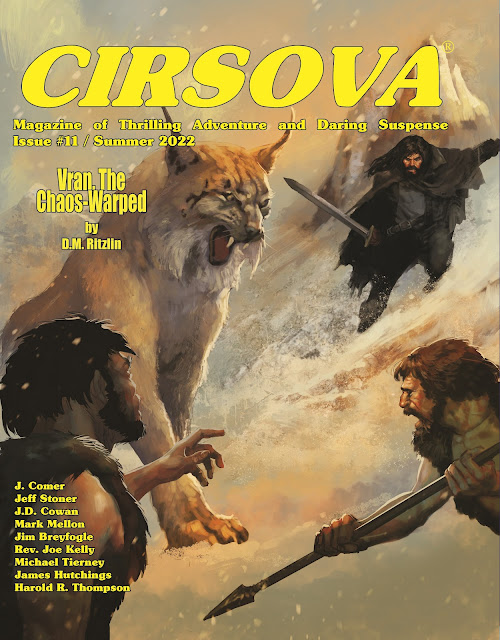
For those unaware, today's subject was just printed in the newest issue of Cirsova, my first ever story in said magazine. I am honored to be in its pages with some of the best modern adventure writers that I've admired for some time now. Being in Cirsova was one of my writing goals that I am beyond ecstatic I was able to achieve. Dead Planet Drifter is one of my favorite stories I've written, but I tend to say that a lot, especially when the story involves Ronan Renfield, the Galactic Enforcer. There is a good reason for that.
I wrote about this a bit in the last post about said new issue, but not very much. Truth be told, when I have a story in a new anthology or magazine I don't want to make it about myself, because it's not. These things are a collaborative effort, and they should be spoken about as such. Every author, editor, and cover artist, deserves the spotlight for bringing these projects to fruition. Nonetheless, now it is time to talk about the story itself.
Today's edition of Story Sheets is about the second published Galactic Enforcer story, Dead Planet Drifter. The first is in StoryHack #7.
The Galactic Enforcer idea came about as a reaction to two separate styles of story. One of the most famous style of space opera is that of the space pirate. Another is that of the military force aiming to achieve victory against an opposing space force. Somewhere along the way, these became basically 95% of all space opera stories. I wanted to do something a bit different and, in a way, took a few elements from each to travel down the path I wanted.
The idea of Ronan Renfield was to find someone who slipped into the cracks of a this large and wide open universe. Someone who was a bit of a wanderer, but also fought for what he believed in--a Good above himself. In the distant future, according to a lot of modern space opera, we would all either be lawless brigands looking out for ourselves, or we would be highly organized intuitions looking out for one group or another. It all felt a little closed in to me.
Ronan Renfield is a lawman who operates above the law (which can get him in trouble, depending on the locals), and an individual working for the forces of Good, despite local politics and rules. What is that "Good" you might ask? You'll have to learn more about the Galactic Enforcers in future stories, but I can say is that they are not your typical organization. He dresses like a twentieth century man, though not for nostalgic reasons. You will see why he does that eventually. He is an anomaly in a wild future that is very alien, and yet familiar, to our present state. Nonetheless, he is an Enforcer above all. They are feared for a reason.
I wanted a man as tough as Charles Bronson but also one with Justice always on his mind. At the same time, despite the continued crashing down of material reality around him, he never loses focus of his goals. How this chaos affects his job and his thoughts on the supernatural will come into play later. For now, he puts it all aside to get the job done.
As for his name's origins, I have a few notes. Renfield is a name taken from the character in Bram Stoker's Dracula, a man who hewed too close to the supernatural and it consumed him whole. He is essentially the flipside of the other Renfield in how he deals with it. Ronan is a name with many meanings. In Japanese, it means "wanderer" or "drifter" (where it can also be written as Ronin) and in Old German it can mean "well-advised ruler." The Irish origins five the name as "Little Seal." The originating story is described by Wikipedia:
"The name is derived from a very old Irish legend, which tells the story of a mother seal who is warned never to stray too close to the land. When the seal is swept ashore by a huge wave, she becomes trapped in a human form, known as a "Selkie" or "seal maiden". Although she lives as the wife of a fisherman and bears him children, known as "ronans" or "little seals", she never quite loses her "sea-longing". Eventually she finds the "seal-skin" which the fisherman has hidden and slips back into the ocean. However, she can't forget her husband and children and can be seen swimming close to the shore, keeping a watchful and loving eye on them."
The detective is being watched over, as we all are, his best protection against the madness he finds is not always his antiquated revolver, but his awareness that he is protected by much higher forces. I think this story will let you know exactly what those forces are. In addition to the above, there were also twelve Irish saints named Ronan, which matches up with the twelve apostles of Christ, though that is more of a happy coincidence.
Detective Renfield is a man constantly finding himself next to, or just out of the range, of incredible supernatural experiences in a universe that is technologically advanced, but broken apart by groups and nations that all have different ideas of how to operate. You've read two of these stories by now, so you can guess much about the future portrayed in them and how even we can reject advanced pleasures for the same basic vices of modernity. Even in a wondrous universe as open as the seas and as infinite as the stars, man still finds new ways to try and bend it to his whims. He still wishes to rule that which he does not understand and to get a step ahead of his neighbors.
In Dead Planet Drifter, Renfield arrives on a world that has consumed life in an attempt to thwart death. While he confronts the madmen that have thrown away humanity for power he also faces a shadow of his past that also underestimated the supernatural. But Justice comes first, even in the face of madness. How will he put a world right that desires to devour itself?
Exploring the stars has taught us new ways to create abominations against God and nature. But just how bizarre can it get before it cannot be put right again? You'll definitely see in this story. Sometimes dead is better.
CL Moore's Northwest Smith by Julien Noirel
Of course I would be remiss to admit that the inspiration for Ronan Renfield did come from CL Moore's Northwest Smith adventures, particularly Black Thirst and The Tree of Life. Her story setups for the series were all rather similar, but they all emphasized the horror of the unknown hidden in the known. Despite being a hard edged pulp protagonist he still found himself at the mercy of the awakened supernatural that should have been left alone and now the hard-bitten rogue must put it all right again before he is consumed by it.
The main difference here to a Northwest Smith story is that Renfield deliberately seeks these situations out in order to resolve them. He is prepared and willing to do what must be done to stop the perversion of the natural state of things. He isn't above showing mercy to those who need it, but by the time he gets there those deeply involved are far too gone to be saved. You wouldn't tear the universe apart if you cared about those in it, would you?
In essence, these stories are a lot like westerns starring a no nonsense lawman. The setting is as open as any space opera, but the horrors are also far blacker and needing of dispensing immediately. Does this fall into Sam Lundwall's old line about space opera masquerading as "Science Fiction" in order to gain clout from Fanatics? No, because I have no desire to be seen as respectable by people who hate what I love. These are adventure stories first, and that is the goal: to scratch that wonder itch. Heroism always comes before respectability.
As I said, I like the idea of future adventures in an unknown place far away from home. However, I find much of said story type today is stuck in a post-1940 framework and missing the freedom of an EE Doc Smith or a CL Moore when the universe was a lot more open instead of being locked to the same handful types of stories involving either rogues or military forces. I wanted to see something a bit different than both. Not to say others haven't done so themselves (you can read Cirsova and StoryHack for other examples of it) but this is what I want to see more of.
We need more wonder and more adventure! There can never be too much.
His appearance was inspired by Terry Bogard from Mark of the Wolves (much shorter hair though!)
His gun is inspired by the Colt Python .357 Magnum Revolver
This is all for fun, as it should be. This universe is far greater and more exciting than we know. Why not let it show as best as we can?
When I was reading Sam Lundwall's books, he appeared very fascinated with a future that was completely disconnected from his present. He desired a place where humanity "grew out" of bad habits and essentially evolved to be something new in an alien universe that would be far beyond our own. "Science Fiction" is supposed to prepare us for change, he says. We need to throw away the hated present in order to reach Paradise.
Of course I don't agree with him. I wanted to write stories that show how similar we are to the men we will be in the future. Even if we kiss the stars we will still be sinners in need of salvation, attempting to fill the cracks in our souls with anything to ease the discomfort of not being able to find a comfortable place, much like we do now. It is not pessimistic--we can still build great republics and empires, ways to travel, advanced colonies, and the entire like. But we will still, at the heart of it, be the same people who care about king, country, and family. We will still be humans, even though we still will try to escape that reality in the far future. That will never change.
We will constantly seek new frontiers and eventually we will learn that we cannot conquer them all, because we were never meant to. Instead we will strive on, much as we always have, to make things a little better, to reach the Good. Whether we do it the right way or not, well, that is to be seen. I'm sure Detective Renfield would prefer we do it the right way.
But we wouldn't be humanity if we always did the right thing, would we?
What is waiting out there, not just on the horizon, but in the spaces between?
Wonder implies large, vast spaces, far beyond what we can even imagine. This does not mean everything we find will be welcoming, but that doesn't mean we shouldn't keep exploring. Just know how to put the right thing forward, and keep your eyes on the Good. We will never have Paradise in this life, but it doesn't mean that we can't hope for better days.
They will come eventually.
Here are a few final stray notes on this story before I wrap this up.
The titular "Dead Planet Drifter" is not necessarily referring to Renfield. You'll know what that means if you've read the story.
There are other spaces and ways to travel besides the surface-level material ones. Whether we should use them or other, this is something to ponder. Now that I think about it, I believe every Renfield story has this in it in some aspect. I'm not quite sure why that is.
It should be no mystery at this point that I enjoy writing weird tales, and this is a particularly weird one. But I also like the western, noir, and hero tales, all of which combine in one in what I do. If you're expecting the sort of safe corporate brand space stories that have been commonplace for decades then you might want to look elsewhere. But if you want to have a blast in a slightly alien vein with plenty of excitement, danger, and wonder, then be sure to check out Dead Planet Drifter and future stories of Detective Ronan Renfield. You most definitely won't be seeing anything like this coming out of OldPub.
It's been a good bit since the last edition of this series, so let us not waste any time getting into it today. Since this is the first free fiction I've offered on the site, it should be explored for the benefit of anyone else curious about the piece. There is quite a lot to go over.
This one is going to take a while so I hope you are strapped in. There is really nothing all that straightforward about this story's creation. It has been a long time coming.
Y Signal is a story that goes back the furthest of anything I've ever written. I came up with it while I was still in college, at least a large portion of it, specifically the character of Lenny and most of what he went through. Though that was long before I had any concept of pulp writing, reading and writing as entertainment, or aspirations of even writing at all, yet it was something that came to me to try to make sense of the changes happening around me at the time. The world became a very different place from the one it had been not even a decade earlier, but no one seemed to notice in the 2000s. They all know it now, as just about everyone can see the nostalgia obsession gripping western culture, but it's far too late to react on the knowledge of the loss that way. Those days are gone.
Of course, my idea wasn't actually Y Signal, but more like the literary junk that had poisoned my imagination at the time and tainted my opinion on reading and writing. I couldn't imagine a story that wasn't depressing, nihilistic, or pointless, so I just let it die. The last thing I wanted to do was inject more misery into a world that was already sinking deeper into it. There was, and is, already far too much of that out there.
What changed my perception was the passage of time, learning more about the world and the past, and understanding just what was it about that time and place that managed to stick in so many people's minds. Of course, I'm talking about Cultural Ground Zero. Only now do we really realize what was actually happening at the time and how long-lasting it would be.
The 1990s, and everything before it, were an entirely different world. Cultural attitudes were the polar opposite of today, communities (real ones, not online forgeries) actually existed, and there was this odd prevailing sense that everything was getting better both in our media and in general. None of this is the case anymore, of course, and pointing this out gets certain parties irrationally angry. It's always been just as bad as today, they say. But that is missing the forest for the trees. Were the 1990s actually all that different, or is that just nostalgia glasses blinding you from reality? The world has always been garbage, (post)modernists say: you were just too blind to see it. Just accept the trash heap, and all will be well! That is, if you listen to their prescription to fix it.
Well, that's actually the tension behind Y Signal. I wanted to look back into the past with eyes unclouded by anything that might be considered "biased" (whatever that means these days) and reflect on a time and place I know like the back of my hand. At the same time, I wanted the opposite: someone who lived during that time and saw the darker parts that the younger ones like us didn't see, and I wanted to mash them together to see what came out of the experience. Y Signal is an attempt to capture the feeling of the time in a single story.
Who do you think had it right between Ray, Lenny, or Yarbrough? They all started at different places and came to different conclusions by the end, seeing different sides of a world we think we all perfectly understand. The truth is that there is a lot of good and evil in this world, much we will never see or encounter, but the opposite is also very much also true. None of us have any idea what our future will hold, how much things will change or stay the same, or who will be there for us in the end. The world is a fascinating place and we should cherish our limited time on it. Looking back on it, the 1990s was the perfect time for such a reflection, being the eye of the storm called modernity. It was a time, like most others, that could only have existed at the exact moment it did.
But I've wasted enough time on the finer details. Let us talk about the rest of the story. There is a lot of other subjects to cover in it.
Of course, one of the most obvious subjects of the story is the one of music. Specifically, Gen X music, which is what Gen Y kids and teens listened to. The older generation always plays music for the one just under them, after all. What I wanted to do was have a band that emphasized the weirder side of Gen X music (Violent Femmes, Meat Puppets, Pavement) with the more abrasive side (The Replacements, Pearl Jam, Smashing Pumpkins) to sort of encapsulate everything in one place. This is where the Panorama Agents came from as sort of a band that should have come out of that era, but didn't. Their spirit certainly has.
Yarbrough, the guitarist and lyricist of the band, is Gen X pushed to the edge. He is at the extreme end of the scale. This is a lonely and empty man doing his best to keep it together, until he can't anymore. Deeply unhappy with the state of the world, seeing injustices everywhere, money and fame not offering any sort of escape, he might seem like a take on Kurt Cobain. However, he's not. There is actually a real life person I took as inspiration on for Yarbrough, but it was not Cobain. It was somebody a lot more off the wall and obscure.
Yarbrough is based on the real life case of James "Richey" Edwards of the band the Manic Street Preachers. He isn't a copy of Edwards, but they both have very similar origins and fates. Here is the background from wiki:
"Richard James “Richey” Edwards (born 22 December 1967 – disappeared 1 February 1995), also known as Richey James or Richey Manic, was a Welsh musician who was the lyricist and rhythm guitarist of the alternative rock band Manic Street Preachers. Although not a particularly prolific musical talent, he was known for his dark, politicised and intellectual songwriting which, combined with an enigmatic and eloquent character, has assured him cult status, as well as having been cited by some as a leading lyricist of his generation, leading the Cool Cymru."
Edwards was a very talented yet depressed and nihilistic fellow who wrote really dark songs at the time they were at their peak in pop culture. The band broke out big with their 1994 album The Holy Bible which is a fever dream of anger and vitriol about the modern state of the world, all featuring lyrics by Edwards. Turns out it was a bit too intense.
As for whether Edwards was serious about his position or not:
"On 15 May 1991, after a gig at the Norwich Arts Centre, NME journalist Steve Lamacq questioned the band's authenticity and values, keen to ensure the punk ethic was not abused. Lamacq asked of Edwards' seriousness towards his art, and Edwards responded by carving the words "4 Real" into his forearm with a razor blade he was carrying. The injury required eighteen stitches."
It goes without saying that he suffered from depression most of his adult life, needing alcohol and drugs to even sleep. While Yarbrough is very much not based on Edwards in any capacity other than their occupation and disappearance, I can't say what eventually happened to the young man didn't help shape the direction of the story.
Yarbrough's sickness turned into nihilistic wrath and his disappearance was fueled by entirely different motives than Edwards' was. Aside from similar events happening to them, such as vanishing from the world after hitting a creative peak, Yarbrough is very much a wholly different person with far more sinister goals.
As for the fate of Edwards, well, no one knows what happened to him to this day. There is plenty of evidence to suggest suicide or voluntary disappearance, and either could easily have been the case. Regardless, he has never been seen alive since 1995.
"Edwards disappeared on 1 February 1995, on the day when he and Bradfield were due to fly to the United States on a promotional tour of The Holy Bible. In the two weeks before his disappearance, Edwards withdrew £200 a day from his bank account, which totalled £2,800 by the day of the scheduled flight. Some speculated that he needed the money for the U.S. trip, and it was also mentioned he had ordered a new desk for his flat from a shop in Cardiff. However, there was no record of the desk having been paid for, and this would have explained only half of the money withdrawn.
"According to Emma Forrest, as quoted in A Version of Reason, "The night before he disappeared Edwards gave a friend a book called Novel with Cocaine, instructing her to read the introduction, which details the author staying in a mental asylum before vanishing." Whilst staying at the Embassy Hotel in Bayswater Road, London, according to Rob Jovanovic's biography, Edwards removed some books and videos from his bag. Among them was a copy of the play Equus. Edwards wrapped them carefully in a box with a note that said "I love you", then decorated the box like a birthday present and decorated the outside of it with collages and literary quotations. These included a picture of a Germanic-looking house and Bugs Bunny. The package was addressed to Edwards' on/off girlfriend, Jo, whom he met some years prior, although they had split a few weeks earlier.
"The next morning, Edwards collected his wallet, car keys, some Prozac and his passport. He reportedly checked out of the hotel at 7:00 a.m., leaving his toiletries, packed suitcase, and some of his Prozac. He then drove to his flat in Cardiff, leaving behind his passport, his Prozac and the Severn Bridge tollbooth receipt. In the two weeks that followed, Edwards was apparently spotted in the Newport passport office and at Newport bus station by a fan who was unaware that he was missing. The fan was reported to have discussed a mutual friend, Lori Fidler, before Edwards departed.
"On 7 February, a taxi driver from Newport supposedly picked up Edwards from the King's Hotel, and drove him around the valleys, including Edwards' hometown of Blackwood. The driver reported that the passenger had spoken in a Cockney accent, which occasionally slipped into a Welsh one, and that he had asked if he could lie down on the back seat. Eventually they reached Blackwood and the bus station, but the passenger reportedly said "this is not the place", and asked to be taken to Pontypool railway station. It was later ascertained, according to Jovanovic's account, that Pontypool did not have a telephone. The passenger got out at the Severn View service station near Aust, South Gloucestershire and paid the £68 fare in cash.
"On 14 February, Edwards' Vauxhall Cavalier received a parking ticket at the Severn View service station, and on 17 February, the vehicle was reported as abandoned. Police discovered the battery to be dead, with evidence that the car had been lived in. The car also had photos he had taken of his family days prior. Due to the service station's proximity to the Severn Bridge, a known suicide site, it was widely believed that Edwards had jumped from the bridge. Many people who knew Edwards, however, have said that he was never the type to contemplate suicide and he himself was quoted in 1994 as saying, "In terms of the 'S' word, that does not enter my mind. And it never has done, in terms of an attempt. Because I am stronger than that. I might be a weak person, but I can take pain".
"Since then, Edwards has reportedly been spotted in a market in Goa, India, and on the islands of Fuerteventura and Lanzarote. There have been other alleged sightings of Edwards, especially in the years immediately following his disappearance. However, none of these has proved conclusive and none have been confirmed by investigators. In 2018, it was revealed that the bridge's toll receipt was a 24-hour clock, meaning he would have crossed the bridge at 2:55 am, rather than 2:55 pm as previously thought for 23 years.
"The investigation itself has received criticism. In his 1999 book Everything (A Book About Manic Street Preachers), Simon Price states that aspects of the investigation were "far from satisfactory". He asserts the police may not have taken Edwards' mental state into account when prioritising his disappearance, and also records Edwards' sister Rachel as having "hit out at police handling" after CCTV footage was analysed two years after Edwards vanished. Price records a member of the investigation team as stating "that the idea that you could identify somebody from that is arrant nonsense". While his family had the option of declaring him legally dead from 2002 onwards, they chose not to for many years, and his status remained open as a missing person[ until 23 November 2008, when he became officially "presumed dead".
If you wish to learn more about Edwards, I suggest looking into the case yourself. However, as I said, his influence on Y Signal really only relates to Yarbrough's own disappearance and the usage of music to reflect the turbulent state of the soul. There isn't any other connection.
I should also add that the Manic Street Preachers also wrote an album using Edwards' left behind notes and journals for lyrics, much like the Panorama Agents did for the titular Y Signal album in the story. And that is where the two part ways.
The Panorama Agents, as I've said are a band that didn't exist at the time but should have. You can tell from the album covers I posted throughout all four parts of Y Signal and that I had a history planned out for them before the events of the story. In fact, I might as well state it outright.
Yarbrough formed the band in 1987 when he was nineteen years old with his childhood friends. Their self-titled album released in 1988 in the indies, and they soon amassed an underground following. One of their roadies was a young man named Lenny, who would go on to be one of the band's biggest fans as he traveled the country with them. This is where he got the trinkets he sent to Ray, who was just a runt at the time.
Nonetheless, the Panorama Agents grew bigger as the years went on. In 1990, they were signed to the majors and put out Now I Got Trouble which was a minor hit. It soon went gold before their follow-up, Last Broadcast, stormed out of the gate and topped the charts. It was all over the radio and the band's music videos were on heavy rotation.
Here is their full discography:
Panorama Agents (1988)
End is Here (1989)
Now I've Got Trouble (1990)
Last Broadcast (1991)
"Live" in 1991 (1993)
Y Signal (1994)
New Babylon (1997) [as Panorama]
Endless (2000) [as Panorama]
I listed the covers backwards as the story went on to show just how backwards Yarbrough was and how is degeneration wasn't really normal. By the time of Last Broadcast he had already discovered the Y Signal and used it to learn the "truth" of the world. Of course, not before making sure to gift it to a very confused Lenny.
Though they look successful from the outside, the band was not doing so well internally. Yarbrough, specifically, was losing his grip on reality and the others didn't know how to deal with it. This is reflected in what they did after he vanished.
When Yarbrough disappeared in 1992, the band was at a loss how to continue. They put out a live album recorded at their peak and then released Y Signal in 1994, an album containing lyrics entirely composed by Yarbrough using his left over lyrics and scraps. The band used the time between albums to craft another masterpiece, but they knew they couldn't go on like this. Though these songs were still hits for the band, it was clear they had to reinvent themselves. Nonetheless, they never replaced Yarbrough at all, deciding to go on as a trio.
In 1997, they would release New Babylon after changing their name to Panorama. They completely overhauled their music to add electronica and industrial sounds. The album did better critically than commercially, with lyrics that appeared hedonistic and detached, making it a bit of a contention among fans if it's even from the same band. But it was a mere stumbling block for the people in the group. The singer/rhythm guitarist left the band for a solo career, you've probably heard him lecturing plebs about politics on TV in recent years, leaving two members left from the original lineup to carry the load. Unfortunately, the drummer was found dead of alcohol poisoning on the train tracks of an abandoned trainyard in 1998. Despite the suspicious circumstances around it, the death was declared accidental. It looked as if it the band was finally over.
In 2000, Panorama put out their final album, Endless, a largely acoustic and lo-fi affair out of joint with everything they had done before. Only the bass player remained in the band, using his acoustic guitar and a drum machine when needed as well as other spare instrumentation, blues rhythm, and a very stripped down production. The album was rejected by fans of the band for being strangely hopeful and reflective, with odd appeals to God and thinking back on misspent youth and looking toward the future, and critics similarly dogged it for not having the sonic experimentation of older releases. Though reappraisal in recent years has looked better on the album, most fans agree it is simply not a proper Panorama Agents album. Then again sentiments for New Babylon were much the same. The album barely reached gold, but it was just not enough.
The lone member quietly called it a day in 2001, and that was the end of the Panorama Agents. They became nothing more than hipster trivia for music nerds on hipster websites. They faded away like every other band that was big in the '90s. Last anyone heard of the bass player, he had joined a monastery somewhere in Vermont.
One final thing about music before we move on: there is band that directly inspired a lot of the creation of this story, though you wouldn't be able to tell if I didn't say something here. The band Less Than Jake, specifically the lyrics of their drummer Vinnie, were what finally pushed me to write this story. It might seem odd that a ska band would inspire this, but if you remember that post I wrote on the band then you definitely understand how that is the case.
LTJ's drummer Vinnie successfully wrote about the worries of the Gen X life to the younger kids in Gen Y better than any other band that didn't turn to emo hipsters or political tools. Their first album released in 1995 (it wasn't even out yet during the events of Y Signal) but their formation in 1992 makes them a prime Gen X band. I specifically looked at the early lyrics and wonder: what would have happened had someone had never found his way out of this world that the generation was trapped in at the time. What would they be driven to do? Well, you would get Yarbrough and Lenny.
I created a City Medley based on 25+ year old Less Than Jake songs specifically because I was writing Y Signal at the time. If you haven't heard it, I posted it on youtube here:
The medley consists of songs written and recorded before the events of this story and were what I used to get into Lenny's head. I imagined this was very close to his experience growing up and figuring out his place in the world. Arranging them in this order made the songs tell a story I don't think the songwriter originally intended, but the theme exists regardless.
The story is simple and not very complex at all. Listening to a narrator living in an urban hell as things just get worse for him before he realizes they'll never get better and he finally leaves it behind tracks with Lenny's life perfectly. After all, he is the one who spurs Ray into action.
The tracklist of the medley is as follows:
Intro
24 Hours in Paramus
St. James Hotel
Down in the Mission
Blindsided
Last Train
Did you notice something familiar about those titles? That's right, I named the last two chapters of the story after the last two Less Than Jake songs in the medley. To understand why, you'd have to know the lyrics and get into the headspace of what Ray was struggling against. It is very much about a particular time and place.
Though Blindsided first released on the band's debut album Pezcore in 1995, it had already been written by the time this story occurs. Last Train, however is an older song and appears as a rarity in early compilations. Even the sound quality is lower because it is so rare.
Nonetheless, these are the songs that helped me to write the story.
Blindsided
Isn't it funny?
It all comes down to money
Running on a treadmill, wasting time
Keeps you too busy to lose your mind
I was blindsided out on the street
The tension was so thick I could hardly even breathe
And I don't like the way things are going down
I don't like the way things are going down
That's all, it's all
It's enough to knock me down
I was blindsided this guy walked right past
Calls for help from some guy from under the pass
So I guess it's the "problem will go away if you block it out"
It'll go away if you block it out
That's all, it's all
It's all enough to knock me down
Isn't it funny?
It all comes down to money
Running on a treadmill, wasting time
Keeps you too busy to lose your mind
Fall to the middle class
Heading for the lower class
The times can't always keep you down
And it's enough to knock me down.
Last Train
It's got me on the run, it's got my brain tied
It's got me down as the trains pass by
All these people crowding my sight
I wonder if my head was ever screwed on tight
Concrete buildings are all that I see
I used to never let it bother me
I used to never let it bother me
Last train, remember me
Walking past the cracks on 2nd street (Watching!)
Lights and sounds, the city doesn't sleep (And I say!)
Get this fucking city out of my brain (So I!)
Guess I'll have to wait for the last train
Remember me
Concrete buildings are all that I see
I never let it bother me
I used to never let it bother me
Last train, remember me
Walking past the cracks on 2nd street (Watching!)
Lights and sounds, the city doesn't sleep (And I say!)
Get this fucking city out of my brain (So I!)
Guess I'll have to wait for the last train
Remember me
Last train, remember me
Remember me
You gotta remember me
Last train.
It was definitely a way to help me understand someone like Lenny a lot better. Though Less Than Jake grew to become far more hopeful, Lenny wasn't there. No one of their generation would be way back in 1995.
Lenny's outlook on life was also not the same as Yarbrough's, which is probably how he came to his decision at the end of the story. At the end of the day, he was just looking for a little light to shine through the constant storm clouds. I'd like to think he found it in the end.
This is probably how Lenny came to have a good relationship with his younger cousin Ray. Gen Y was a very optimistic generation when we were young, pretty much the opposite of Gen X. However, as the story showed, much of that optimism was based on material things and artificial patterns that wouldn't last. Ray telling Lenny to stick around and wait for the next Quentin Tarantino movie wouldn't be enough to reach him because Lenny had already seen what the world had to offer beyond the good art of the time. They wouldn't see each other's point of view, just as Gen x and Y didn't really seem to have much in common back in the 1990s when this tale took place. So Ray instead offered him what Yarbrough couldn't: a place in the world again.
Gen Y has been called a materialistic generation, but I think that's not actually true. We tent to think people of this age bracket just want to buy old brand toys and pretend its the '90s because they think of this stuff as a religion replacement. However, I think it is a bit less complicated than that. They act this way more because they miss the cultural climate those things were created in. They are trying to rediscover a world they woke up one day to find was gone.
While Gen X is a hopeful generation that never had the chance to be hopeful; Gen Y is a nostalgic generation that tends to miss the forest for the trees. We were both sold futures that never happened, but Gen X smiled through the disappointment while muttering under their breath. Gen Y retreated to the past to get some semblance of understanding.
I suppose that might be why I wrote this story. As I said, I came up with the general idea around Lenny long ago, for a reason. But the character of Ray is not actually me. Ray is the Gen Y kid who is willing to face the unknown with one foot in the past and one foot in the future, understanding the world he is in (the one my generation lionizes) has its warts but is willing to do what is needed to move ahead. I'd like to think Gen Y can turn out to be the scribe generation we need in an era of constant revisionism and lies.
Speaking of revisionism, part of the other reason this was written is because Hollywood is currently attempting, albeit rather poorly, to try to retroactively turn the image 1990s inside out to weaponize against those who do not remember a world before Cultural Ground Zero. They are trying to sell the world on a past that didn't happen. Much like they successfully turned the 1950s into a living black and white cartoon centered on one political issue, they are trying to warp the 1990s into a garbage can of pointlessness with revisionist post-9/11 misery.
Here is an example:
This is not my childhood, and I'm tired of others trying to force this lie on the rest of us as if the 1990s were like this for everyone. Normal '90s kids did not live like these rich Hollywood kids did, and it sometimes feels as if we didn't even grow up on the same planet. Which might actually go a long way to showing just why things currently are the way they are.
For another example, I wrote about one such subversive lie a few years ago. This sort of thing is all over the place: an attempt to demonize the past to pretend things were always exactly as bad as they are right now in order to guilt you into doing what they want to fix the world. I can tell you as someone who was very much paying attention to the changes at the time, due to not having much in the way of a choice, that these people are lying.
The 1990s were not a paradise free of corruption, but it was a very different world than the one we live in now. Objectively there are many good things we had back then (real neighborhoods and communities, local and regional identity and clubs, and faith in higher callings and purpose) that have all been homogenized and boiled into the modern goop that nobody alive even likes today. The 1990s are a different universe, at this point.
No, the world was not always as bad as it is right at this moment. If someone is saying this, they have something to sell you, and it's probably a pamphlet with all their solutions carefully written out on it in detailed points. Surprisingly convenient, no?
I would say to talk to the older generations about it, but I've never found a Baby Boomer consistent on this topic. I know boomers who would say back in the day that The Simpsons was trash and terrible now unironically say that they've always liked it and that I'm misremembering what they said to me. But that's not the only subject this happens to. I know others that called video games a giant waste of time that now play more video games than I do. It's a weird consistent inconsistency this generation has. It is as if they are always updating their software.
This is why the Baby Boomers in Y Signal are kind of off in a whole other world, mostly because they all were. And probably still are. They are a non-factor in the story because the Baby Boomers didn't really offer much to the 1990s except helicopter parenting, stricter rules for institutions, and working on the same day in day out loop they mastered in the '80s. It was just another decade to them and they probably think nothing of it now.
Truth be told, if they weren't Baby Boomers, then the entirety of the events of Y Signal probably never would have happened to begin with. Would any of the characters be better off if that were the case? That is hard to say. Things just have a way of working out in strange ways.
Same goes for the references. I'm not going to list them out, but you probably saw them for yourself. I'm not a fan of nostalgia bait stories, of which Y Signal is most definitely not, but having time and place atmosphere and attitudes is necessary for a period piece. I don't tend to write about different times in the past, but I had to make an exception for this story. This is a tale that could only have taken place in the time period it does. Recognizing the references is less important than knowing just how much they mean to the kids in the story. And I'm not saying that is necessarily a good thing. It just is what it is--Gen Y kids defined themselves by what they consumed and where they were when doing it. Ignoring that is ignoring the era.
So you might be wondering why, if I came up with Lenny so long ago, it took me so long to write this story. Shouldn't I have written this years ago?
Well, the truth is that I wouldn't have been able to. Without knowing what I know about weird fiction today, from Appendix N and Weird Tales to StoryHack and Cirsova, I never would have been able to write this. It is the same with learning about Cultural Ground Zero and the events surrounding it, as well as discovering more about the world and the Truth of existence itself. The story would not be what it is today. In fact, knowing what I was like and going through back then, I can't even say if it ever would have been written at all.
You might be confused at how long this post is for a single novelette distributed for free on my own blog when other Story Sheets posts were much shorter and straightforward. The reason is that this one was a long time coming and something I think I needed to write. It's only when I thought back on the history of this piece and edited the post you are currently reading that I realized just how much I put into this one. Hopefully if you haven't yet read Y Signal that this post will convince you to do so. It's definitely a blast.
As for whether we will see the world of Y Signal again, the answer is yes. I have three total tales planned with a definitive endpoint. You will see Ray again, but he probably would have preferred if I left him alone. Unfortunately for him, that isn't really my call. If the story needs to be written then it needs to be written. He's not getting away that easy!
So thank you for reading and enjoying the story. I have more surprises in store, just you wait! It's gonna be a good time. I assure you that I'm just getting started.