It's the weekend! Let us talk about something a bit different.
We've talked a lot here about decline over the years, and that is a subject worth addressing, but now it is the time to finally discuss what it takes to reclaim what has been lost. Now that the 2020s are rolling out, we're going to make this the decade where everything finally changes.
While we've discussed the NewPub phenomenon many times before, we haven't quite discussed another medium that, while commercially successful, is in the final stages before its own collapse. That industry, of course, is video games.
Though video games have been decried for many years as frivolous and useless (as every medium has at one point by the people who provably cannot preserve culture at all), there is a very real formula and meticulous design process that comes from them. Despite current trends, there was a lot more to video games that poorly written Z-movies that contain a few button presses to make scripts happen. In fact, when the industry ran on arcade design was when it reached its peak.
Now, if you've played video games since the death of the arcades, you've noticed a decline in creativity since the Sega Dreamcast died and arcade faded from prominence in the '00s. I am not talking about technology or graphic fidelity, I am talking about the gameplay itself. Gameplay loops (such as they are today) barely exist anymore and have been replaced with carrot on a stick drudgery to get from one cutscene to the next--a trend that began with the first 3D console generation but only started to take over once HD consoles came in.
What is missing from today that we used to have isn't that obvious
This was the era when countless middle market publishers and developers closed up shop, parting the medium in two between AAA cinematic experience and low budget indie game. In other words, this killed creativity almost overnight. If you can think of a big name AAA game in the last three console generations with a new gameplay experience (that isn't made by Nintendo) then I would be surprised. Even more so if you can name more than five. It simply doesn't happen anymore.
As a result of this shift, the industry has been in a creative rut, praising pointless downgraded remakes of old perfectly fine games because they have pointless modern bells and whistles. You should not be buying a new $599 US Dollar console and expecting to play remade and dumbed down games from 2004 on it.
So what caused this? I would recommend watching the video above. It is the loss of arcade design that the entire medium was built off of. Just like "pulp" became a dirty word in OldPub in order to denigrate adventure stories, arcade design has been sold as cheap and lesser since at least the mid-90s thanks to water carrying game journos. In other words, you were sold a lie. the entire collapse that video games are about to suffer through (or already are, depending on your perspective) will be caused by this abandonment of what made the medium what it was.
This has happened more than enough times in other mediums for anyone to understand it at this point. The further you stray from your roots, the more you risk losing them, and video games have definitely lost that link and have lost it some time ago.
Though you might be wondering, what about indie? Well, it's not as easy as all that. Check the video yourself and see why simply being 2D and having pixel art isn't quite the same as classic arcade design and why it's not quite enough. There was more to classic game design than "tightening up the graphics on level 4" as the old saying goes.
If you're a developer yourself, definitely take in the above information and think it over. How much have we lost along the way that we don't even consider anymore? How far can we really push forward without solid ground to stand on? Food for thought.
All of our industries are going to have to start asking those questions if they want to have a future. There is little choice left but to look back and carry forward again. The only other option stagnancy has, is death.
That should be the last thing we want for any medium. We've already lost a lot, at some point we're going to have to start gaining again.
Anyway, have yourself a good weekend and I will see you next time!
It's been quite a year so far, but spring is just ahead of us. I think we're about due for it, especially after the winter that just wouldn't end. We could use some warmth.
Before we get to that, let us take a break. That is what weekends are supposed to be for, after all. I would like to share a few videos from YouTube on things that we lost along the way to the great future we were supposed to already be at by now. Let us reassess where we might have stumbled along the way, and how we might orientate ourselves anew.
For those who remember back when video games were actually for everyone, as opposed to being dumbed down for a mythical wider audience that doesn't exist, they might think on a time when gamers would play anything, as long as it was fun. Believe it or not, there was a time when the gameplay itself was the reason people picked up a video game. If you were a kid in the old days of the medium, you played RPGS, platformers, sports games, shooters, strategy games, point and click adventures, puzzle games, and even racing games. Yes, even racing games.
This was because genres didn't use to be walls, they were signposts for varied gameplay experiences that everyone used to find fresh experiences. No one stuck to their corner and dismissed everything outside of it. It wasn't like it is today.
Believe it or not, back then what mattered was quality. As long as it was fun and the gameplay was solid, we played it. Genre ghettos didn't exist. Now that they do, everyone tends to keep to their own lanes and rarely do they venture out of them. As the video linked above shows, the reason for this is partially because of the people who make the games now. Somewhere along the way they forgot where their very medium came from, and now endeavor to forget it on their quest to find the perfect audience that doesn't exist.
Sound familiar?
At some point, the gameplay became secondary to aesthetics and image, getting into the genre clique's good graces, and their quest ended up chasing out the majority of the audience for a fringe niche that continues to hold said genre back from doing anything interesting. Yes, we've seen this mentality before. The Fanatic mentality is not just a problem in genre fiction. As the video shows, it has become an issue in gaming, too. It's even worse there because they haven't had decades of revisionism to tell them the past was bad and must be destroyed--they only have a decade and change of it. But we've covered that before. It is the same poisonous mindset that must be abandoned if one cares at all about their medium of choice. The past is not an enemy to be destroyed.
The AAA mentality in gaming ate away at ambition and creativity, leading people in the industry who should know better down a road of ignorance, arrogance, and just plain disrespect to the very medium they profess to love. There are plenty of examples where modern developers will outright spit on those who came before, despite not being able to live up to them in the slightest. Again, it's a familiar attitude, and one not without precedence. There is no love, no sense of gratitude, no attempt to make art or connect with others. It's just selfishness all the way around.
Not even creators of formerly beloved properties can escape the siren call of the Fanatic as he embraces his ego over the art. That's right, it's not just newer people, but even those who should know better are proving that they do not. This is how you know when the Golden Age of an industry is long gone and forgotten by those inside of it.
The perfect game even exists that demonstrates this exact process happening. You might be thinking of several, there are many similar examples, but this one sticks out for the simple reason that the people involved should have clearly known better than they did, and just didn't. Feast your eyes on the perfect example of AAA failure that is Lawbreakers. This story isn't one people will forget anytime soon because of how absurd it was.
For those who need some back story, one of the people involved with the rise of gaming megacorp Epic Megagames and helped it into what it is today, somehow completely forgot why people played video games in the first place and created one that simply flatlined and died in record time. It is quite the story, but not uncommon among former celebrity figures in an industry that cares more about appearance than gameplay..
This isn't even to say that Lawbreakers was necessarily a bad game. The quality of gameplay wasn't even the main selling point of the game, and has little to do with its failure. The point of what happened has little to do with the quality of the product. This goes beyond game design, and into everything surrounding what caused such a product to exist in the first place, and where it very quickly ended up. This is the sign of a creatively bankrupt industry.
It isn't the perfect example of AAA hubris because they aren't unaware that AAA is killing gaming. They even understand the problem with the market, but complete misdiagnose the solution and lack the self-awareness to see that they are part of it. And it ends up resulting in, well, the exact industry we are trapped in right now.
This is Lawbreakers:
It's hard to watch that rather short video and not marvel at how clueless the industry has become over the years. It took OldPub decades after the 1930s to completely destroy their past; it only took AAA a mere decade after going HD to obliterate their industry. From racing games not understanding their base appeal to race, to the creators of beloved classics no longer getting what audiences clicked with their creations in the first place, the spark has just been completely lost. AAA is gone, and now it is in the slow slide into the muck.
The old industry is dead, and it isn't coming back. The future will not be coming from them, but by the mavericks outside the system. It is time for better ways.
The last thing I want to leave you with is one more video about a video game franchise that came from the old days back when gaming just went HD. This is one of the last original franchises that came around before everything sank into the mudgenre and developers were slaughtered and gutted to make conveyor belt games. This game is Dead Rising, specifically the game in the series that ended up killing both the studio that made it, as well as the franchise itself.
For those unaware, Dead Rising was a game with a unique design, especially for HD. You were dropped into a zombie apocalypse situation with a time limit to get your wider task done. You then needed to fit your playtime around getting said task done in said limit as best as you can. Your performance would then net you the ending you would earned from your choices therein. The entire game was wide open with many places to go, but that just made it harder to reach the goal you wanted to reach. Every playthrough in Dead Rising was a new chance to figure out the best path forward and get the best ending. It was a good wrinkle and mashing up of arcade design and open world gameplay that no one else has done before, or since.
So naturally they made it into a franchise and, AAA being what it is, ended up turning it from a unique experience unlike any other into another mudgenre open world game with no defining features. In other words, they turned it into the opposite of what it once was, because AAA is anti-gaming at the end of the day. It is merely bad movies and busy work disguised as gameplay. Dead Rising 4 was so bad it killed the franchise stone cold.
This is how you successfully kill a successful creation and wear it as a skinsuit: you do what they did to Dead Rising. Keep in mind, it only took one decade from the original game to do this. That is how fast AAA has deteriorated into what it is today.
AAA is over, OldPub is over, and Hollywood is over. We are going to need to look to be sources before we lose these mediums entirely. There isn't anything left to be gained by supporting an industry holding back its own potential.
It is time to leave them in the dust.
That is all for today! Take heart in the knowledge that we can now clearly see the problems that have plagued us for so long, and now we can finally get to work working them out. It has been a long time coming. The AAA industry might be dead, for much the same reasons as OldPub now is, merely living off the momentum of past successes they do not understand in the slightest yet think they should profit off of, but there are other places to go where the medium still thrives. There are always alternatives and, especially today, they are are frequently the better options.
You don't have to put up with those who wish to destroy, whether intentionally or not, but can instead find creations on par (and in some cases, better) than what came before. Inspiration and creativity still exist outside the mudgenre money pit that is the modern industry, and that is the case with every medium today.
You just have to know where to look. Ask around and you'll be surprised at just how much good stuff there is. And there is more of it all the time.
Back in the day, video games were centered on just about anything. Simply look at the concepts of things like Q-Bert, Bubble Bobble, and Super Mario Bros., to see just how wild things could get. The way designers came up with so many different ways and systems to earn score and top the scoreboards was something else, much more than today.
On the other hand, sometimes they got ideas from more likely places to create things a bit more "realistic" and grounded. One of the more influential games of this type was Capcom's 1985 arcade classic Commando, perhaps one of the most influential of its era. This was a top down run and gun game where you play as the titular Commando as he mows down enemy waves attempting to kill him on his mission and rescue POWs along the way.
Needless to say, the simple yet addicting gameplay would lead the charge for other run and gun games to come, such as Rush 'N Attack (Green Beret), Ikari Warriors, and even the almighty Contra. The video game adaptions of such movie franchises as Rambo even took from Commando. This game's influence couldn't be ignored.
The late 1980s were really the period the Golden Age of gaming started, and titles like this were why. The arcades were the hottest places for new ideas, and their console ports at the time tended to add on to them in unique ways.
Of course, the NES was probably the system most well known for having arcade ports, but it was the one most known for having them be unique and sometimes better than the source material, graphics aside. Games like Contra, Gun.Smoke, and Double Dragon II, were far superior to the arcade editions despite simpler art styles by adding on and sharpening what made the original games work so very well. When it came to a home port, you were gambling, but sometimes it was worth it.
All that said, let us get into 1986's Jackal, also known as Top Gunner in the arcades in North America because Top Gun was a popular movie in the west. It was later released in 1988 on the NES, which is definitely its most well known version today.
Seeing the success of Commando, Konami thought how they could top it themselves. So, taking that top down formula, they instead used vehicles and gave the player a bit more movement. In doing this, they created Tokushu Butai Jackal (Special Forces Jackal) for the arcade. It was originally going to have one of those rotary joysticks to allow aim and shoot (similar to how dual stick aim works now for top down games) but wisely decided against it, instead having the player work around enemy approach instead of making everything into a bullet sponge.
The arcade version of Jackal (which is what every later edition would simply be called) was a very fun experience. Challenging, but the level design and enemy placement required the player thinking about their approach, and the unique control set up made them adopt strategy to succeed. Then there was the soundtrack, driving and high energy to simulate entering enemy territory to rescue your men. It's almost like they made the climax of The Delta Force into a game.
What makes the controls work as that there are only two buttons. One fires a fast but weak machine gun, and the other fires a slower abut strong grenade launcher. In every other version aside from the Japanese arcade original, the machine gun only fires northward meaning that lining your shots around enemy fire requires a bit more strategy, though otherwise the versions are the same. With just these two attacks, and the upgrades that can give you missile launchers, Jackal pretty much stays the same through its half-hour length.
At this point, we might as well discuss the difference between the arcade and the NES version, since the latter is basically what the game is more known for today, if it is thought of at all.
Mainly, the field of view is bigger due to it no longer being limited to a vertical screen. Jackal has a lot of horizontal movement, after all. Also, instead of being one long continuous stage it is divided more traditionally into six stages, though the map at the end of each stage remains the same regardless. It's more of a presentation choice. Your jeep can also carry the full amount of POWs in each level which makes a bit more sense in a game about score and upgrades--you should be able to get the max amount if you play well.
Otherwise, aside from a slight expected graphics dip, the versions are not that much different. The soundtrack is also more typical of Konami's 8-bit output, meaning it was better than most of their arcade OST (sound-wise) at the time. You definitely did not feel like the NES version was a downgrade when you played this one.
What makes Jackal so good is that everything comes together perfectly. It's not a game you think about much when you aren't playing it, until you pick it up again. It's at that moment that everything comes together and you question how you had forgotten it was this good.
As an example, back in the day we didn't tend to buy a lot of games. My friends didn't and neither did my family, especially with rental shops around. For some reason, the one game, aside from the endless versions of Super Mario Bros. everyone had, everyone appeared to own was Jackal. I couldn't quite tell you why, but it was everywhere. It was a great co-op experience with friends, the controls were perfect, the music absorbing, and the incredible variety with such a simple concept such as dealing with on foot enemies, stationary cannons, bombers, and other vehicles, always made it a joy to experience. It was also the perfect length for an arcade shooter at six levels and being almost exactly half an hour in length. And, just like Contra or Sunset Riders, its difficulty is perfectly balanced, never feeling quarter-munching hard, but perfectly fair.
The one thing I couldn't tell you was why it never had a sequel, despite its popularity. It was never quite on the level of fame as the big boys or the licensed games that Konami put out, but it was certainly no bomb and had an enduring success on the NES. One might imagine what a Super Jackal might have been on the SNES, or maybe a MERCs style sequel published by Sega for the Genesis, But one was never made.
Instead it was filed away in the attic with the rest of the NES collection when kids moved on to the new 16-bit systems. Jackal was more or less forgotten by that point.
Regardless, today if one mentioned Jackal to anyone who has ever played an NES before you would certainly get words of praise following it. This is a classic and a game I wish would have more influence now, especially in the top-down action game subgenre. In other words, no dual analog for aiming and thereby turning the game into a bullet sponge fest to pump up the difficulty, but a well balanced game requiring strategy and different approaches to the many situations that the player is faced with.
Many top down games say they are influenced by Jackal, but almost none really are in this aspect. It's one of the reasons it has never been topped in its genre, even though it could be. These old games still have plenty of life left in them!
All that said, the NES is unmistakable one of the best systems video games has ever, and will ever, produce. Nostalgia aside, it was home to many high quality experiences never again replicated either in the arcade or the home market. Jackal is one of these examples, which is what helps make it one of the best games ever made.
In these days, as AAA gaming falls further and further into the abyss and more and more people begin moving to indie and retro gaming, the NES will once again come out of storage, as will that infamous box or cartridge art of those soldiers going wild in the jeep with the gun blasting away. They will put the game in and within minutes realize just what they were missing.
I don't know what the industry's future holds, but I do know that it won't be in what they are pushing today. It will be in the simpler and more pure arcade experiences that built the industry from the ground up to begin with.
It will be with short lengths and infinite replay value, co-op games with loved ones, and pure arcade experiences based on skill, strategy, and score. The future in gaming is going to be when it reconnects with the past to make new experiences again. When it does, games like Jackal will be the blueprint they need to remember the magic they so desperately need. Simple, yet complex. Easy to get into, but hard to master. The classics had it all.
And that is what makes Jackal one of the best games ever made.
I'm currently working on a new series of posts, but I've got a few lighter ones until we get there. This time I want to talk about one of my favorite video games and series. The subject will be Contra on the NES, a genre classic.
In 1987, during the Golden Age of video games, Konami was on top of the world. With games like Time Pilot, Twinbee, Yie Ar Kung-Fu, Gradius, Devil world/Dark Adventure Shao-Lin's Road, Goonies, Jackal, Life Force, Blades of Steel, and Castlevania, they were showing themselves as the masters of just about every genre under the sun, both in the arcades and at home. that familiar logo was just about everywhere.
If you had an NES then you are fully aware as to just how good Konami was at this time, contributing especially well to the rising shooter, beat 'em up, and platformer, genres. They only got better at it as the years moved on. It felt as if their ideas were as endless as the new games they were putting out. Next to Capcom, they were probably the most trusted third party developer of the time period, which is saying quite a lot. There isn't anyone else who came close in the level of consistent quality and varied ideas that Konami did.
One such idea was the Contra series, a run and gun game fashioned after 1980s action movies. It's hard to imagine now, but few companies tried as hard as Konami did to turn such things into video game fodder. There were attempts, but they always felt half-hearted. This series? Not so much.
Contra isn't the first run and gun video game, but it is the first one to really solidify how the mechanics should work and how much the player should have control over their character in order to achieve feats. The original arcade game released in 1987, and was decently popular, being a big looking game with surprising gameplay variety that ostensibly allowed players to become action movie heroes. There was a lot of shooting, dodging, and tough enemies to battle, which made it tough to walk away from. Needless to say, it was a hit.
However, it was in 1988 with the NES home version that Contra cemented itself as a true classic. When people talk about the original Contra, this is usually the game they mean.
Though the graphics couldn't be as powerful as they were in the arcade, the game manages to look much better than the original version. The simplistic art style allows easy visibility of enemy attacks and bullets without any of the clunk found in the arcade original. It's an all around better playing experience. The music also uses the NES soundchip to create a far more energetic soundtrack than the original, allowing for sharper and clearer sound effects on top of it. Then there is the player movement and the controls which are both far tighter here than in the arcade version. The characters can aim and jump in every direction with speed and ease of maneuverability that the genre would use as a base for years to come. No one who has played both is going to argue that the arcade original is superior.
The NES version is also longer. Though it has 8 stages compared to the arcade's 9, many of the arcade stages were short and were combined into one on the NES which then expanded whole segments of the final arcade level into four separate full stages. There is also no time limit in this version. In other words, it's also a longer game on top of being a better playing one.
All in all, whenever anyone talks about how great Contra is, they are talking about the NES version. And so will I.
The NES Contra is still regarded as a classic today. Let us start with why that is.
So what exactly is Contra about? Well, it is a run and gun game: a run and gun is combination of two specific popular genres of games from the 1980s. That being the platformer and the shooter. Contra uses both of these halves to form the bulk of its gameplay time. You are tasked with playing as two action heroes as they avoid enemy fire and slaughter the villains, not unlike Arnold in Commando. you are the ultimate male!
But the story and setting add a bit to the flavor. It isn't just Commando meets Predator and Aliens starring Arnold Schwarzenegger and Sylvester Stallone, even though that is the main gameplay hook, and what the box sells you. There is more than you might think.
The plot, as told by wiki:
"Contra is set in the distant future of the year 2633 A.D., when the evil Red Falcon Organization have set a base on the fictional Galuga archipelago near New Zealand in a plot to wipe out humanity. Two commandos, Bill Rizer and Lance Bean of the Earth Marine Corp's Contra unit (an elite group of soldiers specializing in guerrilla warfare), are sent to the island to destroy the enemy forces and uncover the true nature of the alien entity controlling them. The promotional materials for the US arcade version downplays the futuristic setting of the game, with the manual for the later NES and home computer versions changing the game's setting from the future to the present day and the location from Galuga to the Amazon Jungle."
Why North America tried to retcon this awesome setting is beyond me, but they put it back by the third game, Contra III: The Alien Wars, after first attempting to say the game starred Bill and Lance's descendants Jimbo and Sully (Why they did this I don't know) before giving up and admitting they are all futuristic shooters with an obvious timeline.
It actually makes for an interesting setup. you aren't just dealing with terrorists or aliens. You're dealing with alien-infested terrorists with possible demonic ties as you attempt to save the human race. In a lot of ways, it is not too dissimilar from Castlevania in how it pulls inspiration to make something new. The two series actually do have quite a bit in common, but that is from mostly being made by the same company.
In the distant future, an alien force called Black Viper has slipped into Earth undetected and is slowly amassing power through the darker parts of society. They create the group Red Falcon run by their puppet human terrorist organization to sow chaos around the world. Bill and Lance, guerrilla combat experts, are sent in to stop this supposed human group. What they find is something much worse than they first expected. Each entry reveals more and more of what Black Viper really is, escalating the series as time goes on into one of the spirit of good against the twisted machinations of unknown evil. At least, before the canon goes right off the rails, but that's a whole other conversation.
What Black Viper actually is, aside from a vague alien force, is never actually stated, though they are definitely meant to be demonic terrors far beyond normal enemies. Putting the player up against something so obviously evil and frightening gives the added bonus of having them want to succeed even more. Few people give up after their first Game Over in Contra for a very good reason. these alien freaks are going down!
Konami knew what they were doing.
Nonetheless, Contra is fantastic because of two key reasons. The first is that it is an A+ platformer and the second is that is also an A+ shooter. On their own without the other half they would be great games. Combined they make up a classic gaming experience unmatched in the genre. Even without the rest of it boosting it up, Contra could get by with the fact that it is just that good gameplay-wise.
The tighter controls allow for more precise platforming, though the game rarely kills you for missing a jump like in, say, Super Mario Bros. Instead, being good at platforming simply allows you height advantage and better positions to shoot at the oncoming enemy forces. The game rewards you for being better at the controls by turning you into an unstoppable force of nature.
The shooting, too, is fast paced and sharp. It helps tremendously that most enemies die in one hit--just like you do. Aside from the bosses and enemy vehicles, you are actually on even footing with every obstacle in the game. The only difference is in numbers. This feeling combines with rising stakes and ramps up into the outright obstacle courses you are faced with by the end.
As for the bosses, they are perfect in their simplicity in attacks and patterns and yet retain a foreboding toughness regardless. Every encounter feels like a battle to the death. The first boss is iconic in video games: the giant wall with carefully placed laser sentries and oncoming guards. You must master each enemy's pattern on this obstruction in order to walk out unscathed towards the next level.
Or walk in to the next level. This is another nice touch the game offers. After you destroy the gargantuan monolith, you walk into it into the opening you made and down towards belly of the base, the second level. This interconnected feel pervades throughout the entire experience.
This stage is done from a third person perspective, not too unlike the pale imitations that Sony pumps out these days, where the camera locks behind you as you shoot forward down the wide open halls of the steel tunnels. As you clear out sections you advance forward into the next room, following a clear path towards the center. However, the difficulty is no less harsh here. You will never forget you are in a Contra game, simply because the game will never allow you a moment to realize it. always move forward, never stop. Let's Attack Aggressively!
The base stages, though few in number, represent a refreshing change of scenery from the sidescrolling levels, allowing the player to sharpen their reflexes by altering their entire perspective on where they can get shot from. You thought you knew where all enemy fire was coming from, but you were wrong! Even the boss for this stage has you shooting up towards it while enemy attacks come down at you, a reversal of the usual left and right situation found in the first level and boss. You must completely change your approach on the fly.
This isn't only brilliant design, but it is the perfect curveball to throw at gamers that might be frustrated at the difficulty and keep them interested enough to see what might be just ahead of them if they only continue that one more time. As I said: no one quits Contra after one Game Over. You always continue that one more time.
And we did continue for years to come. Contra is still known as a classic to this day for a very good reason.
The powerups are not the best they've ever been in the series (those would be the ones in Contra 4) but they do add a good wrinkle to the gameplay and the risk/reward system. You're not going to want to go into this gauntlet barely armed.
By blowing up the floating powerups you can upgrade your gun into something better than your standard peashooter. The first is a far faster machinegun that does heavy damage to bosses and can wipe out waves of enemies quick. however, it suffers from being harder to aim at a distance, meaning you have to get close to really use it to its fullest potential. Then there is the flame gun which shoots in a corkscrew pattern, allowing for easier distant shots but not much in the way of power. You can also collect baser power-ups to make your default weapon stronger and to give you a barrier for defense, but these aren't much to talk about.
Lastly, of course, I have to mention the greatest gun powerup of all time, which comes in the form of the Spread Gun, a legendarily overpowered weapon that offers aid to anyone that can't aim. How? By firing a spread wave of bullets that covers the majority of the side of the screen. You will most likely kill everything coming before it even knows what hit them. I'm not overexaggerating the effectiveness of this gun. The spreader is the most difficult weapon to miss an enemy with, which makes it the go-to for many Contra players.
unfortunately, it also has a glaring weakness in that it is the slowest weapon in the game. Should you miss your shot, it takes much longer for the next one to be fired. By then, in a game like Contra, you might already be dead. Unless, of course, you master the game.
And while I made the powerups seem rather overpowered, they all vanish when you are hit once. Unless you are good at the game you won't be using them much, which incentivizes learning everything. This is what good game design should do. If it kicks you down the game should make you want to get back up and give it another shot. How else will you get satisfaction out of conquering it?
Contra is master at this, and why it has remained a classic for over 30 years.
They knew their audience.
As for the future entries of the series, you might be surprised to learn that despite being over 30 years old, almost every entry in the Contra franchise is a quality game. That is impressive. Not even Castlevania has managed the concentrated quality that Contra has had.
The sequel to Contra was Super C (Super Contra in the arcades) which came along in 1990 (Again, 1988 for the arcade) which similarly improved on the original version. Super C is a more focused experience, lacking the variety of the original entry for a shooter-focused challenge. The levels are primarily shooting galleries and left to right affairs. There isn't as much platforming, but that is fine for what this entry wishes to do. People who prefer the sequel tend to like the purist shooter focus. It might not top the original, but it is still a top tier shooter.
Then came a Game Boy entry in 1991 entitled Operation C. This simplified the action even more, especially being that it was on a smaller portable system and screen, yet the action is no less frantic. It's a short game at only 5 stages, but for a bite-sized portable experience it as good as it could be. To be quite honest, shooters on the old Game Boy rarely get better than this one. That they managed to include a game that stacks up so favorably to the original games is very impressive. It is only a shame this series has so few portable entries.
Now we reach what many consider the pinnacle of the series in 1992 with SNES entry Contra III: The Alien Wars (It was even called Contra IV before release) which was a tonal change in focus for the series. What was once a bunch of levels defined by challenges became an attempt to mimic the very action movies it was based on. In essence, every level is a set piece. What they tried to do was turn it into the visual equivalent of playing through an action movie. Not like today's AAA slop, however. There is no story focus or dialogue--it is just in the presentation.
From wiki:
"Contra III was developed by Konami with a team led by Nobuya Nakazato. Although this was Nakazato's third year at Konami, Contra III is the first Contra game he worked on, having only previously done informal playtesting for Super C (1990). He believed the original arcade version of Contra (1987) was difficult to play because of its vertical screen, but he did enjoy the Famicom port. Nakazato's team worked in Konami's new offices in Tokyo, seated next to the arcade team that had developed Contra. Nakazato shared progress on Contra III with the arcade team and received positive feedback. In early coverage, the game was known as Contra IV. Nintendo Power reported the name change to Contra III in its coverage of Winter CES in 1992.
"Nakazato believed Contra had a low-budget movie theme. To emphasize this, he asked the sound team to change the music as the stages progressed to give a cinematic style. He also believed the action in earlier Contra games is too realistic, so for Contra III he wanted to include more comical elements. He was concerned the change may upset series fans, but believed it would be more entertaining. One scene added to accomplish this is a sequence where the player hangs from flying missiles. This strains the Super NES's sprite capabilities, so the team used background tiles to draw the helicopter and missiles in the scene. Making the graphics appear to move like sprites in the foreground required clever programming tricks. The Super NES allowed for "raster scrolling", which allowed the programmers to change the graphics for each scanline. The programmers shifted the vertical sync and cut off the sprites at the scanline. The restriction is that graphics can only move horizontally along the scanline to achieve the illusion that they are actually sprites in the foreground.
"Nakazato was concerned the traditional pattern of weak enemies followed by a boss fight was becoming mundane and did not want players to feel "in for the long haul" every play session. To combat this, he established a key concept for something interesting to happen every three screen scrolls. This made the game content feel more dense and gave it a "boss rush" type feel. Nakazato believed Contra III's fast-paced action was going against the trend of home console games shifting to slow-paced strategy and role-playing games, and is good for quick-starting stress relief.
"Contra III was released in Japan on February 28, 1992, and North America on March 26. In Europe, the game was retitled Super Probotector: Alien Rebels and released on September 12, 1992. In Super Probotector, the gameplay and story remained mostly the same, but the player characters were changed to robots. Due to technical differences in PAL SNES systems, Super Probotector's gameplay is slightly slower."
And it did work. Contra III: The Alien Wars remains one of the best games on one of the best video game systems. They added a new wrinkle to the formula, and it was exactly what was needed for the burgeoning 16-bit era.
Contra was already based on action movies from the 1980s, so deliberately designing a game that played like the over the top sequences it was based off was an ingenious idea. This gives the presentation a cohesive feeling of escalating tension as challenges also get tougher as you descend deeper into the alien menace. As a result, there was really nothing like Contra III when it released, though many take inspiration from what it did to this day.
But the series wasn't done there.
After the success Nakazato had with Contra III, he moved on to the rival 16-bit system, the Sega Genesis. Yes, even Contra contributed to those old console wars. Here he created the flipside to his original idea, that being a game called Contra: Hard Corps. which was released in 1994.
Unlike Contra III, Hard Corps wasn't designed after an action movie. They took a different inspiration. This one was instead fashioned off of serialized television shows and comic books with cliffhangers. At the end of every stage you are tasked with making a choice (like a cliffhanger hook) that will change the level progression and even the resulting ending you get. The levels you end up going through are different every time you play.
Unfortunately, the North American of this game has pointlessly tweaked difficulty. The original has a health bar and unlimited continues while the NA version has the usual one hit kills of the series and a five continue limit. Why they did this I have no idea, since this was not part of the design, but it was meant to be a spin-off for a reason. It is also the first instalment to not have Bill or Lance as the main characters, but a team of characters with different abilities. This gives it a different sort of replay value the other games don't have.
By this point, Contra had become a legendary video game series with clout to spare. It was on top of the world.
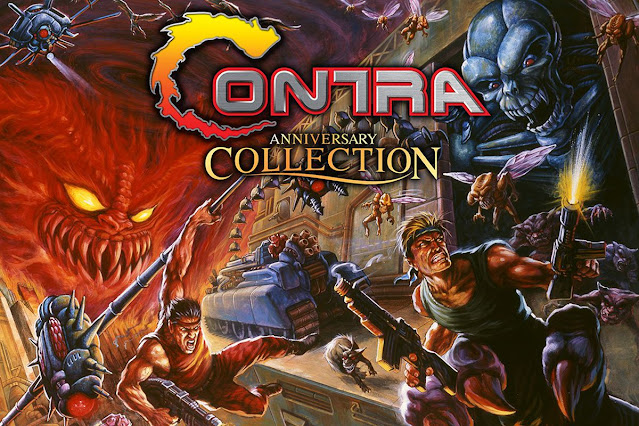
The Anniversary Collection features every game I've mentioned so far.
So far so great. It is easy to see how Contra became one of the most respected video game series. But what I haven't talked about is the elephant in the room, the one that nearly killed every legacy franchise. Yes, I'm referring to the increasingly-maligned 32-bit generation.
This would be considered the darkest era of the franchise's history. In fact, between 1995 and 2002 there were more canceled Contra games than actual series entries. Instalments for the N64, Gamecube, PS2, and Xbox, never managed to get off the ground, while only two PS1 and a single PS2 entry released in that time frame. And only one of these was even good.
For some reason, Konami treated Contra like trash after 1994. It happened to a lot of classic 8 and 16-bit franchises. No one really knows why. The franchise was handed to external teams, b-teams, and had weird ideas attached to them (In no universe does a Contra Online make any sense) and none of it worked out. All of this can be seen in the two PS1 entries that actually did release and were declared non-cannon as fast as could be done.
Instead of fast-paced 2D games, these entries were clunky and slow 3D games that missed everything making the original games such enduring classics. These two PS1 entries came out in 1996 and 1998 and did a lot of damage to the franchise's legacy. Much like the 3D Castlevania games damaged that series, the same was happening to Contra. By the time the PS2 released, it was in danger of being forgotten.
Konami then grew a brain and brought in Nakazato to direct a Contra game in an attempt to salvage this mess, which is exactly what he did. Contra: Shattered Soldier returned the series back to its 2D roots, a fast paced shooter, though this one was more of a boss rush than ever before and the story is typical '00s era Konami silliness filled with stupid retcons to series lore and pointless convolution that would only continue into Neo Contra, the PS2 sequel. While these were good games that did much to re-right the ship, they still had plenty of flaws they shouldn't have had.
All it did was highlight how much gaming had changed. Electronic Boutique's at the time were getting tons of returns on Shattered Soldier because the game was "too hard" and it being in a 2D perspective was a big no-no to game journalists. Because of this, it felt like it was already too late for Contra. The industry wanted it out. the deafening silence on the franchise after Neo Contra seemed to confirm that it was finished. It was time to move on to AAA garbage only.
That is why 2007's Contra 4 for the Nintendo DS was such a surprise. It was against every single thing the modern industry was heading towards. It was a deliberate return to roots, long before the 2D indie onslaught happened.
Konami even got a studio known for quality 2D games to do it! Contra 4 was made by WayForward Technologies, creator of the Shantae series, and was a deliberate attempt to shed all the stupid baggage the series had accumulated since the early '90s. And, boy, was it welcome.
The game is a simple straightforward run and gun game with plenty of platforming. There are some set pieces like in Contra III, and they even included improved weapon stacking and upgrades from that entry, but otherwise the game structure more clearly resembles that of the original two games. In fact, it clearly uses the NES version of the original Contra as its biggest inspiration. It learned all the right tricks. Deliberately calling it Contra 4 was a smart move as it not only harkened it back to the simpler gameplay and aesthetic of the most well known entries, but it allows the game to have a focus the series hasn't had since the 16-bit wars ended.
Contra 4 is possibly WayForward's best game, and one of the best in the series. It is only a shame it has never been re-released in near 15 years. It was the shot in the arm the franchise needed.
Unfortunately, it wasn't too popular. We all know what was happening in gaming during 2007, and a game like Contra 4 was simply not in vogue at the time. Because of this, the series faded from focus as gaming moved away from being about challenge and instead about lackluster D-grade stories. It's a shame, but it is what it is.
And after this point the series more or less became niche, putting out a game every now and then (though sometimes, like with Hard Corps. Uprising, they still manage to be top shelf) not unlike other seminal Konami franchises such as Gradius or Castlevania. Classic gaming was kicked to the curb, but it doesn't matter.
True classics will always be classics.
Hard Corps Uprising is a prequel to Contra: Hard Corps., and manages to live up to it.
So while the original Contra for the NES is one of the best games ever made, so too are most of the other games in the series. There aren't many long-running franchises with as few entries as this that still manage to have near a dozen titles worth playing, but Contra is one of them. Chances are, if it says Contra on the box you are going to have a great time . . . unless it's in 3D, that is. Then your chances aren't so good. Otherwise? It really gets better than this.
Are you a gamer in need of challenge, the likes of which you've never seen before? Then Contra has exactly what you're looking for. Don't sleep on this classic series!
The best games challenge you to better yourself and top new seemingly insurmountable odds one after the other. Few do it as well as this series does. Most of all, this contributes to making the series one of the most fun you can encounter.
We're about due for another dive into the past with one of these posts, so what better time than now? Let us talk about some classic video games. Posts around this place have been a bit heavier than usual, so let us lighten this puppy up. And we're going to lighten it up with one of the goofiest video games you can imagine.
The subject I have chosen is a game I have mentioned briefly one or two times before at Wasteland & Sky, but which has recently been getting noticed by bigger figures in the retro scene and new gamers everyday. This would be the 1993 Beat 'Em Up, Violent Storm, created by Konami. This was Konami's last entry in the genre, alongside Metamorphic Force (which is a game I might also talk about at some point), and is not very well known. Nonetheless, they went out with the strongest possible game they could. Violent Storm is one of the best games ever made.
And that's why this post exists.
Though for the longest time, Violent Storm was mocked by irony-bros and very online people as being too cartoony and stupid with "bad" music, it has recently turned around in appreciation due to the long-awaited wane of '00s bitter and angry internet culture. People now appreciate the game for what it is instead of mocking it for the era it came from.
I chose to talk about this game because of two reasons. The first is that Konami will probably never re-release it--they rarely ever re-release any of their classic arcade games from the late '80s and early '90s. The second is that it epitomizes everything the genre does right and when it was at its absolute peak, and easily shows how Beat 'Em Ups managed to captivate audiences for near a decade back in the day. The genre showed the art of simplicity in concept and how it could be blown up into an entire genre that still engrosses to this day. Keeping it simple allows more flexibility than you would think. Violent Storm is the perfect game to epitomize what the genre does best.
The reason it has shown new appreciation is due to the game finally getting a clear-headed approach. This is due to the death of irony poisoning in game criticism. Now we can discuss what Violent Storm mechanically right, and how its aesthetics are actually not bad, but indicative of the time, bring bright and attractive. Now that we're finally done laughing at a better cultural time period than the present we can see just what appeal was.
Violent Storm is the peak of a genre that had been more or less solidified by 1984 with games such as Kung-Fu Master or Konami's own Shaolin Road.
The Golden Age of the genre (Picture made by me)
Violent Storm came out right as the peak of the genre was starting to wane. By 1995, Beat 'Em Ups would more or less vanish from popular consciousness aside from one or two console releases in the years to come. Due to the advent of the one on one fighter, such as Street Fighter and Mortal Kombat, most arcades changed their focus towards them. The focus remained on the burgeoning fighting game long into the death of the arcade scene. As a consequence, Beat 'Em Ups were looked on as lesser for many years, hitting a low with IGN's review of Double Dragon Neon in 2012 lamenting "quarter munching" difficulty and stating that games such as this should no longer be made.
But that is getting ahead of myself.
Let us begin talking about the subject of the post. Violent Storm was put out at the tail end of August 1993 on the 30th. It was the 21st most successful arcade board of the year in Japan and, as previously mentioned, was Konami's last real entry in the genre. The game sort of came and went, not really getting much notice.
It was also the unofficial third entry in their Crime Fighters arcade series following Crime Fighters from 1989 and Vendetta in 1991. These were all made by the same team, and showed drastic improvements with each entry. Each game was based on a Cannon Films-style action movie plot with Konami's typical brand of cartoony, slapstick humor and buoyant music to brighten the crisp gameplay. As a consequence, this unofficial trilogy is fairly unique, even today.
Most Konami Beat 'Em Ups were based on licenses such as The Simpsons, X-Men, or Teenage Mutant Ninja Turtles, but these were completely original games that carried much of that flavor over in new ways. By 1993 they had the genre mastered. Violent Storm is the peak of everything Konami learned in the genre since they started near a decade prior.
For instance, let us start with the story, such as it is. You don't play these games for the story, but it is important to note how they threw wrinkles in the framework in unexpected ways. It's a jambalaya of well worn ideas, mixed extremely well.
"In the 1990s, World War III has at last ended. The people are left to pick up the pieces and rebuild their civilizations. However, vicious gangs that prey on these defenseless citizens are obstructing the reconstruction.
"The main protagonists are Boris, Wade and Kyle, vigilantes who protect the fearful and helpless. Their largest problem is the corrupt, incorrigible, ruthless and lethal gang known as The Geld Gang. They have commissioned every type of person imaginable: purple-haired, leather-clad, chain-wielding, lead-pipe swinging, masked, martial artists, orange-mohawked, and men who use manhole covers as shields.
"One day, when the trio is patrolling the streets, alert, ready and able to help those in need, they see a woman named Sheena (a friend of theirs) waving at them as she walks across the street from a supermarket with groceries. A moment later, Lord Geld's right-hand man, Red Freddy, snatches her away on his motorcycle. Now, the three braves must save Sheena from the grips of Lord Geld."
Someone clearly likes Fist of the North Star, Mad Max, Cyborg, and Double Dragon, but the twist they took on the topic is what makes it memorable. It takes all those things and adds just enough of a spin to make it different. What makes Violent Storm work so well is where this all goes after said setting and setup is out of the way. They crank it to 11.
While most decided to make such an aesthetic look grim and depressing, Violent Storm decided to do the opposite. They created a strange look that helps the game to stand out from the crowd, inspired from many of the other games in the genre they had made up to this point. As a consequence, Violent Storm doesn't really look or sound anything like the above properties.
The advances in arcade boards and technology also allowed for big, bolder sprites than ever before, as well as improved sound. This game is a 2D powerhouse. What you get is almost an entire world of difference from what was happening in Kung Fu Master nearly a decade earlier, and well beyond what the Super Nintendo and Sega Genesis were capable of. Konami pulled out all the stops. This is how far the Beat 'Em Up genre came in such a short period of time.
1984
1993
The bright palette contrasts with the violent subject matter and adds to the comedic tone without undermining the action. Every character is big, intimidating, and larger than life, and yet their reactions when they get hit are taken to the extreme which both adds to the threat and comedy at the same time. Violent Storm does double duty as a straight Beat 'Em Up and a loving parody at the same time, and both work tremendously well to creating an exciting tone.
However, as hinted at above, Konami also adds in a wrinkle with the aesthetic and setting, which is a sort of post-apocalyptic utopian vibe. You'll see crumbling buildings, creaking trains, dirty punks, and dirty streets outside ruined buildings and museums, and yet you'll also see sealed-bubble cities, beautiful forests, clean water, and happy people dressed in ancient Greek attire. It's a strange setting, but since it isn't elaborated on, it works. This is showing and not telling taken to the extreme, and that's what sells the tone. It also adds to the wide variety of locations you'll be battling through as well as some of the bizarre enemies that will show up to take you on. You won't see anything else in the genre that quite looks like this game does.
Given that you are playing a game as a post-apocalyptic gang, the sights you see along the way to rescuing your girl are quite in contrast with what you might expect. This isn't Double Dragon or Final Fight. It's a bright and busy world, yet filled with a lot of danger that will catch you off guard. And isn't that how it should be in a video game such as this?
As you also might have gathered from the clip at the top of the post, the music is also quite buoyant and loud. Of course many people will take note of the cheesiness, which is very much a good thing, and sort of write it all off as a lark, but that is dismissing much of the appeal. The music works because it knows how to shift with the atmosphere. It never stays in the same gear too long. always changing when the game demands it.
There are tracks that are bright cheery pop songs such as the above, but there are also darker atmospheric tracks for abandoned museums and underground facilities. Most tellingly of all, however, is the presence of rockabilly piano tracks, and surf songs that riff on Konami's own Teenage Mutant Ninja Turtles games. These add a punch of energy, levity, and aesthetic that gives much to the tone of the game. You're always left wondering just what is coming next, and everything works towards that.
Art-style aside, there isn't really any other game that sounds like Violent Storm does.
Then there is the gameplay. This is what puts the game over the top, as it should for any video game.
Konami Beat 'Em Ups have always been the most simple in the genre to get into, and Violent Storm doesn't buck the trend. However, in this game they decided to take the old standby Final Fight formula of one button to attack and the second to jump, and add a host of tweaks to it. Violent Storm is a game that is easy to get into but satisfying to master, much like home entries in the genre such as Streets of Rage 2 or Double Dragon Advance. And, unlike those two, Violent Storm manages this feat with only two buttons.
Depending on the direction you push the joystick, you can block attacks, strike enemies behind you, or angle your own moves in a way to break enemy defenses or strike faster or harder. Subtle directional movements of the stick can also add additional attacks to your arsenal while you hit the attack button. You can also change how you input your presses of the attack or jump button to change the movements you make. In other words, instead of one button being responsible for one move you are afforded an entire move-set depending on how willing you are to dive into what the game offers you. Or you can just mash the attack button. Whatever you'd prefer.
Another advantage is that the game directly tackles what is unavoidably one of the biggest issues with the genre: repetition. No matter how good a Beat 'Em Up is, the largest challenge is getting around the fact that you are beating up more or less the same waves of enemies over and over again for stages at a time. So many entries in the genre fail at offering the variety so sorely needed. This is what makes level design so very important.
In Violent Storm you are always doing or seeing something new. The first stage, as always, introduces the basics, but every level after that throws in a new wrinkle to keep things fresh. Just like the music and changing aesthetic, each stage switches things up in very subtle ways. Stage 2 is on a train that allows you to throw enemies off, light bulbs to shatter, and piglets that turn into weaponized footballs when you pick them up(!), and stage 3 goes from a street brawl with a kicking rap theme into a dance club with some of the craziest music you can imagine, not to mention weaponized potted plants and breaking furniture. In the midst of this are plenty of weapons, enemy patterns, and bosses, as well as varying enemy strengths, that all must be approached differently. The game keeps the flow moving, and keeps you thinking. It also ends at the exact right moment it should.
There are seven stages, each taking somewhere between 5 and 10 minutes to beat, lending the game the perfect length for the genre being around 45 minutes to an hour. This is assuming, of course, that you fly through the levels with ease.
The difficulty isn't really as quarter muncher as you might think. By this point, and with other games such as Sunset Riders and Teenage Mutant Ninja Turtles: Turtles in Time, Konami had mastered their arcade design in a way where they didn't need to suck your quarters to keep you playing. They simply made the game tough enough that you just needed to understand the gameplay loop and get rewarded with having fun simply doing well. It's a hard game, but it isn't close to overbearing. This is arcade difficulty done right.
If you didn't know better you would have to suspect Violent Storm was made by someone who knew the genre inside out, and they very clearly did. As said before, this was made in 1993, when the genre was more or less mastered. Konami had this down to a science.
See for yourself:
Gameplay
As you also might have noticed, this is a three player game. Konami was always good at allowing a party atmosphere into their arcade games, and Violent Storm is no exception. Get together with a bunch of buddies and the lunacy of Violent Storm gets just that much better. The arcades were the peak of co-op gaming, followed by couch co-op with friends, but nothing quite beat making new friends and bonding over great games like this. It's an experience lost with the death of the arcade. Nonetheless, this remains a shining example of a lost era. It doesn't get much better than this.
Unfortunately, Violent Storm has never been ported to anything since its original 1993 arcade release date. As mentioned, Konami never releases compilations or re-releases of their late '80s and early '90s arcade classics, for some reason, leaving gems like this forgotten outside of those in the emulation scene. Unless you find a cabinet of this one (which is very unlikely) there are precious few ways to get your hands on it legally.
Regardless of all that, you should very much play it. They don't make them like Violent Storm anymore.
In an age of $70 AAA games that last for maybe one playthrough before they are forgotten, the arcade age seems like an entirely different world now, and it is. Back in the day the length in games didn't come from artificial length depending on linear progression through a story: it came through mastering gameplay loops and replay value which leaned on fun factor. This is why classic games have stood the test of time like they have and why AAA will not, and such a thing just isn't admitted in the current broken industry. But you know it's true.
We are coming to the seventh anniversary of when the game journalists declared Gamers Were Over, and, as you can tell, that turned out to be patently false. They get everything wrong, just as they passed over great games such as this. They have no idea what they are doing or what made their own industry so successful to begin with. This is why they are dying out.
As the old industry falls apart under its weight from years of going in the wrong direction, it is more important than ever to realize what made the medium so big and so good to begin with. In other words, industry guards are not to be trusted. Be wary when this crowd reviews classic games. They aren't looking at it from the right angle, and they deliberately undersell them. Keep that in mind in the unlikely event that Violent Storm is ever released. Guarantee that nothing I mentioned in this post will be brought up by them.
Nonetheless, none of that matters. What does matter is that Violent Storm is one of the best games ever made, and one that everyone should play. It epitomizes the best in the genre, and the best gaming has to offer. Its gameplay, aesthetic, and structure, are all perfectly crafted to form the ultimate example of what one expects from a video game.
Seek it out and play it. Few games are so fun as Violent Storm is, and few ever will be. It epitomizes what makes a Beat 'Em Up great.
And that is what makes it one of the best games of all time.
For more Beat 'Em Up inspired action, check out Grey Cat Blues! Where mudmen from hell run rampant on the shadow planet!
It's been awhile since I made a post like this, but it's about due. In the spirit of Brand Zero, I'm going to go old school and talk about a dead series that no one will ever revive due to the genre being abandoned long ago. At the same time, I hope to show just what we miss out when destroying the foundation from underneath your feet.
This post is about a little game named Soldier Blade, a forgotten classic on a now forgotten system. This is in a climate where classic gaming is currently being whitewashed away by certain AAA companies attempting to reframe the 32-bit generation as the first console generation. No doubt if Nintendo weren't still around they would do it successfully and certain gamers would allow them to do it.
But I digress.
The reason I've chosen Soldier Blade is because it is one of the best shmups ever made, but explaining why is a bit tough due to the genre's heavy use of gameplay to leverage itself over flash and presentation. To understand these days why the genre was beloved you have to wipe gimmicky "Bullet Hell" games from your head and put your mindset back to when games began and the genre's beginnings. Because shooters have fallen quite a bit from where they began and are near extinct these days.
As an action game, few are as tight, as responsive, or as colorful as this one is. There's a reason it still remains a favorite of genre fans of this near-30-year-old-game to this day. And that's unlikely to ever change.
Soldier Blade came more or less at the peak of the genre, in the early 90s, before video games abandoned their roots in arcade challenge and goals for cinematic experiences. It is pure gameplay, meant for that rental store, or that dying breed of gamer who needs to master levels and accumulate high scores. You have to go back to a certain time and a specific mindset. You have remember when games were about gaming first above presentation or flash. In many ways this game represents its era on top of also being excellent in its own right.
Soldier Blade was released in 1992 for the popular PC Engine in Japan, and the nearly forgotten TurboGrafx-16 in the West. Despite how it might look and sound, it was not released for the CD attachment games such as Ys were given. This was done on the original hardware before any revisions. It's a bit hard to imagine, but the TG16 was a much better and impressive system than gamers were lead to believe.
The game was also the last in a series that ended on this system. Well, it was technically the last. There were other games, but they were more remix than sequel. Before we go on, let me talk about the Star Soldier series a bit.
Star Soldier was a competent shooter that came out back in the mid-'80s on the MSX and the NES. It was Hudson's attempt to try to take on the almighty Compile, creator of classics such as The Guardian Legend, GunNac, Blazing Lazers, Musha, Spriggan, and Zanac x Zanac. If you don't those then you really, really, should. At the time they were one of the kings of the genre, up there with Capcom, Konami, and IREM.
But Hudson was more of a platformer-type developer at the time with Adventure Island, Bonk, and even Bomberman under their belts. Shooters weren't their thing, despite the genre being so big at the time. So their first two attempts with Star Soldier and a few years later with Super Star Solider, were merely decent.
They did offer a Caravan feature for their games, as score hunting was big back in the Golden Age of gaming. In case you don't know what a Caravan Mode is, I should explain. In an exclusive level, the player has 2 or 5 minutes (depending on the mode selected) to attack enemies, gain power-ups, and defeat bosses, to rack up the highest score possible. As can be deducted, such a mode can be addictive among a group of gamers. There is also a score attack mode on top of the time limit ones which adds yet another layer of replayability. And this doesn't even have anything to do with the main game.
However, in 1991, they finally nailed it with the Japan-exclusive (and mis-titled) third entry Final Soldier. A game that understood shmups had appeal beyond shooting waves of erratic-patterned enemies with sparse or no background elements at all. They had finally made it up there with the best of the best. They realized the genre is about level design, creative art, and weapon management, just as much as pattern recognition and quick reflexes. This is, after all, a video game, and not just a pachinko machine.
But in 1992 they put out a game which pushed their system to the limits with Soldier Blade, technically the final game in the series. This is, in my humble opinion, one of the Top Ten best Shooters ever made.
I say it was technically the last in the series, because there was the also excellent Star Parodier released in the same year which was a (natch) parody of its own series. Plus there was an N64 game and Caravan-only Wii release years later, but none of these really were new entries that pushed the series forward. They were just basic shooter releases, not as in-depth as the proper games in the series were.
So what exactly makes Soldier Blade so good? If you just think of shoot 'em ups as mindless games of pattern recognition then you're missing the point (as well as describing every genre in a reductive way) though I think it is something that was lost when Bullet Hell became the standard. When people think Shoot 'em up today they typically don't think of games like Soldier Blade anymore, and that's a shame.
To begin with, the controls are rock solid. There's no slipperiness to be found. Should you die then you have no one else to blame but your own weakness. This is good because of the different enemy patterns and types that meld together which require good reaction time to deal with properly. The enemy patterns are never overwhelming and offer enough variety to keep you on your toes through the game's rather lengthy 7 stages and one Caravan stage. But that's only part of what makes Soldier Blade so good. The patterns and enemy design would be enough to make it top tier, but there's more beyond that.
One thing I don't like about Bullet Hell shooters is that they feel like they exchange level design difficulty with purely dodging enemy fire instead. It makes the games less visually interesting to play, and cuts down on immersion. You could make the aesthetic a blank white background and little would actually change.
For example, in Soldier Blade you have to weave in between nigh-indestructible fleets, meteor showers, tight structures, and large enemies in between their fire. In other words, the level design and the enemies work together against you to emphasize that feeling of lone soldier against the world. It's more than just dodging bullets. In this way it's not unlike a vertical Contra or Metal Slug game without a jump button.
In Bullet Hell shooters there isn't really any level design beyond dimmed backgrounds (so you can see the bullets) and waves of one or two colors to keep track of from enemies that might as well be floating guns. The levels are also much shorter to compensate for this repetitive experience. It's not as interesting a formula as the classic shooters had, and it may be why they became niche almost immediately after they began.
Soldier Blade isn't like that, and, in my opinion, neither are the best games in the genre. It's a classic shmup through and through that relies on every part of the genre to be great. This is what allows it to stand the test of time.
Every level of the game tells a story that could be its own tale in a Fred Saberhagen collection. It does this without cutscenes or dialogue boxes. Events happen around the player and in the background to show a new scenario in the alien attack on every level that is as cool to see as it is to play. You get the impression that you've been thrown right into the middle of a larger story. As an example, I suggest watching the video below.
Operation 4 (Ignore the sound issues, the game doesn't have those)
That's about this time I realized Soldier Blade was something special. And this is but one of the levels in the game.
Another thing you might have noticed in the video is the lack of one-hit deaths at certain points. This is because of how the power-up system works. This is a bit different than previous games in the series, and might be my favorite of any shooter short of a Compile joint. Though I bet even they wish they could have made a system this clear and sharp.
Your guns start at the base level, then rise with every pick-up to three levels with a max of 3. Every time you're hit it lowers your power back to zero and then a quick death with the next hit. At the same time, collecting a power up also gives you aspecial screen-clearing weapon that changes depending on the color you stack. Certain levels and enemies are easier to take down depending on which power-up you wield, so choose what works for you in every given scenario. This means there is a lot more strategy to tackling levels than you would think for a shmup.
You also have a tiny mecha buddy following you around every level. It shadows your movement and copies your weapons. At the same time it is also invincible, so if you play smart you can use it to block bullets from the enemy. Aim it right and you can be an unstoppable force.
There is a lot here for such a simple system. Every trip through the game is a different experience due to this.
It also means multiple ways of racking up that high score to beat your buddies in Caravan mode. This adds much replay value for both modes, and a good crutch for new players to learn the game at the same time. It is an ingenious touch to game that was already one of the best games on its system.
The soundtrack is . . . well, you can hear it for yourself above. It's upbeat, fast-paced, and intense, the exact sort of thing you want to hear when shooting alien scum. The TG16 sound-chip was one of the best even at the time, and this game shows it off. Even for a shoot 'em up soundtrack in the Golden Age of the genre it is genius.
As you can surmise, there isn't one piece of this game that isn't the best of its genre. I could go on, but why bother?
I think by now you're beginning to see just what makes Soldier Blade such a classic, and why after 30 years it still is thought highly by those who still remember what a good genre the shoot 'em up is. Long before cinematic experiences turned shooters into joyless, plodding, D-grade movies, it was about gameplay first and aesthetic built on that. Here you can go on a journey to save the world from the alien menace, and look stylish doing it.
What more could you ask for?
But watching videos only gives part of the experience. This is a game that should be played. Unfortunately, much like the genre itself, it has mostly been forgotten thanks to revisionism. The arcade roots of gaming have been severed and have left the medium floundering in its futile attempt to be terrible movies instead.
Soldier Blade is also not that easy to get a hold of. The original TurboGrafx version is expensive, as is the system it came on, and it has only been re-released on the Wii and Wii-U Virtual Console as well as the PS3 store digitally. It should be more easily available, but it's just not, like most of the genre isn't. And the devaluing of the shoot 'em up genre over the years by difficulty-hating game journalists hasn't helped it stay visible. Over the years they've done more damage to classic gaming than anyone else.
If it isn't one complaining about a game with incredible replay value costing more the $5 while praising $60 one-time movie experiences as A-okay, they are reviewing these games from a modern perspective and harping on complaints no one involved with the creation of said game could know at the time. That isn't how reviewing classic material should work.
All I'm saying is, don't trust game journalists to review classic games. They aren't equipped for it, at all. They also don't want gaming to be like this anymore, which is why the medium has been allowed to fall so far from where it began.
Unfortunately, classics in gaming tend to fly under the radar all the time due to such behavior. Shmups have suffered the worst from this revisionism due to the medium's hatred of its arcade origin points. Shoot 'em ups are as arcade as you can get: unforgiving, fast, and yet gives the player multiple ways to assess any of the challenges it offers without hand-holding. It is pure video gaming, and that isn't allowed anymore.
In Current Year, we expect differently. Old thing bad!
But that's it for that.
I'm just going to leave you with this. Soldier Blade is one of the best video games, not just shooters, ever made. It does everything games were made to do, and it is stylish and inventive when doing so. You can't ask for more. This is what you play video games for.
Hopefully, that should be enough to tell you that this is a game well worth seeking out. Video games rarely get more fun than Soldier Blade, even to this day.
And that's why it's a classic.
I'm working on fun stories of my own. Gemini Warrior is pure adventure, and that's just the way I like it. I'm sure you do, too!