Back in the '90s, it felt like something new was coming out about every other day. Which, it was. People have described it as every day feeling like Christmas, which isn't entirely inaccurate, but a sign as to just how much was being put out at the time by the gatekeepers.
Today I wanted to highlight one such interesting project, which was released by the cereal brand Chex back in the mid-90s. This has always been a fascinating case.
Everyone alive today knows how popular DOOM was when it first released, pretty much singlehandedly reshaping the PC gaming scene in its image and truly kickstarting the FPS genre. One of the games that came in its wake, and one still looked back on as a favorite from that day, was the project called Chex Quest.
Essentially one of the first top tier DOOM mods before the scene really got well known, Chex Quest was an entire child friendly mission pack given out for free in cereal boxes. That's right, they gave out entire games as free bonuses back in the day. Not only that, but Chex Quest was actually really good. Such a thing is unthinkable today.
There was also a second episode released by Chex and, eventually, a third one was put out for free online to complete the entire adventure. To this day, Chex Quest is considered one of the defining FPS titles from its Golden Age. And it was given out for free by a cereal company.
Check out the video above for more information. If you're a genre fan and haven't given it a shot, now is your chance. It's also perfectly safe for kids, too. There isn't really anything violence to be found, despite the genre it takes place in.
Again, this was a much different era than the one we live in now. Something this is unthinkable today, especially when every company is so aggressive against their perceived outgroups, but Chex Quest is a pleasant memory to when things were a little different and when possibilities in the mainstream were a lot more open to things than they are today.
It truly was a different and long over era. Oh well, we'll just have to work even harder to make the next one even better.
That's all for this weekend, and I will see you next time.
It's the weekend! Let us talk about something a bit different.
We've talked a lot here about decline over the years, and that is a subject worth addressing, but now it is the time to finally discuss what it takes to reclaim what has been lost. Now that the 2020s are rolling out, we're going to make this the decade where everything finally changes.
While we've discussed the NewPub phenomenon many times before, we haven't quite discussed another medium that, while commercially successful, is in the final stages before its own collapse. That industry, of course, is video games.
Though video games have been decried for many years as frivolous and useless (as every medium has at one point by the people who provably cannot preserve culture at all), there is a very real formula and meticulous design process that comes from them. Despite current trends, there was a lot more to video games that poorly written Z-movies that contain a few button presses to make scripts happen. In fact, when the industry ran on arcade design was when it reached its peak.
Now, if you've played video games since the death of the arcades, you've noticed a decline in creativity since the Sega Dreamcast died and arcade faded from prominence in the '00s. I am not talking about technology or graphic fidelity, I am talking about the gameplay itself. Gameplay loops (such as they are today) barely exist anymore and have been replaced with carrot on a stick drudgery to get from one cutscene to the next--a trend that began with the first 3D console generation but only started to take over once HD consoles came in.
What is missing from today that we used to have isn't that obvious
This was the era when countless middle market publishers and developers closed up shop, parting the medium in two between AAA cinematic experience and low budget indie game. In other words, this killed creativity almost overnight. If you can think of a big name AAA game in the last three console generations with a new gameplay experience (that isn't made by Nintendo) then I would be surprised. Even more so if you can name more than five. It simply doesn't happen anymore.
As a result of this shift, the industry has been in a creative rut, praising pointless downgraded remakes of old perfectly fine games because they have pointless modern bells and whistles. You should not be buying a new $599 US Dollar console and expecting to play remade and dumbed down games from 2004 on it.
So what caused this? I would recommend watching the video above. It is the loss of arcade design that the entire medium was built off of. Just like "pulp" became a dirty word in OldPub in order to denigrate adventure stories, arcade design has been sold as cheap and lesser since at least the mid-90s thanks to water carrying game journos. In other words, you were sold a lie. the entire collapse that video games are about to suffer through (or already are, depending on your perspective) will be caused by this abandonment of what made the medium what it was.
This has happened more than enough times in other mediums for anyone to understand it at this point. The further you stray from your roots, the more you risk losing them, and video games have definitely lost that link and have lost it some time ago.
Though you might be wondering, what about indie? Well, it's not as easy as all that. Check the video yourself and see why simply being 2D and having pixel art isn't quite the same as classic arcade design and why it's not quite enough. There was more to classic game design than "tightening up the graphics on level 4" as the old saying goes.
If you're a developer yourself, definitely take in the above information and think it over. How much have we lost along the way that we don't even consider anymore? How far can we really push forward without solid ground to stand on? Food for thought.
All of our industries are going to have to start asking those questions if they want to have a future. There is little choice left but to look back and carry forward again. The only other option stagnancy has, is death.
That should be the last thing we want for any medium. We've already lost a lot, at some point we're going to have to start gaining again.
Anyway, have yourself a good weekend and I will see you next time!
For those old enough, you might have remembered what was called the Video Revolution back in the early 1990s. This was the period where technology was making so many leaps and bounds that no one could quite keep up with everything going on. It mostly peaked by the time of Windows '95 and affordable internet for the masses, but for awhile it seemed as if the sky was the limit. By the end of the decade, technology would rule everything and the planned analog future would be a thing of the past.
One such example of this wave was the burgeoning Nickelodeon television network. Their game show series, Nick Arcade, combined the exploding video game hobby (yes, it was always popular, folks) as well as the arcade scene, with their wildly popular game format made popular by Double Dare and Guts, in order to form this unique creation.
You can see the entire history and what tech it took to get this crazy idea running in the above video. Not only can you see the style and attitude that made the early 90s so very distinct from the back half, but you can also see just how different video games were back then before the AAA monstrosity warped them into bad D-tier movies. It's truly a time capsule of a different era slowly being forgotten.
At the same time, watching an episode is strange because it's very clear something like this couldn't be made now. It is because "Game Shows" and "Video Games" both equated to the same thing: surmounting challenges and getting high scores to beat your friend on the couch or standing beside you in the local arcade. The latter no longer does this, long since stripped from its routes. As a result, I have no idea how younger generations would take this series.
The industry has simply shifted too much. Then again, supposedly the industry is having the same issue as comics did before it imploded: unable to try to connect with younger generations and catering to a dwindling demographic who do not enjoy the changes fostered on their hobby. We are far from the Golden Age of video games that existed with Nick Arcade was around. And we are even further from the time the network itself was relevant which ran out with the 1990s itself.
That said, this creation is a fascinating time capsule from before Nickelodeon bought their shares to separate from MTV before then being scooped up by Viacom and having their originality gutted to become . . . basically what it is to this day. Here you can see two early '90s juggernauts, Nickelodeon and video games, at their peak from a much better time. It looks like an entirely different universe today, doesn't it?
Here is an episode of Nick Arcade you can watch today since, like most of their live action material, it will never have a physical release:
A weird aside. I have watched a few of these old episodes recently, and some of the questions really show you how different it was, and what basic pop culture knowledge once contained. One of the strangest is that so many kids seemed to know about Tarzan in the 1990s. Not only that, they knew a lot of things made in the early part of the 20th century. We're talking from before any of them were even born. Strange, isn't it?
This was before the "kids don't watch old things" propaganda was set down. I know because I was there. They didn't need to put out the lie that old things were bad to sell new things yet. That would come in a few years after this. Everyone cared more about something being good first.
Again, it was a different era. One we can probably still learn plenty from. Which is why '90s nostalgia has stuck around so long. There is still much we haven't quite learned from it yet.
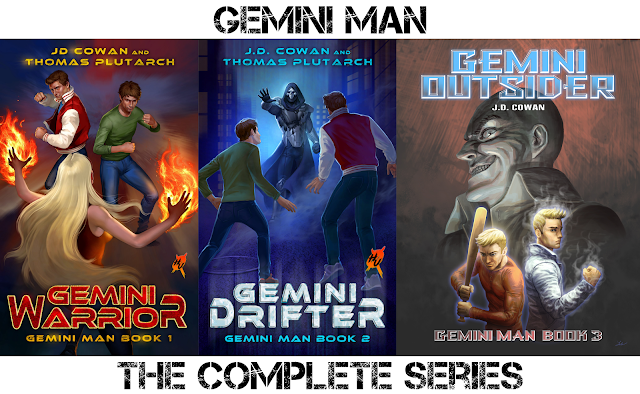
Anyway, that's it! That's all for today. As an update: The Gemini Man campaign is now wrapping up (answer your surveys, please!) and the kindle versions will complete release next week in time for the holidays. If you haven't backed the campaign then keep an eye out! You have quite a lot of books to look forward to. I will hopefully have news for a mass market physical version by then too. It's been quite a busy 2023 getting this series finished up, so it is nice to finally see the end of the road up ahead.
I know it's been a rough year for a lot of people, but the holidays are close and we are very near the end. Just a bit further to go! So sit back and relax, and enjoy your weekend. You have earned it.
If you know anything about video games, you almost assuredly know about the original DOOM, from 1993. The revolutionary game that more or less invented the first person shooter as we know it (Wolfenstein 3D laid the groundwork, but it was DOOM that set the standard) was quite the wonder when it released. The game was fast paced, immaculately designed, simplistic and yet deep, and contained nearly limitless possibilities. Needless to say, it was a phenomenon. To this day it is still thought of as one of the greatest games of all time.
It didn't stop there, though. 1994's DOOM II added the super shotgun to the already impressive arsenal and a handful more enemy types, going all out with the level design and showing all the potential possibilities it had, but there was little else to build on beyond that. They more or less nailed it the first time, and this was a victory lap for developers id Software. DOOM remains one of the greatest games of all time, and there was little way to improve on those first two games. This was proven when 2004's DOOM 3 instead changed focus to be more of a survival horror experience instead. What more could one really do to improve the rock solid formula, after all?
But back in the mid '90s, developer id Software had to do just that. Not only did they have to follow up one of the best and most revolutionary games of all time (It was easily as popular as Mortal Kombat, Sonic the Hedgehog, or Super Mario Bros. back then) but they also had to jump into the third dimension. Yes, DOOM is infamously a 2.5D game, one that pushed the second dimension to its limit in what could be achieved. Aside from Build Engine games like Duke Nukem 3D, Blood, and Shadow Warrior, the three genre classics that pushed 2D graphics as far as they could at the time, the industry was screaming for 3D.
So id Software had to oblige.
I'm not going to go into the total cluster fudge that was the development of their follow-up to DOOM, but I'm sure you can guess how much pressure there was for them at the time. Think about it: How in the world do you follow-up something like DOOM, a game that completely changed the entire industry?
Suffice to say there were a lot of discussions and arguments around what their follow-up game should be. Everything from a full-on RPG with a protagonist named Quake to a third person adventure game inspired by Virtua Fighter, of all things. However, since there was so much pressure on them to deliver, and do it quickly, they decided on making another first person shooter. But this one ended up being quite a bit different than expected, even for the time.
It also ended up being the last game the famous id Software dream team would make together as a group. Thus there is quite a lot of mystique around this title, and almost as much hate from those who hated the shift. Needless to say, the final product is an interesting thing to talk about, because it actually does represent the end of an era, but not quite the start of a new one.
I will get into what that means, but let us first go into the game in question. Yes, the topic of today's post is Quake.
The infamous Quake released in 1996, the year 3D completely overtook gaming as a whole, and it was a revolution for both id Software and the industry. John Carmack created one of the most important engines for game creation and John Romero was allowed to let his hair down and finally use all three dimensions to torment players as he had in DOOM. This was quite a unique and special occasion. The end result is one of the few early examples of a full jump to 3D that still manages to hold up to this day. There are a few reasons for that.
The first question you might have is if Quake is merely just DOOM in 3D. After all, surely all the creative interference and paring down of ideas in production must have led to a safe, bland product for mass consumption. Would it not have made sense to play it safe then? Safe is not what I would describe Quake as being. In fact, it is not at all. While DOOM is one of the most influential games in the entire industry, Quake also ranks up there, as well. That is quite a hard trick to pull, but id Software managed to weave through development issues and create a classic in its own right.
The main difference with Quake is that while it is a shooter, it is not a fast paced run n gun like DOOM. Because it was early 3D and they could not yet afford the speed or enemy count of 2D, id Software played it smart and changed focus to that of a horror game. There were horror aspects to DOOM, obviously, but the feeling of helplessness and dangerous exploration through eerie territory took a backseat to the frantic action. In Quake, it is about quick thinking and exploring the towering 3D labyrinths filled with traps and dodging the incredibly dangerous enemy horde in claustrophobic spaces. There is still a focus on combat, but it is chunkier and the player is at a disadvantage due to the level design and enemy behavior tied to it. The shooting is still satisfying and powerful, but you will find yourself counting bullets and learning to manage them well. Quake is more environmentally involved than DOOM is, and that ends up changing the entire focus.
One of the best things about Quake is its HP Lovecraft influence it is swimming in. It isn't the typical "Lovecraftian" copy paste job most such products went for (though there are some name drops, it isn't obnoxious) but for the crushing terror of the unknown and cold, choking atmosphere where insanity is a hair's breadth away. The enemies are almost as disturbing as the creatures in DOOM, but all of them have far different roles and ways of dealing with them. On top of it is the foreboding soundtrack by Nine Inch Nails that really sets the tone that you are roaming where you should not be. The entire game oozes atmosphere of the kind few ever had before, or have had since.
You play as a nameless ranger, much like in DOOM, sent out into portals to worlds of gothic terror, gutted military bases, and abandoned dig sites where horrid creatures were found long ago. You are just a normal soldier who must use your wits to survive and stop these impossible creatures from getting to Earth and wreaking havoc there. It's really that simple, as it should be, but like DOOM it offers much in the way of gameplay possibilities.
The fascinating aspect of Quake is that while the core game at times might feel like the concept isn't quite as fleshed out as you would like (there is no Use key, for example), the expansion packs actually do exactly that--they really expand just how deep Quake can go and how many possibilities it has in such a primitive 3D space. It turns out there is much under the surface here, much like the world of Quake itself. This is what has helped it maintain its level of popularity over the decades. Quake's modding scene is still one of the biggest in the genre.
That alone should make Quake one of the greatest games of all time. It might feel dated today, but that is part of its appeal. The creaking old corners of the world matches the gameplay and adds to the impression that you are being thrown into a place that simply isn't right.
In essence, Quake feels like a sequel to DOOM, emphasizing different elements of the formula and striking out on its own. The story itself also still has those references to satanic interference, implying the creatures you are fighting might have higher allegiances than originally thought by what the plot description tells you. The portal technology now instead of opening a portal to Hell has been mastered for man to invade his enemy's territory instead. Although, much like DOOM, this is probably something that would have been better left untouched as it opens paths to places where man should most definitely never roam.
All this contributes to create a stone cold classic, one whose stature has only improved with the passage of time. To this day, there is still nothing like Quake.
But we are not ending today's entry here. 1996's Quake is only half of today's subject. We have a bit more to cover.
Needless to say, Quake was a revolution in the industry and became one of the highest rated games of the year, a huge seller, and quickly made many gamers' top game lists. It was exactly the follow-up to DOOM that was needed, and did as well as it needed to, solidifying id Software's stature as kings of the genre and the industry itself. Despite everything working against them, the team managed to pull off a grand slam.
But the cost was huge. Developer id Software was almost destroyed by making Quake and the majority of the Dream Team that made them one of the best in the industry more or less left the company after the game was finally released. In essence, as said earlier, Quake is more of the end of an era instead of the start of a new one. This game, in many ways, was their swansong. The change that the company would go through happened much faster than you would think.
So the game came out and was a big success, okay, but what about afterwards? How did id Software capitalize on the massive success of Quake while also recovering the heavy losses occurred when developing a whole new game engine and losing so many key members?
That's easy, they put out a new game a year later. Much like DOOM II came out one year after DOOM, id Software did the same again. The main difference here is . . . well, we'll get to it. Suffice to say, it wasn't the first time they've made a sequel directly after the massive success of the previous game. Where it differs here is in execution.
The remaining members of the dev team worked on a new game while Carmack also put out a new engine, the legendary Quake II Engine, and used it to make one of the biggest and most popular games of the 1990s.
This would of course be the famous Quake II.
It is impossible today to really go into what made Quake II so huge at the time. If Quake I was a huge hit, then Quake II was a megahit. It was almost instantly praised as being a quantum leap forward from the first, was given as the reason many got into PC gaming for the first time, topped countless GOTY and best game ever lists, and more or less set the standard for what shooters have become today. In the 1990s, Quake II was one of the most popular games period.
And yet nowadays most people who like it will tell you it is underrated. You will hear about how it is forgotten and needlessly spat upon by the general public, if it is remembered at all. Where did this mindset shift come from, and why does it seem to prevail even to this day? Was Quake II overhyped, or is it just mindless hate?
As usual, the truth is a fair bit more complicated than that.
What I said earlier still applies. Quake II almost instantly pushed the original Quake out of the spotlight when it released in 1997 and overtook it in popularity pretty much instantly. How did it do this after everything I had just described of the original? Well, you have to put your mind back in 1997 and see what it is that Quake II actually did.
The first thing that should be said is that Quake II is not a sequel to Quake I. It is a completely original FPS that merely bears the same name. And the games are so different that one could hardly ever confuse the two. That aside, there are plenty of design decisions that change the game entirely, even aside from the tone.
Quake II's missions changed the structure of all FPS games going forward. Each mission, instead of being one map a player goes through to find all secrets and items before moving on to the next one, was instead a set of around 3 to 4 maps where players had to go between them to solve objectives and battle enemies along the way. The total game length was still about the same length, but the levels became more complex than they had been before simply due to this.
Another change is that Quake II is slower than Quake I, but so are the enemies, which allows for more reaction time. There are more wide open spaces compared to Quake I, more enemies in the levels themselves, and the enemy types don't hit as hard as the ones in the last game . . . for the most part. In essence it does feel like a deliberate step towards DOOM and away from the original Quake as far as general combat goes. Quake II in a lot of ways is a bit of an anti-Quake, a reaction to what they think went wrong with the first game.
Lastly, the setting was made far more straightforward. In Quake II you play as a space marine sent to a planet of body horror aliens who wish to dissect humanity for themselves. The game portrays their final assault on the home planet. Your mission is to complete objectives like shutting down satellite arrays and destroying space lasers and the like on your way to finally conquering the big boss alien at the end. It's typical Space Opera stuff, but that wasn't common in games then, never mind in FPS games. Even Blake Stone was more James Bond than Captain Future.
All of this was new in 1997, it had never been done before in a video game, and this explains why it was huge when it released. Quake II became a template for the genre going forward, and they didn't really look back.
However, this also explains why the game isn't as highly regarded today as it once was. The biggest problem with Quake II is that the next twenty years of FPS games would be trying to outdo Quake II, and many of them have beaten that horse deep into the ground. Oddly enough, it's success is why it isn't as highly thought of as it once was, despite the fact it is designed very well. Quake II is a victim of its own success.
So what exactly is the problem? Let's try to dig into it a bit.
Unlike the original Quake, Quake II actually does feel like a new era in the genre, one that would eventually be cribbed from with games like Halo and the millions of other space marine games over the years to come to the point that anything unique it might have had was buried in the context of the time it released. There really isn't any way to express how much of a change it was when its changes have been so ubiquitous in its genre over the years.
Does this new reception mean it was overrated at release? Were gamers blinded by hype? Is there anything fundamentally wrong with Quake II that holds it back?
No, not really. Quake II is a good game. It can even be very good at times. The bigger problem is that it is not particularly great. There isn't anything particularly unique about it to recommend playing it, unlike most other classics of the genre. Quake II feels like a game going through the motions, doing what id Software was expected to do--turning them into "the FPS guys" instead of a developer with wild ideas that could do anything. There is a reason the team fractured after making the first Quake. Compared to DOOM or Quake I, Quake II is just kind of there--a product for the market. shaking that impression is very difficult playing it outside of its original context.
It should also be mentioned that the changes from the original game, thought to have been revolutionary (and actually were) at the time, turned out to be a double edged sword. A lot of this might be the reason it isn't as well thought of as the original these days.
There isn't anything truly terrible in Quake II, but nothing I would call outstanding.
The level design is solid, but because of the concept of maps basically duct-taped together, there is a lot of dead space and repeatedly wandering over areas where enemies had already been cleared out earlier. This makes the levels drag on and not feel as snappy or player friendly as older games. Because of this there are no real memorable levels, and most of the aesthetic consists of colorless military bases of the kind the genre would be mocked for in the era ahead. The entire experience bleeds into one long level, which was the point, but it takes away from the pick up and play nature of the genre.
The weapons are fine, but this is the game where the FPS standard loadout was more or less solidified. Pistol, shotgun, machine gun, grenade launcher etc., none of the weapons are all that interesting. At least DOOM set the bar and also had the Super Shotgun and BFG, and Quake had things like nail and lightning guns. The weapons in Quake II do the job, but they don't feel that satisfying to use a lot of the time. The original release of Quake II did not even have muzzle flashes which lessens the impact even more.
The enemy types are okay, but after fighting demons in DOOM, and disturbing Lovecraftian mutants, living knight armor and swords, and shambling behemoths in Quake, fighting body horror machine aliens is a step down in creepiness. The Strogg are just not that interesting to fight, overall. This doesn't even mention the annoying feature that EVERY basic enemy you kill has an annoying habit of shooting shots off at you after they're already dead unless you either wait patiently for them to fall and die or waste more ammo to blow up their still-standing corpse so they can't do that. This slows the game's combat to a crawl and at times makes exploration tedious.
All of this could have been looked past when the game was new, but the passage of time reveals a base that simply isn't as fantastic as originally thought. The developers made a good game, one worthy of success, but it is easy to see why it no longer wows after a look back to the era and where the industry went not long afterwards. There just isn't much there that you can't find somewhere else, not something id Software was known for doing.
The game deliberately being an anti-Quake is what hurt it, because those aspects are what the game is more remembered for today. It is not known for what it did otherwise.
And it wasn't as if id Software didn't know their own goals going in:
It was a conscious decision [to change Quake II's direction] and controversial inside the company. We weren't happy with the [original] Quake story. [John] Romero was gone, so there was no one left to defend it. Kevin Cloud headed up Quake II and he wanted to make it story-driven.
— Todd Hollenshead
This is all well and good, but it is the Quake I story people remember and still influences today because it is unique enough to still stand out both in atmosphere and simplistic execution. The Quake II story was completely outdone by Halo a mere handful of years later. Not a single person plays Quake II today for the story.
The harsh truth is that the only reason to play Quake II today is if you want to play another good '90s shooter, you have nostalgia for it, or you want to play through all the id Software games. It is absolutely worth playing today, though. Just don't be shocked when you find out DOOM 3 is considerably more interesting and unique, and that game has a surprisingly large hate base. There just isn't much there to recommend over their other efforts.
Quake II is a game defeated by its own success.
It is truly interesting how the passage of time changes perception. Now Quake II is considered underrated when it was once thought of as the greatest game of all time at release. Not bad for a game where critics said that Quake II was "the only first-person shooter to render the original Quake entirely obsolete."
And yet nowadays most would rather play the original.
The thing that made me write this piece you are reading was, oddly enough, the recent 25th anniversary remaster Bethesda gave Quake II. Now is the best time to play it and revisit just what made it tick, making it more relevant than ever. I had never really clicked well with Quake II, so I decided to give it a go and play through the whole thing to see if I was missing something.
My general impressions of my playthrough, however, remained unchanged from the last time I went through it. Quake II is a good shooter. It's fun. It's worth playing. You'll have a good time. But it's not a great game. It's definitely not one of the best games of all time. It's missing the spark of id Software's best work--the intense pace of DOOM, the creeping terror of Quake . . . it's just a solid game for fans of the genre.
The expansion packs are terrible, too. I played them hoping for some sort of revelation like I had when playing the Quake I expansions that showed how much was really under the hood of this whole concept. The first game's expansions are legitimately great and well worth playing. The second game's expansions, however, were worse than the main game by a considerable margin. There wasn't anything to see except bullet sponge respawning enemies and more taped-together maps in very similar environments. It was actually quite a downer playing them.
However, there is an exception.
The brand new episode made for the new remaster, Call of the Machine, changes the entire game. This expansion has you play as different space marines dropping on different worlds and digging into the Strogg's true plans for galactic conquest. This simple set up allows the developers to make each mission a stand out experience from the rest, and inject a lot of life into the game. Just about every change it makes improves on the original game in every way.
The developers found a way to make back tracking less boring, constantly add new sights and sounds and ideas, and even managed to inject some of the horror atmosphere back in again, though said horror is a bit closer to DOOM than Quake, at least for the most part.
Each mission feels like a standalone episode of its own, bringing back the better pacing from the older games, and allowing far more variety than the same three repeated locations from the original game. The entire thing is never really boring (aside from one of the early missions with rising water levels feeling a bit sluggish) and almost all of them vary from run n gun to slower horror at varying degrees, always keeping you on your toes and mastering enemy placement in a way that utilizes their attacks instead of stonewalling the player into an endless circle strafing battle. The expansion is actually quite invigorating to go through, and breathes new life into Quake II, thereby making it the game I wish the original was..
The elephant in the room is that the new expansion ties Quake I in with Quake II, and in the process breathes a lot of life into Quake II's more flat atmosphere, also returning a lot of the tricks and traps from the original game as a more important part of the level design, including an ending that makes it all feel like it came full circle. Honestly, I think Call of the Machine is far better than Quake II proper, and would actually call it great and very much worth playing.
After beating Quake II's remaster and playing these expansions, I decided to actually go back through Quake I the same way, and there really is no contest. The original Quake is simply the better overall experience.
The truth is that Quake I's particular datedness has helped it age better than Quake II's has. Playing Quake felt like playing Quake, a feeling you won't get from anything else. Quake II never really gives me any comparable feeling, aside from the excellent new expansion that, in my mind, is a huge leap over II's campaign. Even without the Quake I references, it's just a much more fun and engaging adventure to go through, and gives an experience you simply won't get anywhere else. And that's what really counts.
Again, it's really fascinating going through the two games. Their design philosophies just come across so different from each other that it makes comparing them interesting. It also helps that neither of them are intolerable to play, either.
So in my final judgement I would obviously say the original is the better of the two games, though they really show how much the industry changed in such a short time. Looking back at the two Quake games is like looking at the first real fissure in the gaming industry.
As time passed, the genre became little more than highly scripted hallways punctuated by cutscenes, the atmosphere and player input becoming more and more limited, until all that was left was reskinned version of Call of Duty and little else. The industry that allowed games like Quake to flourish was basically gone.
Then, in the middle of the 2010s came that Boomer Shooter wave, gamers who grew up in a much different industry ready to fold their influences into new games. This is how you get games inspired by the original Quake like DUSK. who build their own brand new experience on the shoulders of giants. No one could have foreseen such a change coming, until it did. As a result, the way we look back on the past has changed and we can see it from a refreshed perspective. The entire landscape and history of the genre has been recontextualized, and it will never be the same again.
It really goes to show you how strange the world of art and entertainment is. I highly doubt anyone who made Quake thought it was anything but a disappointment compared to what they could have made. Half the team left and the other half instantly began on another game intentionally ejecting everything the original even was. And yet those who played Quake at the time, and even now, see it as a genre classic and one of the best games ever made, it's influence living on to this day. You never know just what the influence you might have will become years later and detached from your own thoughts and intentions.
Perhaps it is better to keep a clear head when assessing what works and what doesn't, but that doesn't stop the passage of time from making those decisions for you. No one could have foreseen where the industry would go, after all. 1997 was a different country; 1996 even more alien. We are looking back at a whole other world.
All this going on to say, just be honest with what you want and make it the best you can. There is nothing else to be done. At least we can say id Software never chased trends and made their own way, for better or for worse. Maybe that's the key.
Regardless, thanks for reading. I have a few levels of a Quake expansion left to wrap up. I've got a universe to save.
Welcome to the weekend! Today I just wanted to highlight a couple of cool little tidbits you might have missed.
The first is the above Sega Genesis Mini 2. This product is a repackaging of the second model of the Sega Genesis console only with built in games. The mini-console trend has been around awhile, and this is merely the next step for it. Gamers who want to hold a physical version without paying inflated scalper prices on old cartridges might find this appealing, especially for children and younger relatives. These games have aged very well. At least, the ones that were good to begin with! Your mileage may vary on that.
There are 60(!) games in this one. You can find the full lineup on Niche Gamer. If you're into classic gaming, you will probably have a good time here!
At the same time, in new gaming news is the upcoming Vengeful Guardian: Moonrider, a game by the creators of Blazing Chrome and other new retro-style games, Joymasher. This is an action platformer of the kind the 16-bit era excelled at.
These guys know how to create new games that feel like they could have been made back in the day. In an age where the majority of AAA big budget creations have nothing in common with the roots of the medium, it is nice to see things like this cans till be made.
This is the sort of thing that didn't feel possible a decade ago, which makes it doubly exciting that it is happening now.
Lastly, in tandem with the above news, both Sunsoft and Toaplan (classic game developers) are having their old games finally re-released properly, making a lot of hard to find classics available for the first time in decades. Finally, both Gimmick! and Zero Wing will gain the exposure they haven't been able to have since the early 1990s.
Much can be said about the current generation's nostalgia obsession, but one thing they are good at it is preservation of a lot of this sort of thing. A lot of the people who originally made this material (and in other mediums) completely dropped the ball.
I can't say exactly what the future holds, but the return to traditional forms long abandoned by an industry currently treading water seems to be occurring more and more. Here is hoping it doesn't let up anytime soon.
That's all for today! Have a good weekend, and I'll see you next time!
A long time ago, hobbies were hobbies and people treated them as such. Today, they are entire "lifestyle brands" and "communities" where people go to get their entire personalities from. What that sort of view has led to is tribalism and lunch table theatrics on par with the worst of secondary education. It hasn't led to better scenes, higher quality products or ideas, or more scrupulous "fans" and customers. All that has happened is that is has given corporations more eager drones to hand them many for the brand title on their product--brand titles they swiped and subverted from the people who created them and are long gone.
We are living on the scraps of a long dead era while simultaneously spitting on those very people who created what we love so we can keep our scavenger culture alive. It's disgusting, but it does help us avoid actually moving towards a future worth living in. We instead get stuck in a cult of our own personality where everything we like reflects back on us like Narcissus finding that perfect pool for himself. At the end of the day, it always about us and what we can benefit from: not what we can learn from others or how we can grow from where we are. You can see this most clearly on social media, though I would thoroughly recommend staying well clear of that disaster if given the chance too. It really does show the worst of us.
But the issue is more than that. It is like we lost the page count on a book we're reading so we instead just randomly skip around and pretend we understand what's happening inside. No one is fooled except for ourselves, but still we do it.
One of the strangest aspects of living in Clown World is how backwards everything has gotten over the decades, to the point that many might not have even realized it. I'm certain you can find all sorts of examples just by paying attention to world events and how opinions flip and all converge in the same direction over night, but the most obvious place this exists in is in our every day lives. It's subtle, but obvious when you notice it.
Take the above image, taken from Twitter. It would have to be social media, of course. The image shows a library of books entirely assembled to teach you how to play a game. Included are no history books, no short story collections or anthologies, or anything that would have caused the game to exist in the first place, but only books centered on doing the heavy-lifting of your imagination for you so you can consume product easily and in peace.
Before I annoy a contingent of tabletop gamers over the above, I want to specify the point being made here. This isn't about buying modules or general handbooks to understand your game better. It is about what the game, and all games, have always been intended to be about from the very beginning. This also goes well with obsession of "story-based" gaming of the above users.
Games are created from distinct parts and histories that merge together to form a new set of rules for the gamers to conquer. A game is defined by its rules which the players work with in order to beat. In essence, you should only need one rulebook or instruction manual to understand how to play a game. Why would you ever need more than one unless the game is either broken, or the people who made it want to syphon more money off of you?
This dove-tails into a point I made a while back on the bird site myself:
We are reading games and playing books and no one has realized it has turned around backwards from where it started.
Without fail almost all the replies and quote-tweets of the above image were all about this being the Ideal Library and the way it should be, but few seemed to really point out how upside down a goal having such a thing should be. Libraries are for knowledge, not learning to play games. In fact, libraries as they are classically defined as such, should already be helping you learn to play these games better. Libraries are basically where games came from, after all.
What makes it bizarre is how much tabletop gaming is formed from wargaming and games like Dungeons & Dragons were explicitly made to imitate the sword and sorcery short stories back in the day. You need a library of old books to even understand the context of these games. Theoretically, all the modules and handbooks for D&D already exist: they are the very books that created said game to begin with. Everything you need came from them and it was up to you to utilize these works in your own game.
But one perusal of the above bookshelf gamers are raving over contains none of those books. It actually contains nothing in the way of anything aside from corporate product. The owner would rather read his games and keep his playstyle locked into the technical framework of whoever owns the brand now. The owner would prefer exercising the same nuts and bolts instead of exercising his imagination to learn new ways to approach the classic games he apparently loves so much and spends much of his life pouring money into.
This might not be such an issue if so many in that scene (I can't definitively say whether the OP is one of these people or not) were not so vitriolic to the idea of reading old books, including the ones their games came from. The books that inspired the very scene they model their lives around, written by old dead men, are very much worthless. Why read those when you have "experts" and "influencers" in corporate positions to sell prepackaged imagination and ideas to you instead? Why do the heavy lifting when you can pay people to do it for you?
Why would you want to read Lord Dunsany to see magical and unknown worlds full of danger and wonder when you can buy a corporate module that mechanically writes out specific scenarios out for you to follow?
Why would you want to read Harold Lamb, the man who inspired Robert E. Howard to write Sword & Sorcery to begin with, as he imaginatively describes the heroism of crusaders, Cossacks, and strangers in the desert? How about his history books? Why bother when history has nothing to do with why your game exists in the first place? Right?
Why would you want to read Andrew Lang's fairy books where the idea for such stories were inspired? Why bother when you can have people repackage and sell you warmed over ideas from the 1980s instead?
Isn't there more to life than that?
Why do you desire to read games instead of reading books? Why do you desire to play books instead of playing games? Why do we never question how tangled up this has become? These are questions that are never quite answered.
This isn't any different in other subcultures. There is no real reason to single out one them. This is pretty much status quo everywhere.
Comic books wish to be dragged out movie screenplays even as movie screenplays poorly imitate comic books. Meanwhile, the original audience for comics, kids, are completely ignored entirely for full grown adults still playing dolls with their youth. Who is Cyclops going to date this week?! Who cares.
Video games insult themselves as being too "video-gamey" for having elements (like HUDs, life bars, stage-based progression, lives, or even scores) because gamers think it "takes them out of it" for whatever reason. They applaud the removal of video game music for bad, indistinctive wannabe Hollywood "scores" that even Hollywood didn't use at their best. Video games should be rolling in pulp clichés--not trying to aim for their own "Citizen Kane" in a medium that doesn't support it. Their roots have been jettisoned.
At some point they all decided being destroyed and subverted was a Good Thing. Even as their industries die.
Meanwhile, everyone wants to be Hollywood, an industry that has been on a downhill slide since the 1990s, and makes less and less every year while the majority of people walk away searching for something better. For some reason we wish to imitate this dying industry anyway. Why are we trying to lead them back where they already fled from?
Aside from being backwards, putting on new hats is not creativity. It's just a gimmick. Worse--it's a gimmick that is a failure. And still we cling to it.
Would one point this out to the consumer crowd, it would be met with volatile resistance. How dare you point out failing industries and ideas or failing? Just accept that Times Change and swallow whatever the corporations give you, or leave the "community" alone to slurp corporate teat unchallenged. That is what a good fanatic would do.
Is there not more to life than that? When did slavishly following along with the crowd like lemmings off a cliff be thought of as noble? Why is having a lack of imagination considered a badge of honor? How does this put you above the people who came before you?
The weird arrogance that comes in defense of the above subversion of healthy traditions to objective degradations never ceases to amaze. Why brag about how much less you have than those who came before? How does this improve your station or scene in any positive way? How long are we going to keep this up for as everything implodes?
We form "communities" around these things, then, not preserve what we love, but to brag about warping it from its original intent to attract onlookers who don't care about said source to begin with. And then we wonder why nothing improves.
Perhaps it can be accepted now? This doesn't work.
We've gotten ourselves all mixed up and caught in our own spiderwebs, unsure of how we got there but adamants that being stuck and unable to move is the Way It Should Be. Perhaps complacency and comfort from better times allowed this to be, but that doesn't mean it should stay that way forever. Especially when those days are long gone.
I've been floating around in independent spaces for a while now and can definitely see a strong contingent of those righting the ship that was long ago steered into icebergs. They are counting backwards to the past to find their inspiration to start with in order to move forward. They then count forwards towards a better future.
As an example, you can check out the crowdfund for author Schuyler Hernstrom's Thune's Vision, organized by Pilum Press. This is a talented author, aided by a like-minded small pub, to revisit the roots that had been abandoned for so long and create something new from it.
Mr. Hermstrom writes adventure and weird of the old kind, the sort that would have run in Weird Tales were it still around: sword and sorcery as well as horror with a fairy tale edge. These are the sort of stories OldPub and the dying industry rejected long ago. You would do well backing the project if you have not yet. Mr. Hernstrom's material is worth it!
Thune's Vision already has over 100 backers and has blown past its initial goal for funding, proving there is a burgeoning audience for these sorts of stories. Check the campaign yourself and be amazed at the progress it has already made!
Why buy yet another module to file on your shelf when you could instead exercise your imagination by reading the sort of stories that helped invent your hobby to begin with? Inspire your games with actual stories.
Pilum Press has also started another campaign for a different writer by JB Jackson entitled Shagduk, which is the first book in a new series called De re dordica.
The description is as follows:
"The year is 1977. Professor Sherwood has gone missing. Between working at the library and playing gigs in Fort Worth holes in the wall after hours, Steven and his pal Randy set out to discover why, unwittingly summoning a demon and setting into motion a chain of astonishing events that could put the entire world at risk of total destruction."
For more on Pilum Press, including their unique anthologies, you can find their site here. They are doing some good work!
There is plenty out there aiming to give you what has been missing for some time now. Counting backwards works out more often than not, especially in an age that has long forgotten what mathematics even is.
Then again, 2022 is just getting going. Who knows what else is coming down the pike? I can assure you, however, that the best stuff will be like this: from those going back to the past to bring us towards a better future. Counting backwards is the exact approach we need to be able to learn how to count forward again. Keep an eye out! Good times are on the way.
It's been quite a February, hasn't it? We're still only halfway done, but I've got a few new projects I wanted to share with readers regardless.
The first is Brian Niemeier's new Combat Frame XSeed RPG! You might have heard inklings about this before, but now it's finally here. It's available in ebook, hardcover, and even paperback. As far as mecha TTRPGs goes, this is one of the more interesting ones.
And it's coming straight out of NewPub!
The description:
"Ripped from the hit novels, the Combat Frame XSeed Roleplaying Game puts you in control of history's ultimate weapons. Stage hit-and-run strikes across the FMAS-Coalition border in your trusty Grenzie. Defend the L1 Colonies from ZoDiaC incursions in your bleeding edge Ein Dolph. Or play a soldier of fortune raiding desert trade routes in your junkyard Grenzmark I.The post-future is up to you. Forge your legend in a world of brutal mech combat. Play the Combat Frame XSeed Roleplaying game now!"
Up next is an anthology of stories of combat vets who deal with the aftershocks of traumatic experiences. This one is entitled Can't Go Home Again and it is edited by Cedar Sanderson. Though it is primarily about heavy subjects, readers appear to connect quite well with is judging from the reviews. We are all human, after all.
The description is as follows:
"Men and women who lay their life on the line never escape unscathed, and when the time comes to return home, they find a wall between them, and loved ones. These tales follow those who gather the hope to begin healing, and tearing down the walls that have sprung up between them, and their loved ones. No one ever said it would be easy..."
Finally, we have the next book in Declan Finn's new series, the space opera yarn called White Ops. The second book is entitled Politics Kills. A very apt description of today's climate, despite being a work that takes place in the far future!
Here is the description:
"Sean Patrick Ryan's White Ops team has taken on impossible odds and walked away unscathed. But when Earth President Douglas Wills turns Earth into a prison camp, they will fight an entire planet to save their loved ones.
"Along the way, they must unite hundreds of alien races against the looming threat from another galaxy and recruit allies that can only be reached through hyperspace filled with hostile space jihadis.
"War may be Hell, but politics may kill them first."
But that's not all! Book 3 of the series will be out next month! You can preorder it here. NewPub never slows down.
So as you can see, there is still quite a lot here, even in these slower months at the start of the year. The weather may be cold, but that doesn't mean you have to stay chilled. Grab yourself something new and warm yourself up. The heat will be here before you know it.
Things are just getting started! We're only a month and a half into the new year. There is much more to come in this wild year of 2022.
This is a boost for a product that isn't even out yet, but in the preview stage. It's a tabletop RPG focused on a retro-futuristic approach to the 1980s that runs on a ranked 2d10 system. There isn't a whole lot yet to go off of, but it does have promise.
There isn't a whole lot yet revealed about it, as the campaign is still in preview, but you can get a 45 page quickstart by signing up now. For those sick of modern corporate gaming, you might want to give this a go. You definitely won't be getting this from them.
As for the general setting:
Welcome to Retrofuturistic Chicago
In 2038, half of the world is going through cultural stagnation in the wake of the breakup of the US. The independent city-state of Chicago is spearheading a cultural revival inspired by the culture of the 1980s. RoNIN is a game will take you through the neon glow of the Second City reborn.
For those interested in new avenues for gaming, new approaches, be sure to check this out. There are all kinds of fresh ideas not coming from mainstream sources these days. You just have to keep an eye out and work to find them.
Once again, you can find RoNIN and the free 45 page quickstart here.
For something a bit weirder, here is Karina Fabian's Neeta Lyffe: Zombie Exterminator--a novel about the future, game shows, and more general weirdness!