It's the weekend! Let us talk about something a bit different.
We've talked a lot here about decline over the years, and that is a subject worth addressing, but now it is the time to finally discuss what it takes to reclaim what has been lost. Now that the 2020s are rolling out, we're going to make this the decade where everything finally changes.
While we've discussed the NewPub phenomenon many times before, we haven't quite discussed another medium that, while commercially successful, is in the final stages before its own collapse. That industry, of course, is video games.
Though video games have been decried for many years as frivolous and useless (as every medium has at one point by the people who provably cannot preserve culture at all), there is a very real formula and meticulous design process that comes from them. Despite current trends, there was a lot more to video games that poorly written Z-movies that contain a few button presses to make scripts happen. In fact, when the industry ran on arcade design was when it reached its peak.
Now, if you've played video games since the death of the arcades, you've noticed a decline in creativity since the Sega Dreamcast died and arcade faded from prominence in the '00s. I am not talking about technology or graphic fidelity, I am talking about the gameplay itself. Gameplay loops (such as they are today) barely exist anymore and have been replaced with carrot on a stick drudgery to get from one cutscene to the next--a trend that began with the first 3D console generation but only started to take over once HD consoles came in.
What is missing from today that we used to have isn't that obvious
This was the era when countless middle market publishers and developers closed up shop, parting the medium in two between AAA cinematic experience and low budget indie game. In other words, this killed creativity almost overnight. If you can think of a big name AAA game in the last three console generations with a new gameplay experience (that isn't made by Nintendo) then I would be surprised. Even more so if you can name more than five. It simply doesn't happen anymore.
As a result of this shift, the industry has been in a creative rut, praising pointless downgraded remakes of old perfectly fine games because they have pointless modern bells and whistles. You should not be buying a new $599 US Dollar console and expecting to play remade and dumbed down games from 2004 on it.
So what caused this? I would recommend watching the video above. It is the loss of arcade design that the entire medium was built off of. Just like "pulp" became a dirty word in OldPub in order to denigrate adventure stories, arcade design has been sold as cheap and lesser since at least the mid-90s thanks to water carrying game journos. In other words, you were sold a lie. the entire collapse that video games are about to suffer through (or already are, depending on your perspective) will be caused by this abandonment of what made the medium what it was.
This has happened more than enough times in other mediums for anyone to understand it at this point. The further you stray from your roots, the more you risk losing them, and video games have definitely lost that link and have lost it some time ago.
Though you might be wondering, what about indie? Well, it's not as easy as all that. Check the video yourself and see why simply being 2D and having pixel art isn't quite the same as classic arcade design and why it's not quite enough. There was more to classic game design than "tightening up the graphics on level 4" as the old saying goes.
If you're a developer yourself, definitely take in the above information and think it over. How much have we lost along the way that we don't even consider anymore? How far can we really push forward without solid ground to stand on? Food for thought.
All of our industries are going to have to start asking those questions if they want to have a future. There is little choice left but to look back and carry forward again. The only other option stagnancy has, is death.
That should be the last thing we want for any medium. We've already lost a lot, at some point we're going to have to start gaining again.
Anyway, have yourself a good weekend and I will see you next time!
Hello! Good to see you again. I'm sorry for the silence for the past week, but I've been working very diligently on finishing off the Gemini Man trilogy and preparing for the crowdfund and some stuff in real life has also taken priority. It's sure going to be nice once this hill has been climbed, I can tell you that much!
So, today I wanted to share with you this little nugget from a forgotten era of Gen Y internet history, but before it got defined by what it is now. The subject is early YouTube and the wild west days of the internet; the topic is an early internet series known as Captain S. No, not Captain N: The Game Master, and not the web comic Captain SNES, but nearly work from the now defunct ScrewAttack (who also had another little series called the Angry Video Game Nerd), itself a relic of the way things were before everything became corporatized and stock.
Captain S was an early attempt to create a TV series on a much smaller budget with a bit of a quirky idea. Think old early 1990s series like Saved By the Bell or Full House mixed with the game hopping adventures of the Captain N: The Game Master cartoon, and in a strange rubber band reality where the console wars are eternally stuck in 1990 (though the games themselves can be from later years) and you might be able to guess what they were attempting. It's worth seeing, if only for the fact there is nothing really like this made anymore, and couldn't be without too much winking irony or intrusive computer effects. They don't make them like this anymore.
It is also nice hearing from a member of a younger generation who doesn't have quite the same context for why things were what they were and has to puzzle it out himself. Again, it really highlights how much has changed, even when it is difficult to understand just how much it has at times. The old internet is gone, but it can never really be replaced.
So check out the above video and immerse yourself in the way things were once done and learn what we might have tomorrow. It's only by learning from the past that we can truly grow, after all. Captain S seems to highlight exactly this lesson.
Perhaps I keep looking this stuff up because of how stock and standard so much of our climate of art and entertainment has become, but you will note how different the expectations and view of the world was back before it all was poisoned with bitter irony and an overwhelming sense of self-hatred that permeates everything now. Despite how silly it might be, there is still something to be gained from even this. There is always something to be gained from the past, whether we like it or not. No matter how much we might dislike it--that is never going to change.
Thanks for reading and I will see you again next time! Hopefully by then I will have some good news to share with you. Until then, have a good spring. The cold has finally departed and the warmth is here. Enjoy it until the summer screw it up!
BONUS Video: The same creator also made a video tracing the early days of the Nostalgic Critic. The perfect irony of a nostalgic look at a nostalgic character is interesting enough, but it is another look at just how different the early days of internet video making really was compared to now. It was a whole different world--before it went insane.
Have a good weekend! Stay safe and I will see you next time. By then I will have much more to share with you, God willing!
I'm currently working on a new series of posts, but I've got a few lighter ones until we get there. This time I want to talk about one of my favorite video games and series. The subject will be Contra on the NES, a genre classic.
In 1987, during the Golden Age of video games, Konami was on top of the world. With games like Time Pilot, Twinbee, Yie Ar Kung-Fu, Gradius, Devil world/Dark Adventure Shao-Lin's Road, Goonies, Jackal, Life Force, Blades of Steel, and Castlevania, they were showing themselves as the masters of just about every genre under the sun, both in the arcades and at home. that familiar logo was just about everywhere.
If you had an NES then you are fully aware as to just how good Konami was at this time, contributing especially well to the rising shooter, beat 'em up, and platformer, genres. They only got better at it as the years moved on. It felt as if their ideas were as endless as the new games they were putting out. Next to Capcom, they were probably the most trusted third party developer of the time period, which is saying quite a lot. There isn't anyone else who came close in the level of consistent quality and varied ideas that Konami did.
One such idea was the Contra series, a run and gun game fashioned after 1980s action movies. It's hard to imagine now, but few companies tried as hard as Konami did to turn such things into video game fodder. There were attempts, but they always felt half-hearted. This series? Not so much.
Contra isn't the first run and gun video game, but it is the first one to really solidify how the mechanics should work and how much the player should have control over their character in order to achieve feats. The original arcade game released in 1987, and was decently popular, being a big looking game with surprising gameplay variety that ostensibly allowed players to become action movie heroes. There was a lot of shooting, dodging, and tough enemies to battle, which made it tough to walk away from. Needless to say, it was a hit.
However, it was in 1988 with the NES home version that Contra cemented itself as a true classic. When people talk about the original Contra, this is usually the game they mean.
Though the graphics couldn't be as powerful as they were in the arcade, the game manages to look much better than the original version. The simplistic art style allows easy visibility of enemy attacks and bullets without any of the clunk found in the arcade original. It's an all around better playing experience. The music also uses the NES soundchip to create a far more energetic soundtrack than the original, allowing for sharper and clearer sound effects on top of it. Then there is the player movement and the controls which are both far tighter here than in the arcade version. The characters can aim and jump in every direction with speed and ease of maneuverability that the genre would use as a base for years to come. No one who has played both is going to argue that the arcade original is superior.
The NES version is also longer. Though it has 8 stages compared to the arcade's 9, many of the arcade stages were short and were combined into one on the NES which then expanded whole segments of the final arcade level into four separate full stages. There is also no time limit in this version. In other words, it's also a longer game on top of being a better playing one.
All in all, whenever anyone talks about how great Contra is, they are talking about the NES version. And so will I.
The NES Contra is still regarded as a classic today. Let us start with why that is.
So what exactly is Contra about? Well, it is a run and gun game: a run and gun is combination of two specific popular genres of games from the 1980s. That being the platformer and the shooter. Contra uses both of these halves to form the bulk of its gameplay time. You are tasked with playing as two action heroes as they avoid enemy fire and slaughter the villains, not unlike Arnold in Commando. you are the ultimate male!
But the story and setting add a bit to the flavor. It isn't just Commando meets Predator and Aliens starring Arnold Schwarzenegger and Sylvester Stallone, even though that is the main gameplay hook, and what the box sells you. There is more than you might think.
The plot, as told by wiki:
"Contra is set in the distant future of the year 2633 A.D., when the evil Red Falcon Organization have set a base on the fictional Galuga archipelago near New Zealand in a plot to wipe out humanity. Two commandos, Bill Rizer and Lance Bean of the Earth Marine Corp's Contra unit (an elite group of soldiers specializing in guerrilla warfare), are sent to the island to destroy the enemy forces and uncover the true nature of the alien entity controlling them. The promotional materials for the US arcade version downplays the futuristic setting of the game, with the manual for the later NES and home computer versions changing the game's setting from the future to the present day and the location from Galuga to the Amazon Jungle."
Why North America tried to retcon this awesome setting is beyond me, but they put it back by the third game, Contra III: The Alien Wars, after first attempting to say the game starred Bill and Lance's descendants Jimbo and Sully (Why they did this I don't know) before giving up and admitting they are all futuristic shooters with an obvious timeline.
It actually makes for an interesting setup. you aren't just dealing with terrorists or aliens. You're dealing with alien-infested terrorists with possible demonic ties as you attempt to save the human race. In a lot of ways, it is not too dissimilar from Castlevania in how it pulls inspiration to make something new. The two series actually do have quite a bit in common, but that is from mostly being made by the same company.
In the distant future, an alien force called Black Viper has slipped into Earth undetected and is slowly amassing power through the darker parts of society. They create the group Red Falcon run by their puppet human terrorist organization to sow chaos around the world. Bill and Lance, guerrilla combat experts, are sent in to stop this supposed human group. What they find is something much worse than they first expected. Each entry reveals more and more of what Black Viper really is, escalating the series as time goes on into one of the spirit of good against the twisted machinations of unknown evil. At least, before the canon goes right off the rails, but that's a whole other conversation.
What Black Viper actually is, aside from a vague alien force, is never actually stated, though they are definitely meant to be demonic terrors far beyond normal enemies. Putting the player up against something so obviously evil and frightening gives the added bonus of having them want to succeed even more. Few people give up after their first Game Over in Contra for a very good reason. these alien freaks are going down!
Konami knew what they were doing.
Nonetheless, Contra is fantastic because of two key reasons. The first is that it is an A+ platformer and the second is that is also an A+ shooter. On their own without the other half they would be great games. Combined they make up a classic gaming experience unmatched in the genre. Even without the rest of it boosting it up, Contra could get by with the fact that it is just that good gameplay-wise.
The tighter controls allow for more precise platforming, though the game rarely kills you for missing a jump like in, say, Super Mario Bros. Instead, being good at platforming simply allows you height advantage and better positions to shoot at the oncoming enemy forces. The game rewards you for being better at the controls by turning you into an unstoppable force of nature.
The shooting, too, is fast paced and sharp. It helps tremendously that most enemies die in one hit--just like you do. Aside from the bosses and enemy vehicles, you are actually on even footing with every obstacle in the game. The only difference is in numbers. This feeling combines with rising stakes and ramps up into the outright obstacle courses you are faced with by the end.
As for the bosses, they are perfect in their simplicity in attacks and patterns and yet retain a foreboding toughness regardless. Every encounter feels like a battle to the death. The first boss is iconic in video games: the giant wall with carefully placed laser sentries and oncoming guards. You must master each enemy's pattern on this obstruction in order to walk out unscathed towards the next level.
Or walk in to the next level. This is another nice touch the game offers. After you destroy the gargantuan monolith, you walk into it into the opening you made and down towards belly of the base, the second level. This interconnected feel pervades throughout the entire experience.
This stage is done from a third person perspective, not too unlike the pale imitations that Sony pumps out these days, where the camera locks behind you as you shoot forward down the wide open halls of the steel tunnels. As you clear out sections you advance forward into the next room, following a clear path towards the center. However, the difficulty is no less harsh here. You will never forget you are in a Contra game, simply because the game will never allow you a moment to realize it. always move forward, never stop. Let's Attack Aggressively!
The base stages, though few in number, represent a refreshing change of scenery from the sidescrolling levels, allowing the player to sharpen their reflexes by altering their entire perspective on where they can get shot from. You thought you knew where all enemy fire was coming from, but you were wrong! Even the boss for this stage has you shooting up towards it while enemy attacks come down at you, a reversal of the usual left and right situation found in the first level and boss. You must completely change your approach on the fly.
This isn't only brilliant design, but it is the perfect curveball to throw at gamers that might be frustrated at the difficulty and keep them interested enough to see what might be just ahead of them if they only continue that one more time. As I said: no one quits Contra after one Game Over. You always continue that one more time.
And we did continue for years to come. Contra is still known as a classic to this day for a very good reason.
The powerups are not the best they've ever been in the series (those would be the ones in Contra 4) but they do add a good wrinkle to the gameplay and the risk/reward system. You're not going to want to go into this gauntlet barely armed.
By blowing up the floating powerups you can upgrade your gun into something better than your standard peashooter. The first is a far faster machinegun that does heavy damage to bosses and can wipe out waves of enemies quick. however, it suffers from being harder to aim at a distance, meaning you have to get close to really use it to its fullest potential. Then there is the flame gun which shoots in a corkscrew pattern, allowing for easier distant shots but not much in the way of power. You can also collect baser power-ups to make your default weapon stronger and to give you a barrier for defense, but these aren't much to talk about.
Lastly, of course, I have to mention the greatest gun powerup of all time, which comes in the form of the Spread Gun, a legendarily overpowered weapon that offers aid to anyone that can't aim. How? By firing a spread wave of bullets that covers the majority of the side of the screen. You will most likely kill everything coming before it even knows what hit them. I'm not overexaggerating the effectiveness of this gun. The spreader is the most difficult weapon to miss an enemy with, which makes it the go-to for many Contra players.
unfortunately, it also has a glaring weakness in that it is the slowest weapon in the game. Should you miss your shot, it takes much longer for the next one to be fired. By then, in a game like Contra, you might already be dead. Unless, of course, you master the game.
And while I made the powerups seem rather overpowered, they all vanish when you are hit once. Unless you are good at the game you won't be using them much, which incentivizes learning everything. This is what good game design should do. If it kicks you down the game should make you want to get back up and give it another shot. How else will you get satisfaction out of conquering it?
Contra is master at this, and why it has remained a classic for over 30 years.
They knew their audience.
As for the future entries of the series, you might be surprised to learn that despite being over 30 years old, almost every entry in the Contra franchise is a quality game. That is impressive. Not even Castlevania has managed the concentrated quality that Contra has had.
The sequel to Contra was Super C (Super Contra in the arcades) which came along in 1990 (Again, 1988 for the arcade) which similarly improved on the original version. Super C is a more focused experience, lacking the variety of the original entry for a shooter-focused challenge. The levels are primarily shooting galleries and left to right affairs. There isn't as much platforming, but that is fine for what this entry wishes to do. People who prefer the sequel tend to like the purist shooter focus. It might not top the original, but it is still a top tier shooter.
Then came a Game Boy entry in 1991 entitled Operation C. This simplified the action even more, especially being that it was on a smaller portable system and screen, yet the action is no less frantic. It's a short game at only 5 stages, but for a bite-sized portable experience it as good as it could be. To be quite honest, shooters on the old Game Boy rarely get better than this one. That they managed to include a game that stacks up so favorably to the original games is very impressive. It is only a shame this series has so few portable entries.
Now we reach what many consider the pinnacle of the series in 1992 with SNES entry Contra III: The Alien Wars (It was even called Contra IV before release) which was a tonal change in focus for the series. What was once a bunch of levels defined by challenges became an attempt to mimic the very action movies it was based on. In essence, every level is a set piece. What they tried to do was turn it into the visual equivalent of playing through an action movie. Not like today's AAA slop, however. There is no story focus or dialogue--it is just in the presentation.
From wiki:
"Contra III was developed by Konami with a team led by Nobuya Nakazato. Although this was Nakazato's third year at Konami, Contra III is the first Contra game he worked on, having only previously done informal playtesting for Super C (1990). He believed the original arcade version of Contra (1987) was difficult to play because of its vertical screen, but he did enjoy the Famicom port. Nakazato's team worked in Konami's new offices in Tokyo, seated next to the arcade team that had developed Contra. Nakazato shared progress on Contra III with the arcade team and received positive feedback. In early coverage, the game was known as Contra IV. Nintendo Power reported the name change to Contra III in its coverage of Winter CES in 1992.
"Nakazato believed Contra had a low-budget movie theme. To emphasize this, he asked the sound team to change the music as the stages progressed to give a cinematic style. He also believed the action in earlier Contra games is too realistic, so for Contra III he wanted to include more comical elements. He was concerned the change may upset series fans, but believed it would be more entertaining. One scene added to accomplish this is a sequence where the player hangs from flying missiles. This strains the Super NES's sprite capabilities, so the team used background tiles to draw the helicopter and missiles in the scene. Making the graphics appear to move like sprites in the foreground required clever programming tricks. The Super NES allowed for "raster scrolling", which allowed the programmers to change the graphics for each scanline. The programmers shifted the vertical sync and cut off the sprites at the scanline. The restriction is that graphics can only move horizontally along the scanline to achieve the illusion that they are actually sprites in the foreground.
"Nakazato was concerned the traditional pattern of weak enemies followed by a boss fight was becoming mundane and did not want players to feel "in for the long haul" every play session. To combat this, he established a key concept for something interesting to happen every three screen scrolls. This made the game content feel more dense and gave it a "boss rush" type feel. Nakazato believed Contra III's fast-paced action was going against the trend of home console games shifting to slow-paced strategy and role-playing games, and is good for quick-starting stress relief.
"Contra III was released in Japan on February 28, 1992, and North America on March 26. In Europe, the game was retitled Super Probotector: Alien Rebels and released on September 12, 1992. In Super Probotector, the gameplay and story remained mostly the same, but the player characters were changed to robots. Due to technical differences in PAL SNES systems, Super Probotector's gameplay is slightly slower."
And it did work. Contra III: The Alien Wars remains one of the best games on one of the best video game systems. They added a new wrinkle to the formula, and it was exactly what was needed for the burgeoning 16-bit era.
Contra was already based on action movies from the 1980s, so deliberately designing a game that played like the over the top sequences it was based off was an ingenious idea. This gives the presentation a cohesive feeling of escalating tension as challenges also get tougher as you descend deeper into the alien menace. As a result, there was really nothing like Contra III when it released, though many take inspiration from what it did to this day.
But the series wasn't done there.
After the success Nakazato had with Contra III, he moved on to the rival 16-bit system, the Sega Genesis. Yes, even Contra contributed to those old console wars. Here he created the flipside to his original idea, that being a game called Contra: Hard Corps. which was released in 1994.
Unlike Contra III, Hard Corps wasn't designed after an action movie. They took a different inspiration. This one was instead fashioned off of serialized television shows and comic books with cliffhangers. At the end of every stage you are tasked with making a choice (like a cliffhanger hook) that will change the level progression and even the resulting ending you get. The levels you end up going through are different every time you play.
Unfortunately, the North American of this game has pointlessly tweaked difficulty. The original has a health bar and unlimited continues while the NA version has the usual one hit kills of the series and a five continue limit. Why they did this I have no idea, since this was not part of the design, but it was meant to be a spin-off for a reason. It is also the first instalment to not have Bill or Lance as the main characters, but a team of characters with different abilities. This gives it a different sort of replay value the other games don't have.
By this point, Contra had become a legendary video game series with clout to spare. It was on top of the world.
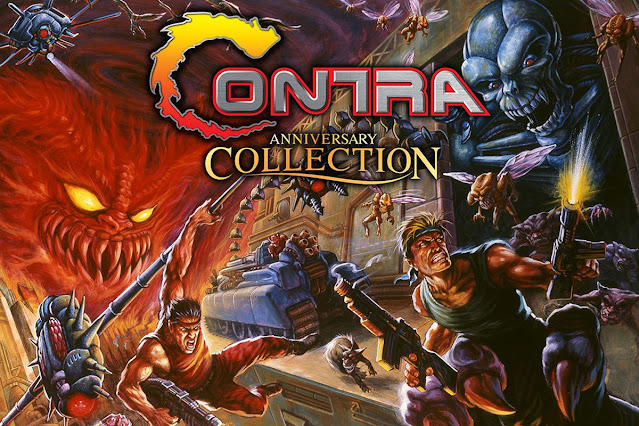
The Anniversary Collection features every game I've mentioned so far.
So far so great. It is easy to see how Contra became one of the most respected video game series. But what I haven't talked about is the elephant in the room, the one that nearly killed every legacy franchise. Yes, I'm referring to the increasingly-maligned 32-bit generation.
This would be considered the darkest era of the franchise's history. In fact, between 1995 and 2002 there were more canceled Contra games than actual series entries. Instalments for the N64, Gamecube, PS2, and Xbox, never managed to get off the ground, while only two PS1 and a single PS2 entry released in that time frame. And only one of these was even good.
For some reason, Konami treated Contra like trash after 1994. It happened to a lot of classic 8 and 16-bit franchises. No one really knows why. The franchise was handed to external teams, b-teams, and had weird ideas attached to them (In no universe does a Contra Online make any sense) and none of it worked out. All of this can be seen in the two PS1 entries that actually did release and were declared non-cannon as fast as could be done.
Instead of fast-paced 2D games, these entries were clunky and slow 3D games that missed everything making the original games such enduring classics. These two PS1 entries came out in 1996 and 1998 and did a lot of damage to the franchise's legacy. Much like the 3D Castlevania games damaged that series, the same was happening to Contra. By the time the PS2 released, it was in danger of being forgotten.
Konami then grew a brain and brought in Nakazato to direct a Contra game in an attempt to salvage this mess, which is exactly what he did. Contra: Shattered Soldier returned the series back to its 2D roots, a fast paced shooter, though this one was more of a boss rush than ever before and the story is typical '00s era Konami silliness filled with stupid retcons to series lore and pointless convolution that would only continue into Neo Contra, the PS2 sequel. While these were good games that did much to re-right the ship, they still had plenty of flaws they shouldn't have had.
All it did was highlight how much gaming had changed. Electronic Boutique's at the time were getting tons of returns on Shattered Soldier because the game was "too hard" and it being in a 2D perspective was a big no-no to game journalists. Because of this, it felt like it was already too late for Contra. The industry wanted it out. the deafening silence on the franchise after Neo Contra seemed to confirm that it was finished. It was time to move on to AAA garbage only.
That is why 2007's Contra 4 for the Nintendo DS was such a surprise. It was against every single thing the modern industry was heading towards. It was a deliberate return to roots, long before the 2D indie onslaught happened.
Konami even got a studio known for quality 2D games to do it! Contra 4 was made by WayForward Technologies, creator of the Shantae series, and was a deliberate attempt to shed all the stupid baggage the series had accumulated since the early '90s. And, boy, was it welcome.
The game is a simple straightforward run and gun game with plenty of platforming. There are some set pieces like in Contra III, and they even included improved weapon stacking and upgrades from that entry, but otherwise the game structure more clearly resembles that of the original two games. In fact, it clearly uses the NES version of the original Contra as its biggest inspiration. It learned all the right tricks. Deliberately calling it Contra 4 was a smart move as it not only harkened it back to the simpler gameplay and aesthetic of the most well known entries, but it allows the game to have a focus the series hasn't had since the 16-bit wars ended.
Contra 4 is possibly WayForward's best game, and one of the best in the series. It is only a shame it has never been re-released in near 15 years. It was the shot in the arm the franchise needed.
Unfortunately, it wasn't too popular. We all know what was happening in gaming during 2007, and a game like Contra 4 was simply not in vogue at the time. Because of this, the series faded from focus as gaming moved away from being about challenge and instead about lackluster D-grade stories. It's a shame, but it is what it is.
And after this point the series more or less became niche, putting out a game every now and then (though sometimes, like with Hard Corps. Uprising, they still manage to be top shelf) not unlike other seminal Konami franchises such as Gradius or Castlevania. Classic gaming was kicked to the curb, but it doesn't matter.
True classics will always be classics.
Hard Corps Uprising is a prequel to Contra: Hard Corps., and manages to live up to it.
So while the original Contra for the NES is one of the best games ever made, so too are most of the other games in the series. There aren't many long-running franchises with as few entries as this that still manage to have near a dozen titles worth playing, but Contra is one of them. Chances are, if it says Contra on the box you are going to have a great time . . . unless it's in 3D, that is. Then your chances aren't so good. Otherwise? It really gets better than this.
Are you a gamer in need of challenge, the likes of which you've never seen before? Then Contra has exactly what you're looking for. Don't sleep on this classic series!
The best games challenge you to better yourself and top new seemingly insurmountable odds one after the other. Few do it as well as this series does. Most of all, this contributes to making the series one of the most fun you can encounter.
One of the genres that doesn't come across so well these days is cyberpunk. It has just gotten a good deal less imaginative than it once was, relying on leaning on the way the modern world looks without much else to say or do. Where it was once a possible look into where the modern world might head, it ended up becoming a flat and muted dystopian present without much in the way of the blood and dirt cyberpunk needs to justify itself.
But it didn't used to be this way.
Take Perfect Dark, for instance. A video game from the year 2000 on the Nintendo 64 at the end of the console's lifespan, it remains one of developer Rare's highlights even two decades removed from its original release. This is a game that nailed the cyberpunk feel of a familiar yet alien future where things aren't quite right. Even twenty years later the game still looks futuristic enough to be a look into our future.
However, it is the gameplay that makes it what it is. Even on the N64 it was ahead of its time, and remains so now even as the genre has since sunken to having the ambition of a doorknob. What makes it one of the best games ever made is its ambitious nature.
Finding Perfect Dark today is not so easy, though.
After its original release it didn't get much in the way of attention. The game has since been re-released by Microsoft on both the Xbox 360 and in Rare Replay for the Xbox One which fixes the framerate, gets rid of the fog and blur, and otherwise leaves the core game alone. It no longer needs the N64 expansion pak just to access game modes. If only more companies would learn to upgrade their early 3D games this way.
But I'm getting off the trail. What is it that makes Perfect Dark special? For that we need to go back to the genre's start.
In 1993, another of the best games ever made was released. DOOM more or less took over PC gaming, helping to turn it into a force for creativity at a time when consoles and the arcades were unstoppable. It was a genre more or less based on playing out the final shootout from Death Wish 3. Being that action movies were still big in the early '90s, the genre exploded in popularity. This led to the rise of the First Person Shooter, which soon became one of the staple video game genres in mere years. The 1990s were their creative peak, and Perfect Dark came at the tail end of this high, before their dip a generation later and their creative bottoming out right after that.
In a first person shooter, your goal is to navigate a 3D space to either find something, or reach an exit, and you use your guns to blast your way through anything that stands in your way. It's a very simple formula that relies heavily on level design and shooting mechanics to make it work. Without those, the genre just doesn't work.
However, by 2000 there were already many wrinkles in the genre from the pseudo-RPG of Strife to the cinematic scope of Duke Nukem 3D. Even though they changed things up, they never lost the focus of the genre in question. What all these games had in common was a heavy emphasis on exploring large levels filled with tough enemies to hold the player at bay. This is what makes the genre stand out from the crowd.
Eventually the FPS would lose its way by the time Call of Duty 4: Modern Warfare came out and sucked up all the oxygen in the room. Every game had to be like that: highly scripted hallways with little in the way of player interaction with the environment.
But before the first HD generation the focus was on hardcore gameplay and testing the player. Rare's shooters for the N64 were no different. Where now one complains of consoles "ruining" the genre, Perfect Dark had none of the worst concessions modern developers put in their games. You could carry an arsenal of weapons and gadgets, you could get lost in the levels, and there was no hand-holding whatsoever. It stacks up to the best.
The game deserves its reputation as a classic FPS.
From the remaster
In GoldenEye 007 for the Nintendo 64, Rare added a superspy-twist to the proceedings by adding in a good bit of stealth, and accomplishing objectives (which change depending on difficulty level), as well as a cinematic presentation around the levels. Perfect Dark followed up on this by having voiced cutscenes between levels, bigger stages, a more robust multiplayer (with bots!), and far more inventive weapons and gadgets, with a bonkers story. It was a proper sequel to GoldenEye, and outdid that mega-seller in every way that counted.
Perfect Dark is a first person shooter starring super-spy Joanna Dark, as she gets embroiled in a convoluted plot involving corporate conspiracy that ends up spiraling into dealing with the existence of aliens. You sneak around highrise skyscrapers, hidden factories, cyberpunk backstreets, and alien ships. It's completely over the top and insane, but what is important is that is a followup to the phenomenally popular GoldenEye 007 for the N64.
Perfect Dark pushes beyond even that.
For those unaware, GoldenEye 007 is a game based on the movie of the same name in the James Bond superspy franchise. In that game you are tasked with being James Bond and working out missions from, and based on, the movie of the same name. You go through challenging stages swarming with enemies and obscure objectives that test your mettle. It goes without saying that the game was a massive hit. No other game at the time was as good as allowing the player to play a character as well as GoldenEye did. This then set the James Bond franchise to have a long-running video game series of its own, but none by Rare.
However, while I enjoyed GoldenEye at the time, and still think its campaign is very well designed, I think Perfect Dark is the far superior game. It is an unpopular opinion, but it's one I will stick by. I don't rate anything on nostalgia, but how well it succeeds. Even without its re-release, Perfect Dark was just an improvement over GoldenEye all the way around.
Without the license surrounding it, Rare had to be creative and come up with its own world and characters, and they did it in spades. I'll get to just why that is, in a moment. Suffice to say, they went all out and created a game many are still waiting for a proper sequel even now. There is a very, very good reason for that.
This is still Rare's best game even years later, in my eyes.
The music is perfect, too
First, I have to say that Perfect Dark is very ambitious.
If we take a look at the gadgets and weapons, we have an alien sniper rifle that fires through walls, a gun that makes the victim sick, a rifle that turns into a proximity mine when thrown, a crossbow, throwing knives, different types of mines, grenades, and my personal favorite, a laptop that turns into a gun that then turns into a turret when thrown against a wall. You can also fistfight and knock fools senseless, if you want. Not to mention that every single weapon has an alternate firing mode, technically doubling the amount of weapons that can be used. Modern FPS games wish they had as much variety.
Then there are the many different modes. I can't remember the last time an FPS offered so much to gamers. It might have been the last Timesplitters game--which was developed by ex-Rare guys. There is much for both single player and multiplayer.
Not only is there a co-op mode for two players, but there is also a counter-op mode. In this one the second players takes control of weaker enemies and must take the player down before they complete the mission. When the second player dies he respawns as another bad guy on the map, thereby evening the odds. For a Nintendo 64 game to do this is awe-inspiring on its own, but that it works quite well as a mode is even more impressive.
This is in addition to the 4 player split-screen multiplayer that also allows all manners of bots to compete. You have a plethora of maps from parking garages, to alien temples, to Area 51 sites to cyberpunk factories. Also included are some of the best maps from GoldenEye. On the N64 the slowdown of all this content allowed the game to chug, but the remake fixes all this to make it smooth no matter what you wish to play or do. With friends and bots, the sky is the limit in Perfect Dark. GoldenEye does not even come close.
In addition to that, there are many additions to single player beyond the 9 base missions (split into 17 levels) including bonus missions once the game is completed.
Of course, playing the missions on higher difficulties also changes and adds objectives, thereby opening up the maps more and altering the experience a good deal.
You can wander the Carrington Institute from the main menu which is a hub before those became more standard for FPSes. You also unlock classic weapons from GoldenEye (renamed, of course) by competing and getting good scores on the firing range in said hub, and wander around Joanna's headquarters for fun and for Easter eggs.
The game is stuffed with things to find and do.
The first stage
All this is buoyed by the fact that the core gameplay just feels smooth to just play. Joanna slides around catlike, making sneaking around fun. Her playful attitude makes her a likeable protagonist that you want to hang around with as she goes on adventures
The AI is good enough, and silly enough, to know how to react to the player's actions from rolling out of the way of fire, to running for alarms, to having dramatic deaths with cheesy one-liners that make you feel unstoppable and like a superspy. Every shot you fire has weight, as they always either prevent an enemy from firing back, cause them to drop their own weapons, or die in an over the top manner. You always enjoy shooting in this game.
The atmosphere of Perfect Dark is perfect cyberpunk from immaculately clean office buildings and offices, to chrome-plated factories, to dirty and decaying backstreets and hidden underground tunnels. The incredible synth music sells it, too. The cheesy voice-acting gives the entire affair a b-movie feel without having to rely on the hallway and scripted design of overly serious modern shooters. If you play this one you will be guaranteed an experience like no other.
It really is a shame Rare only made a small handful of shooters. Aside from the Timesplitters series a few years later, which is not quite the same as these, nobody made games like they did at their peak. It is tough to nail ambition and enjoyability in equal measures, but they did it here.
However, I wouldn't recommend playing the game on an N64 today, just as I wouldn't for most 3D games of that era. The 32-bit console generation's 3D games have aged horribly and are really tough to play today. They all suffern from some combination of tons of slowdown, blur, fog, or sluggish control. Perfect Dark is no exception to this.
I would instead recommend finding the remake 4J Studios made for the Xbox 360, re-released in Rare Replay for the Xbox One. As said before, it is the remake all 3D games from that era should have: leave the core gameplay alone and simply polish and eliminate performance issues. This is the one you want to play, and is the way the original would have been without hardware limitations.
Because as it is, Perfect Dark is an excellent first person shooter, and in my opinion is one of the best. It's actually in my top ten.
In an age of brown gray hyper-serious overly-scripted sleeping pill shooters, Perfect Dark has only gotten better with the passage of time. We have plenty of "Boomer shooters" in 2020 that take inspiration from classics like DOOM, Quake, and Duke Nukem 3D, to create new experiences from their base, but nothing yet that has reached for the eccentric heights of Perfect Dark. In other words, there isn't anything like it.
But if you want the fun of being a superspy cyberpunk dealing with evil corporations, cheesy one-liners, and strange aliens named Elvis, then don't pass it by.
Games like Perfect Dark validate the existence of video games as a medium. Fun is fun, and they don't come much better than this.
We're living in an age of nostalgia. That much is certain. However, what is the substance of said nostalgia? Is it centered around the good feelings and memories involved or on the products themselves? Do we even know? I can't answer that, and yet I doubt the entertainment conglomerates know either. It will require years of cultural studies to find out just where this whole thing came from and why no one can define it in concrete terms.
But the truth is that the past we all remember wasn't some Golden Age where everything was perfect and the sun always shined bright on the world. There were plenty of terrible things, and we know this. Remember Friends and Survivor? Try watching them now. Those haven't held up too well, and you won't find much argument to the contrary.
Some things simply don't age well, and sometimes those in charge completely misunderstand that. And sometimes they're more interested in re-purposing the old for sinister (and not-so-sinister) motives. Then, just as now, there existed a media that wanted to weaponize art and slander the past to create it. Either way they tend to misunderstand what made the original product hit the mark to begin with.
Even as far back as the '90s there were those who attempted to control discourse by gripping nostalgia by the throat and choking the life out of it. You don't have to look much further than video games and the attempted murder of 2D gaming.
It might have fallen down the memory hole for the general culture, but for those of us who didn't jump and clap our hands at the newest shiny toy on the block it remains fresh in our minds. An entire industry, and its sycophants tried to erase a genre overnight. Yes, this happened, and people in the industry deny that it ever occurred.
*Special mention must be made of several comments solely blaming Nintendo and/or saying this propaganda effort doesn't matter now. If you want to know why your hobby is a multi-billion dollar industry and is still dying then you can blame yourself for being completely unable to discern symptoms of the issues destroying it.
For those unaware, in the mid-80s when the video game industry was on its last legs, Nintendo came out with the Nintendo Entertainment System, a video game console that saved the industry with its focus on quality and stamping out the clutter and junk the shelves had been flooded with. The effort wasn't perfect as some quality was blocked from release and trash still slipping through the gates, but Nintendo's focus helped the hobby gain footing again.
By the mid-90s, video game systems like the Sega Genesis, Turbografx-16 and Super NES, had come around and raised the quality of the medium by putting fun first and creating the single best console generation of gaming to date. These systems proved video games were sticking around.
However, that was not to last. You can read the article to see why things changed and why the move to 3D was wanted by different companies, but it was inevitability either way. 3D was new and there were things you could explore with it that you couldn't in 2D space. I don't blame Sony, Nintendo, and Sega for pushing 3D (but I do blame Sony's anti-2D policy as directly harmful. Sorry, Dualshockers, we missed out on many 2D games because of Sony's censorship and no one in the industry ever calls them out on it) because there had never been a 3D console before. As far as selling points go, it was a great one.
What was damaging to the industry, however, were the game journalists who for the first time revealed themselves as corporate slaves more interested in pushing some nebulous form of progress while burning its roots to a crisp at the same time over promoting what the customers wanted. They deserve to be called out over this.
You see, 2D gaming is why the video game industry exists at all. It's where the medium started, where the top franchises emerged from, and where genres (including first person perspective games) were born. Without 2D your favorite video game would not exist because the medium wouldn't.
And game journalists fought to kill it. I had personally gotten into arguments on the internet as a boy with these very people who would give good ports of arcade games lower scores for being arcade games, lower price be damned. I'd seen 2D platformers degraded for being 2D platformers. I watched as sprite games were outright dismissed because they weren't overly blocky polygons. All this when less than five years prior games like Contra 3 and Axelay were praised for the inventive use of sprites and scrolling. Now these games suddenly didn't matter?
Meanwhile these journalists pushed 3D as the future of gaming and a step towards some utopian future for the hobby. Why both couldn't coexist was a mystery to me at the time, and it took until the Nintendo Wii (much to the chagrin of game journalists: they hated the Wii) and New Super Mario Bros. Wii (which IGN even wrote an article decrying Nintendo for releasing) being the highest selling game of the generation to show that audiences still wanted 2D. Because game journalists wanted it dead and relegated to 5 buck indie games. They didn't care that the audience made NSMBWii a higher seller than every Call of Duty game--they wanted their industry the way they wanted it.
Because of the success of that game, 2D came flooding back. One year after Mega Man 9's success and 2D was allowed to live on consoles again after being quarantined to handhelds (and with the rise of the Nintendo DS and then 3DS it was already being replaced by 3D) and saved from extinction. Years of quality games later and 2D is alive and well again.
No thanks to game journalists.
And with the recent success of the NES and SNES Classic, with the announcement of a Sega Genesis one, with affordable arcade cabinets coming into fashion and being sold at Walmart, with classic gaming merchandise selling higher than ever, the question remains. Was the audience actually tired of 2D, or were they simply not given a choice to get sick of it?
Because as much goodwill as the 8 and 16 bit generations have, the following one does not have anywhere near their popularity.
The uncomfortable truth is that 3D games from the PlayStation 1, Sega Saturn, and Nintendo 64, have not aged well. While many games came out for those systems that were great, they suffered from problems later systems never did and it hampers playing them today or with fresh eyes. If there is a generation of gaming that deserves to be totally remade with modern hardware it is that one.
Ironic that the most "important" and "advanced" console generation aged the worst of any, but there it is.
But the generation before it? The SNES, TG16, and Genesis, have aged perfectly well. In fact, there was room for improvement. The SNES had problems with faster games, the Genesis couldn't output as much on screen as the SNES, and the TG16 was weaker than both despite the CD attachment giving it a boost of Redbook audio. Systems like the Sega CD and the Sega Saturn showed where 2D could have gone with multiple levels of parallax scrolling, large sprites, and imaginative and bright art design, but were too enamored with a graphical arms race that amounted to nothing in the end to pursue it. That road led to bloated HD gaming costs, closed companies, oversized teams, and a decrease in output from studios. But at least every game looks as exciting as a National Geographic photo. That blind obsession with progress is what led gaming down the hole it's currently sitting in. The pursuit of 3D derailed the hobby.
So why are gamers nostalgic for the past? I wouldn't say they are, actually. I'd say the 8 and 16-bit generations remain popular because they are objectively the best generations in all of gaming. It was the one that hit worldwide, where genres flourished, and where quality was more important than technology. It's the 32-bit generation that requires nostalgia to enjoy to its fullest, and the trends started under it are what led to every modern problem (Save DLC) that is currently stagnating the industry from cinematic obsession to a focus on "realism" at the expense of player agency and fun. There is nothing to miss from post-16 bit console generations because everything they started still remains.
It isn't that people think the past is better but that the present is so terrible that they have nowhere else to go, and that is because of a pointless and obsessive worship of the future that buried it all to begin with. When you stray off the path you need to retrace your steps to where you first got lost to find your way forward again. You don't blindly plod along in the dark toward the coyotes howling over the next hill. You know what they say about doing the same thing multiple times and wondering why you get the same results.
Maybe this will serve a lesson for Gen Z coming from Gen Y and Millennials not to believe the hype. The hype is not on your side. Eventually it will turn against you.
And the problem has not been remedied.
Yes, we can say games like Cuphead exist now and sell gangbusters so the stigma against an entire genre isn't a problem anymore. But that would be a lie. Entertainment was disposed of for the simple reason that it was declared outdated by someone other than the customers. We were never given the choice.
The fact of the matter is that it happened, and could very well happen again. In an age where journalism is losing credibility due to hacks and liars working against their customer base, we must remain more vigilant than ever. They're not going to stop doing the same thing over and over.
Pulp, 2D gaming, action cartoons, adventure movies, and comics as a whole, have all suffered heavy blows from groups of people who hate what they stand for and will do anything to take them away.
None of this is anything new, so don't be surprised when they try it again.
Don't forget, because it's not over yet. Nostalgia cash-grabs exist because of the feelings corporations are hoping to invoke, not because they want to continue the lineage of the product you enjoy. That's not necessarily a bad thing, but it is when those involved don't understand the appeal to begin with. That is how you take a billion dollar franchise and within three years release a movie that can't even break even. That's how you know they don't get it.
The truth is we're not in any Golden Age right now, but we have the tools to make one. While those who dislike us and wish to pilfer the last remaining bills from out pocket as we walk by their foreclosed business look at us with scorn, we actually do know what we want.
We don't want the past, we don't want the present, and we don't want the future. We want all three at once. And if you don't understand that then maybe that's why modern art fails to connect with so many people.
Screw your bloodless manic-depressive Utopian paradise. We deserve better.
I have two recent stories out in Storyhack #3 and one in DimensionBucket Magazine. If you are looking for good old fashioned action and adventure stories like they haven't made since the '90s then I've got you covered.
For anyone who played video games in the 1980s and 90s, they can clearly see what this is.
It's a small version of Nintendo's very first console (the one that saved the industry) pre-packaged with 30 games, and with HDMI ports for those who have those newfangled TVs. And, personally, I think it's a great idea.
Just looking at the list of games, you would be hard-pressed to deny any of their importance:
Balloon Fight
BUBBLE BOBBLE
Castlevania
Castlevania II: Simon’s Quest
Donkey Kong
Donkey Kong Jr.
DOUBLE DRAGON II: THE REVENGE
Dr. Mario
Excitebike
FINAL FANTASY
Galaga
GHOSTS’N GOBLINS
GRADIUS
Ice Climber
Kid Icarus
Kirby’s Adventure
Mario Bros.
MEGA MAN 2
Metroid
NINJA GAIDEN
PAC-MAN
Punch-Out!! Featuring Mr. Dream
StarTropics
SUPER C
Super Mario Bros.
Super Mario Bros. 2
Super Mario Bros. 3
TECMO BOWL
The Legend of Zelda
Zelda II: The Adventure of Link
Now, one could quibble with omissions. The lack of Contra, Crystallis, Adventure Island, Ninja Gaiden II, Castelvania III, or Jackal, is fairly inexcusable. But, the line up is a good summation as to what made that era of gaming so great, and why the system essentially built the whole industry.
Looking out at the current crop of grey and brown military shooters with ham-handed plots and comparing it to what built gaming in the first place, is a real eye-opener.
The list includes puzzle games, adventure games, fighting games, action games, racing games, sports games, and simple arcade style games. That's more variety than you'll find on your average Gamestop shelf these days.
But let's use one example.
It is my opinion that the NES version of Double Dragon II is one of the best, most underrated games of all time. The stylized graphics, music, and overstuffed controls, gives off a sense of wonder and creativity to the setting that I never get tired of.
Also, unlike the mediocre arcade version, this one has an actual ending, which is pretty rocking. Listen to that final boss music and raise your fists in triumph!
In an era that takes itself too seriously, while not taking important things seriously at all, it is a nice reminder that we can still have fun while being lifted up at the same time.
It's more than just nostalgia. Once games entered the 3D realm, it became harder and harder to find games with a sense of wonder or pure fun as the years went on. You can even look at a fairly early 3D adventure game like Thief and compare it to the recent mediocrity of Dishonored to see all the joy sucked out.
So, good luck to Nintendo on this. Hopefully it is enough of a success that the SNES, N64, and Gamecube, and get the same treatment. And hopefully their next system is a reminder to them, as well as us, what made the hobby so much fun in the first place.
Before I go, let's put one more Double Dragon track out there. Because, why not?