Been a bit since the last one. There's been a lot going on behind the scenes, so it's been tough to sit down and make one of these. Hopefully today's post has been worth the wait.
For a while I wanted to write a bit about the Telecommunications Act of 1996 and what it did to modern music. It is more than you might think. One could just list it out point by point and talk dryly about the result of the bad decisions that lead to the Act, but as the modern internet has proven, something like that just isn't going to fly. Instead, give a watch to the above video to understand the decisions that lead to it and get a load of some of its fallout in the process. After that we can move on to the rest of this madness.
It's hard to really emphasize what the '90s was like for music unless you were there, and I don't mean that in an old man sort of bragging. It was a different planet. There was a period where you could hear anything at pretty much anytime, and it was always new. Anything from metal to swing music could have been found on the radio or the TV, and obscure bands could be found under even overturned rocks. Much is said about the high quality of mainstream music from the '50s to the '80s, and it was definitely high quality, but where the '90s excelled at, at least, for a time, was the sheer variety one could find. It is a hard experience to describe.
However, it didn't last. Something shifted, and it shifted hard. By the end of the '90s, all of that disappeared, never to be seen again. You would no longer hear an oddball band like Squirrel Nut Zippers or a random blues song out of nowhere. Instead, you would hear the same 20 songs on repeat, on every radio station and every music channel regardless of the "genre" of the station or music in question.
It actually happened around the same time Napster took off, proving God has a sense of humor. Once the industry decided you couldn't have what you had five minutes ago, the audience started to leave. This is always overlooked when legalistic boomers and music industry sycophants talk about the negative effects of Napster and file sharing: they act like it occurred in a vacuum, and it most certainly did not. This was probably the first indication that the monoculture was over, and no one realized it at the time.
I can give an idea of how this artificial infection spread even outside the US, showing it was a philosophical battle, and not just industry whim in one country. Canada's own YTV once had a show called The Hit List which was a music show that promoted bands and music from all over the spectrum. If you were a kid in the '90s, you watched this to keep your finger on the pulse of the music world. By the late '90s, the host, Tarzan Dan, was replaced with young women who only promoted the same groups you saw on MTV and heard on the radio, seemingly out of nowhere. It all happened at the same time as what happened down south.
Not only did I include the interview discussing what happened at that time in the free Gen Y book from awhile back, I also posted it on Wasteland & Sky itself.
Here are some excerpts:
Tarzan Dan Freeman: "When I did [The Hit List], it was one of those things where you could hear Blur and Smashing Pumpkins, and you could also hear the Spice Girls and the Backstreet Boys, and people still watched the show, and it had massive, massive numbers. The other side of it was, we didn’t have as many cable channels back then, or music-based television shows. We didn’t have social media, and email was just new, so it was where people went to find out about the newest songs or to see an interview and hear about music beyond radio….
"For us to be there when the Spice Girls came up and became massive, and Backstreet and ‘N Sync and all those different groups, be it rock and pop and dance or whatever it was…the ’90s were great, because everything that came out was played. It wasn’t just a genre."
That is what it was like growing up in the early '90s. In your mind there was no limit to what you could do or how far you could stretch. It was a much different way of seeing the world than what is currently pushed. That all changed, though.
As he would go on to say:
Tarzan Dan Freeman: "If kids started watching [The Hit List] when they were 12 years old, and when I’m leaving they’re 19 years old, then all of a sudden they’re outside the demographic. What we noticed was, the demographic was aging. When I left, they took the show off the air for a couple of months, and they came with plastic furniture and a couple of female hosts, and it was really about young boy bands or Aaron Carter, that kind of thing—really pop, ear-candy type of music that was more geared towards the kids. [JD: This was 1997, by the way]
"Originally the show was going to be cancelled, because the show had run its course and had gone on for quite a while. What happened was, because I’d been there for seven-ish, eight years, and the demographic had changed, I think when they decided they were going to bring the show back in a different form, I was too old for the show. Because for me to go back and go “Here’s Aaron Carter!” after I’d just been playing Smashing Pumpkins and Blur and Collective Soul and Creed, and then to go, “Aaron Carter’s the best!”…y’know, we could still play Backstreet Boys, but I think what would have happened is, my credibility would have been somewhat crushed."
And that's what the shift was like at the time. If you were a Gen Y kid who grew up with all this stuff, suddenly you were treated as if you no longer existed. There was no longer a place for you. All of a sudden, backs were turned to you. It was as if you no longer existed. It was as if you woke up one day in a new reality where the old never happened, and you were expected to not remember it, because why would you? That's not Progress.
All this to say that the cultural shift was huge. Over night everything you liked was not only gone, you were also not supposed to notice it. You either embrace it and forget everything you grew up with, or you move on. They were telling you to go away. In a monoculture, you can't exactly do that, though. There is either the crowd, or there is nothing. This wasn't the same as "countercultural" movements like punk or goth that had to be chosen willingly: this was a generation of people now told they no longer existed. So what exactly did everyone do?
They did what they were told: they disappeared.
Enter the internet. Napster and general online piracy took off before even 9/11. If the culture not only didn't respect you, but was willing to tell you what you could be, the response for a Gen Y kid was to give them the finger. No one was going to tell you who you were through the thing that was your whole world. We took our media consumption very seriously back then. We delved deeper into Our Media, made online subcultures around it, and sneered at the growing mainstream that was, coincidently, starting to push Geek Culture (which a lot of these same people threw in with, to the same result of their earlier trust in the system), before the mainstream itself tried to cash in on them with new terrible Terminator, Ghostbusters, and Transformers movies. Gen Y, throughout our entire existence, has never quite shaken our dependence on corporate IP.
We consumed, were thrown out, clung to it from the fringes, and when those decisions came to bit them in the rear, we forgave them and allowed them to sell slop with the skin of what we truly worshiped, like an even more pathetic Tashlan. Though, like everything, it came with diminishing returns as many realized what was being done, and finally decoupled from the parasitic relationship. The memberberries are not as strong a draw as they once were.
It did eventually come at high price. Losing trust of the people in charge and forcibly carving your own path into the wilderness divorced from the culture made sense at the time, but no one considered the consequences. Gen Y's choices were as fractious as the mainstream, and in the end helped lead us to where we are.
What did it lead to? Stuck culture.
And that's where we are now.
I'm obviously not defending the mainstream's act or the reaction to it, but that is the consequences of having a culture that is throwaway and purely cynical towards its audience. People deep down want to belong. They want to belong, but they also want things that matter. At a certain point, culture stopped being about anything connected to the human or the community experience. Even the dumber trends in the '90s at least tried to sell kids on it being cool and belonging with your friends. Now it hardly feels like they care if anyone buys anything, which is probably true but outside the scope of this post. Abandon your original audience at your own peril.
But that isn't sustainable. A culture of nothing leads to nothing and creates nothing. We still haven't had '00s nostalgia becoming mainstream despite recently having the 25th anniversary of 9/11. We won't have it ever, but it's important to realize it is because the '00s was when the last bits of shared culture frayed and split. No one is going to have nostalgia for that except kids remembering private experiences. Especially when all those media properties from that time have never gone away. What else is there to pine for?
What is to be nostalgic for that isn't a personal, which means isolated, memory? I see a lot of nostalgic posts about desk setups and old phones, but what else? Not a whole lot that you can't easily find one click away.
The '90s were also not where this all started. As I've said before, the '90s were only good if you grew up in them. The media for kids was high quality, society was still high trust, and everything was very affordable. It was the period just before the internet, social media, and phones overtook everything. It was the last time a kid didn't have to grow up in a bubble of electric unreality all the time. Everything else about the era, however? Not too good.
The point is to be aware of how things can change out of nowhere, and how you're expected to just accept the shift or be erased with it all. You are not a person, but a consumer, and that is all you will ever be. That isn't the sign of a healthy society, but one already on its way down. And that is why we are where are today.
But I don't intend to go quietly into that night. I'm going to keep doing what I can where I can, and I hope you continue to do the same. Giving up does nothing for no one. Besides, if things could change like they did in the first place, who is to say what tomorrow might hold? Anything is possible, after all. We have living memory of a time where that was true.
That doesn't mean I'm ever going to like late '90s bubblegum pop music, though. It was bad back then and has aged even worse when the music industry never left it behind.
I think I'll go listen to my Collected Eurodance vinyl instead. What is Love and Rhythm of the Night never get old. And neither does the real stuff. Never forget the real stuff.
Given recent heated discussions, I figured it would be best to bring the temperature down a little, and talk about something a bit lighter. We can all use a break every now and then, right? In fact, I wanted to talk a bit about physical media in a way that does not get talked about much anymore. Let's not talk about practicality or physical quality, but something else entirely. I want to show in example of what makes it special. The above video is tangentially related more to show how little I'll be talking about audio quality in today's topic, because I think too many get hung up on it.
For anyone who has followed me for any amount of time, you are aware that I am big into music. Since I started being able to as a kid back in the '90s, I have amassed a pretty good CD collection that, despite bizarre attempts at fearmongering in recent years, is still perfectly functional today. Mostly because I take care of them. Regardless, this is to say I've been at the game for around three decades at this point. While my CD collection is more or less complete (I still have a few more Rhapsody albums to get), I still go out of my way to try to hear stuff I've never heard before.
I tend to focus more on rock music and its many subgenre and spinoffs. It's just what has always clicked with me the most.
Not too long ago, I had an epiphany. I realized that with vinyl records becoming ubiquitous and affordable for the first time since before I'd actually started collecting music, I could finally get into them myself. Obviously I wouldn't be able to ever match my CD collection, but I didn't want to. There was no reason for that. I had always wanted to get my absolute favorite albums in the format, and now was my chance. So, I went for it.
You see, for anyone younger than Gen X, vinyl has been a dead format for the majority of our lives. It was elbowed out in the late 20th century format wars by CDs (cassettes suffered the same fate) as antiquated and limiting. It was not progressive enough and there were too many rough edges in the format. Records were clunkier, held less music, were more fragile, and a bit of a pain to store. CDs, they said, would solve all those problems. They did. CDs are easy to use, hold twice as much music as a vinyl, are much more durable, and very easy to store. There's a good reason mine are still in pristine condition, some bad jewel cases aside. Essentially, CDs were the most obvious step forward, the progressive choice for music listening. Eventually that would move over to streaming, but as far as physical media went, CDs were considered it.
Then it might shock you to hear this as someone who hadn't heard vinyl since I was a child and never owned any myself before relatively recently that I actually think it is the greatest physical format for listening to music and that all its limitations are its strengths. And it's not for the reasons you might think.
The weaknesses of vinyl are actually its strengths. I know that's confusing. You're going to have to put up with my logic as I explain it.
The reason for this is that all the conveniences of CDs are actually a drawback for the listening experience that only multiplied when streaming came along. In essence it was a downhill slide to get here, though I will admit that CDs and the like do have their uses for travel or exercise. That said, for listening to music as an activity? They are not as good as vinyl. Let me explain just why that might be with a few points you might not have considered.
If you've never used vinyl before then you might be surprised as to how much set up there is to getting one to play. Slide the record from its sleeve, keep your fingers away from the surface as you lower it on the turntable, and then start it up. But of course it doesn't quite end there. You have to put on Side A and then lower the arm (making sure the needle isn't covered first), delicately onto the record. Did it right? Congrats, it's time to listen to the first side . . . of two. Vinyl rarely contains more than 20-25 minutes a side, which means you are going to have to stick close to the player and make sure you're there for all of it. Also, of course, to make sure no loud stomping or pushing of heavy furniture happens nearby to disturb the record or potentially cause skipping. This does not afford you the chance to wander off to do anything else. You will be there for the 20 minutes or so of Side A, paying attention. After this, you will do it again with Side B, making sure you're paying attention to the entire album. Here it is time to finally lift the arm and remove the record, once again handling it delicately and avoiding dust and dirt (or possibly cleaning it with your brush) before putting it away again.
Get all that? It's a process.
The end result of all this inconvenience other mediums don't offer? You will be paying attention to the music first and foremost above all else. Nothing else will take precedence, guaranteed. You cannot afford to zone out around a vinyl record, which makes you need to give it all your focus. It's too delicate to be left alone for too long.
All this is why vinyl is the best musical format. The reason is it makes the listener prioritize the music and listening experience over all else, and it's the only format that does this short of attending a live show. When you're putting on a record it is because you want to listen to the record. The lack of skipping tracks, of wandering off, of putting it in the background, means appreciation of the music comes first. It will always have your priority. Yes, vinyl's sound is less flat and more rounded and spacious than digital files are, and that could be an argument itself but the real difference is in how much attention each format must be given.
A sample of my own collection
As an example of my annoying ramble above, let me tell you a little tale. One of the records I have is Hysteria by Def Leppard. You can see my copy right there in the picture. This is a 12 song album that is over an hour long. Naturally, this means modern releases wisely split it across two records, effectively making it a double album. This is an immediate improvement, even despite improved sound quality. The above process of playing all four sides made me give the album my full attention for the first time in ages. No skipping songs, no letting it fall to the background as I find myself doing something else with my free time, and no pausing it for whatever random reason I feel like I had to sit there and listen, really listen, and hear all the bells and whistles and incredible songwriting that album is filled with. As I did so I felt myself pulled into the music and the tone the band sets, and engrossed the entire time making me appreciate everything about the craft, the energy, and the hooks, all the more. It turned what I thought was a 10/10 album into an 11/10 one. It effectively made me think an album I already thought was perfect even better. All of this could only happen because of the limitations vinyl set on me as well as the different presentation of audio than what I'm used to.
It started to make sense why back in the day music was treated as more of an event, why they had record listening parties and why kids would spend time just listening to records at friend's houses: all things no one does anymore. Sure, you can have a listening party on bandcamp, but it's hardly the same thing as being in the same room and having to concentrate on all the contours of the specific sonic presentation smacking you in the face while minding the limitations to keep you focused. Without that there is a high risk of music becoming a background novelty, which is more or less what it's become today since vinyl fell away.
The size of the format itself also contributes to it. Vinyl records are large, attention grabbing, and very in your face. They almost demand to take all your attention when you look in their direction. On top of that, they are the hardest to store and take care of, as well. Basically, it's a form tailor made to be intimidating, which, oddly enough, is something that makes them all the more compelling. The inconvenience is appreciated.
This isn't so much a music hipster thing, I'm not really going on about vinyl being "warmer" as the cliche goes, but in how everything about it prioritizes the importance of its own artform before anything else. That's its biggest strength that no one really brings up.
Even the idea that the storage space is overly miniscule and was improved on with CD and then that was improved on with unlimited streaming is incorrect. Almost all of the best albums worth hearing are under 50 minutes long. In the CD era, because the limit was increased to nearly 80 minutes, albums started to become loaded with filler. This made heavy use of the track skip feature CDs added and took away from the experience described above. It made the album look weaker and feel more disposable. The fact is that the limitation of the vinyl gave albums their perfect length. A 40 minute album is perfectly paced, coinciding, incidentally, with most live shows if you take out banter and general set up. Exceptions like the above Hysteria, an album over that limit, still benefits from the fact that it earns its mammoth length: there's no filler on it at all.
Your space on a record is limited, so you have to dredge up your best material for it and be aware that the audience will be paying close attention to it due to the nature of vinyl. This sets a higher bar for music and is in fact a good reason why Classic Rock has the name it has.
Even in the CD era, albums that did not have vinyl as their primary release format, or sometimes not even one at all (essentially the early 90s through the late '00s, almost two decades), the ones that aged the best are ones that still, for one reason or another, adhered to the old rule set by the format. The best albums didn't "fill up the CD" just because they could have.
This means when these sorts of albums actually get a vinyl release (think albums like The Strokes' Room on Fire, Less Than Jake's Hello Rockview, Jimmy Eat World's Bleed American, or the White Stripes' White Blood Cells), they fit it like a glove. Even the better longer albums transition over to becoming great double albums (think Alice in Chain's Dirt, Soundgarden's Superunknown, Queens of the Stone Age's Songs for the Deaf, or White Stripes' Elephant) like they were always meant to be that in the first place. The pacing set by the limitations of the form not only make it more digestible, but allow more concentration and appreciation for what is being done. This is a good sign that vinyl got it right ages before we figured it out. We were just blinded by new tech and progress, which is a very common 20th century habit we still haven't broken.
Some could make the case that vinyl is only come back because of hipsterism, but that doesn't really explain it's unavailability during the peak hipster years of the '00s and why now it's only coming back in a big way now. If anytime would have been the time for that it would have been the post-High Fidelity snarky Scott Pilgrim era. But that never really took, did it? The reason is because younger generations want the inconveniences they never had, and older audiences are missing it now more than ever. It just doesn't hit as hard with the way things are. Experiencing what you love in a more involved way is always a good way to learn just how you like it.
All of this is a long way to say that convenience has devalued a lot of our artforms. The base level for engaging with art used to require a level of inconvenience which played into engagement, which meant most people put up with it, and they benefited. What we forgot is that sometimes inconveniences aren't bad things. Fishing out a cartridge to stick into your SNES or disc into your PS2. Taking out a tape or disc to slot into your player to watch a movie (and then either rewind or dig through menus). Rushing to catch a TV show on at a specific time or else hope for reruns in the summer. Picking up a paperback or hardcover to flip through and set down with a bookmark. These could be seen as mildly annoying or even frustrating, especially as opposed to how plug and play everything is in Current Year, but they also made these things more engaging and participatory for the audience. And most of these annoyances are just little things, but it's the little things that add up to the total and greater experience.
The easier and more convenient all these things have made things, the more it all gets streamlined into an app on a device to press and go, the less we care and the less we care about creating or preserving these forms, because now they're little more than distraction from mundanity, not art to engage or consider. This is the core of what modern slop is and why it's so hard to define: it's the end result of convenience culture, it doesn't spring out of anything else. Everything has been reduced to a dopamine hit with the least amount of effort or backlash.
To create a future of art that is meaningful, that can connect, and can grow, the old ways have to be understood, and inconvenience must no longer be seen as the greatest evil like it currently is. The warts and the difficulties are part of the experience: they add up to the greater whole. Taking that away simply takes away part of the core experience. It can't really be ignored any longer.
Life isn't convenience, and it never will be. No utopia or perfect world is ever coming. Accept the warts and realize that sometimes they aren't really warts at all. You're just too focused on the tree instead of the forest.
What we need is something real, and that means annoyances. We ain't in Heaven folks, not yet, so get used to it. We're gonna be here a while, so let's make it count.
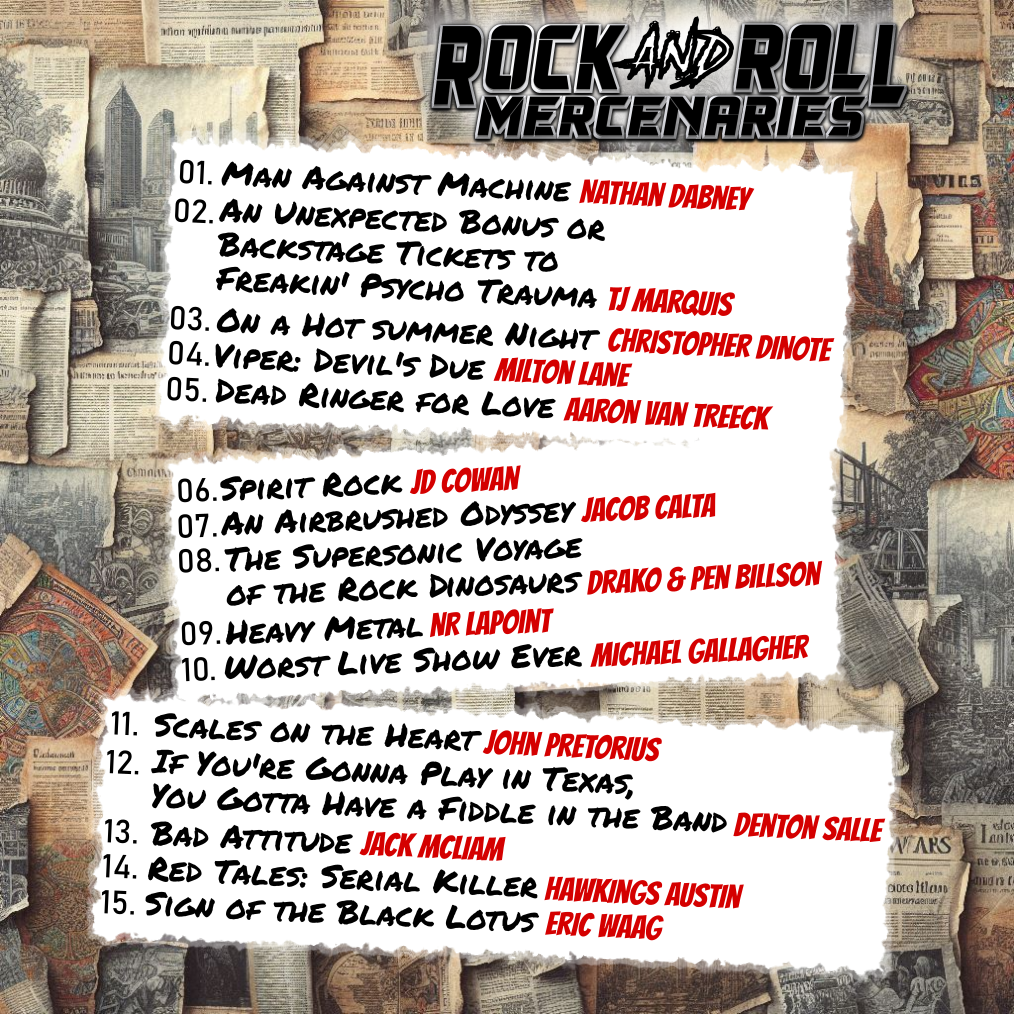
Today I'm proud to announce the official release of Rock and Roll Mercenaries anthology edited by Mistcreek Publishing, This brand new book contains fifteen exciting stories of hard rock adventures all inspired by and/or centered around the art of rock and roll music. Both a throwback and a tribute to the greatest musical style of the 20th century, and an inspiration to all the above writers, this is the kind of thing that could only come from NewPub.
You might recognize the above authors from various different projects over the years, but they all share two things in common: a love for pulp-inspired adventure stories and of the art of rock. Both of these aspects come together to form an anthology that is a celebration of two of the greatest things to come out of the 20th century as well as a look towards what might be laying in wait on the road ahead. As the world is getting gradually more and more reenchanted with has been lost by those in charge fumbling the ball, one has to wonder just how much the stories and music we lost along the way might help guide our way forward.
As the band X once said, "We knew the gutter, also the future." Despite all the sad songs, the cocky rants, the blazing fury, the overindulgent behavior, and the goofball antics, there is a truth waiting there under the surface waiting to be discovered from this nearly forgotten genre of music. If Rock 'n Roll never truly dies it will be because of that wild and carefree spirit that lies deep within its chest: a celebration of the joys of life that will never stop beating.
My stories have quite a lot of musical influence to them, some of which are even directly inspired by the music itself, and my entry into this anthology is no different. In fact, NR LaPoint of Mistcreek was kind enough to generate a song to tell you about it!
Harmonica included!
If you recognized a couple of names in there, well, there's a good reason. This tale is a new entry in my Night Rhythm stories starring the band Three Wolves. I've written three stories before, each starring a different band member. You might remember Daniel, Jordan, and Edward, three guys in a rockabilly band driving across a forgotten backwater planet in a distant future on a world time seems to have forgotten. "Spirit Rock" is a novelette starring all three, as well as their manager, who find themselves in a situation more dire than any they've seen so far.
You see, Three Wolves are a band that exist to revive a forgotten music style in a future where such simple joys are on the edge of becoming extinct, a world where even technology has been discarded for the shadows and the shade. The band got together after rediscovering such forgotten treasures and, not seeing a future for themselves where they were, decided to wander out into the world to share it themselves. It is their life's mission and calling.
The leader and guitarist, Daniel, is the one most in touch with the intangible hidden in the gaps of the world, always distracted by things he can't explain. The bassist and rational one, Jordan, is the romantic that desperately wants to see more than he can see and tends to get caught being the band spokesman. The muscle and drummer, Edward (don't call him Eddie!), is the blunt instrument who doesn't care if the threat is man or monster, but will push through regardless. Then there's the manager who is in it to give the boys all he thinks they are owed, even at the cost of his well-being. Learn more about them all in "Spirit Rock", the grandest and best of these stories so far.
The way this story came together was rather simple. I wanted a tale that brought all these characters into the driver seat and gave a reason they would all need to act individually in a crazy situation. What better excuse than discovering a legendary town on the coast that was rumored to have up and disappeared one day? Why did it vanish? Was it even real in the first place? If so, what could possibly exist to destroy it all? What is waiting out there in the wilds of this backwoods world?
And how can a bunch of dudes that can only rock do anything about it?
Suffice to say, music is powerful. The band knows it, but its not a weapon to them: it's a way of life. That said, as Silver John taught us long ago, there is power in the audible that isn't quite understandable for those limited by their immediate physical sensations. And yes, this series of stories was very much inspired by those very stories written by Manly Wade Wellman. The difference is that I wanted to bring about the mysterious and powerful force of 20th century rock music in a place where its effects had been mostly forgotten and itself relegated to legend. Unlike the false advertising technique of selling rock as "rebellion" that's been a technique since the 1960s, I wanted to bring about rock's power to break tension and anxiety and strike through like a hammer through to the truth where emotions swirl about unchecked and entangled with hope.
Rock has been used as a weapon, an advertising technique, and an aesthetic, but I wanted these stories to cut to its essence of why it is so powerful. The depths of the blues, the warmth of the country, and the heights of the gospel, all inspiring to pick you up from the doldrums that threaten to ensnare you. Rock music consumed the music world for half a century for a good reason, and it is the same reason no other musical style can seem to replace it and never truly will. Much like how classical music has its place that can never be overthrown, so too does rock have a role no other can ever really fulfil, and I hope these stories can show how that might be.
[From L to R: Edward, Daniel, and Jordan]
I've never touched much on where the band itself comes from, but I don't think it matters as much as where they are going. The short story is they come from a small town like everyplace on this world, tucked away in a corner of the galaxy forgotten for progress among brighter stars waiting for better men, or so has been said. They are normal guys like you or me inspired to climb to greater heights than they thought they would.
Just like today we have younger generations taking inspiration from a past that was either demonized or deliberately buried. The main guys in Three Wolves find life in what was thought to be dead, finding light in what they were told was only darkness, and they have discovered adventure. In a sense, it is through the power, energy, and life, in the music, that they are able to discover more of who they are. Plus, it is eternally cool. What red-blooded male does not want to be cool?
But in "Spirit Rock" they have to face a different kind of forgotten world--one much different than the one they sought to discover. I could go a bit more into it, but I would much rather you read the tale for yourself. This is quite a fun story with a lot of moving parts (four protagonists will do that) and an ending that is the most outright cool I've penned so far. Of the four Three Wolves stories released, this one is my favorite so far. Read it and I think you will agree.
Are there more stories to come after "Spirit Rock" for the band? Yes, actually. I have one half written, another outlined, and a big finale I have yet to nail down. I like these guys and I want to see where their journey through the forgotten backwoods world takes them, and I would like to take you with me through these adventures.
Of course, Rock and Roll Mercenaries isn't just about me. It also contains 14 other stories by some top notch writers who love music and pulp-inspired adventure as much as I do. It's going to be a perfect summer read, too. Make sure you pick it up today!
Welcome to the weekend! It's the last go around for 2024!
For the last Weekend Lounge post of the year I wanted to introduce you to the Cannon Cruisers YouTube channel. This one isn't actually run by me, but my co-host, and, as a result has a more modern look than the rest of our channels. It's not up to date, but the channel will be slowly updated as we have the time.
It's another alternative to check out the Cannon Cruisers, if that's the kind of thing you're interested in. We talk old b-movies, discover old classics (and not-so classics), and have a lot of fun along the way. We've been doing it for over half a decade at this point, surprising both of us. What started as a lark turned into a long term side project for both of us. I don't think we'll be stopping anytime soon. There's plenty to go over.
We've covered over 300 movies since we started, by the way. You can peruse what we covered on our Letterboxd page here.
Uploads on the YouTube channel are not our first priority right now, so if you want to keep up I highly recommend going straight to the blog itself. It was the first place we set up camp and I make sure to update it every week or when there's a new episode up.
As always, check out the Cannon Cruisers if you like or are interested in old movies and want some fun.
Completely unrelated to that, I was recently fooling around with AI music again, and concocted the following EP. It is related to a writing project I've been slowly trying to puzzle out of my end of the year brain.
The idea was to create an EP that matched the weird dour tone at the end of the 1990s and early 2000s before 9/11 or even Columbine really changed the mood permanently. I specifically chose third wave ska to do this with because of how much the genre changed over the decade and I wanted to see if I could push it in a different direction than it went in reaction to the Telecommunications Act of 1996 and the resulting Clear Channel monopoly which more or less banned it and other genres of the time from the radio. So it's an oddly reflective piece on endings since there was a lot of that as we were leaving the 1900s behind at the time.
In other words, I wanted to grab a mood that existed with a sound that didn't. Where could it have gone if things went differently? Who knows. I tried to puzzle it out here. It was an interesting little project to try out because I could almost imagine it existing, even though it didn't. and in retrospect it's kind of eerie, which I suppose was the point.
The album starts with the skate-punk inspired sound the decade started with before changing over the course of the album to being more in line with the more confident style it had by the end of the 90s when it broke into the mainstream. Where could it have gone after this, we'll never know. It was cast out of the club and most of the bands either abandoned the style or deliberately went insular, crashing the genre in the '00s.
This is a bit of a what-if, I guess.
As for how it relates into my writing, well, you probably won't see that for awhile, but a lot of it is based on a story cycle I've had in my head for awhile and have been trying to write down for about as long. So if you see lyrical motifs or lines show up in stories later on, you'll know where they first showed up. It's been strange cobbling this together. I've never quite done anything like this before, so it's been strange figuring it out.
But, really, just have fun with it. Enjoy the music, download it, remix it, or ignore it. Love it, hate it, or be indifferent. Whatever you want. It's a bit of an experiment to help me with inspiration for something else, so it's all meant in good fun. Don't take it too seriously!
Enjoy the Northbound Lights, a band that might or might not have existed from an era long gone that increasingly few remember. There's always something we can learn from those forgotten days. In this case, I don't know. I just felt like doing something strange and off the wall. You can find the End of the Century EP for free here. It might be a bit different than you're expecting, especially if you only know the genre from its oft-mocked tropes.
And that's all for this week!
Enjoy the last week of the year and I will see you soon enough!
Welcome to the weekend! Hope this season has been going well for you despite the weird weather shifts. I have a few treats for you today! The first is a song. As you can tell, I've been playing around with generators.
The above is a song I generated in the newer Udio song generator I was introduced to by TheQuQu. Yes, it's a skabilly song (Ska + Rockabilly) because it's a sound I like and a sound no band seems to want to play anymore, so I decided to cobble one together. Please enjoy it at your leisure. It was a fun one to put together as an experiment, and it's not like you're going to hear it anywhere else. Perhaps these generators have more purpose than you might think.
Regardless, it exists now!
Do whatever you'd like with the track, too. The whole point was to make a fun song to do fun things with that just doesn't exist anywhere else. Not like you're going to hear a new Skabilly band anytime soon since this sound is abnormally unpopular. I also slapped together two remixes of it on the side, one acoustic and one alternative rock, so give those a shot on the site if you're so inclined. Hey, someone's gotta do something with all these abandoned genres. If this bother you, then knock me down a peg by writing some skabilly and making me happy.
But of course, this is not why I'm writing this post today. There's more to discuss. You probably want to know about writing!
Spring 2025 Flight From Reckoning (Part 1), by Michael Tierney The American Dream, by Rodica Bretin Salt Roses, by Jim Breyfogle Waegnwyrhta, by William Suboski The Siege of Verisa, by Richard Rubin Void Railway, by JD Cowan The Demacron, by Gary K Shepherd Machine Dreams for Wired People, by Jaime Faye Torkelson Cracking the Cyber Ziggurat, by Kevan Larson In the Last Days, by James Hutchings Paying the Doctor’s Due, by William Drell
Summer 2025 Flight From Reckoning (Part 2), by Michael Tierney Tigers Dream in Color, by Rodica Bretin Black Sand, by Jim Breyfogle Heart of the Goddess, by Harold R. Thompson Melkart and the Rich One, by Mark Mellon ‘Twas Bato Did It, by David Skinner Threnody Bacchant for Ruins Demoniac, by Matthew Pungitore While the Islands Slept, by J. L. Royce Double or Nothing, by Michael Ray True Destiny, by Paul Lucas
Fall 2025 Drown Melancholy, by Stanley Wheeler Labyrinth, by C. P. Webster Ghosts in the Green, by Mike Robinson Rossoya, by Bob Johnston She Who Was the Sea, by J. Thomas Howard The Whole Wide World, by Tais Teng Ghost in the Garden, by Jim Breyfogle Troll Fen, by Ken Lizzi What’s He Building In There? by N. R. LaPoint Satisfaction, by Vincent Valkier The Merchants of Maaaw, by Mark Pellegrini Do You Wear a Bulletproof Vest, Lieutenant?, by Rodica Bretin Flight From Reckoning (Part 3), by Michael Tierney
Winter 2025 Flight From Reckoning (Part 4), by Michael Tierney A Serial Killer’s Diary, by Rodica Bretin They Always Come Back, by Frank Sawielijew Reborn From the Blackened Bayou, by Jacob Calta Master of the Hounds, by Misha Burnett The Gallowsport Resurrections, Daniel J. Minucci Pact of the Ruin Witch, by J. E. Tabor Dreams of an Eden, by Jed Jalico Del Rosario The Fang of Yog-Bora, by Blake Carpenter Cool Beans, by Teel James Glenn An Elegant Adventure, by Jim Breyfogle
That's quite a lineup, but you might not have noticed one of the stories in the Spring issue is by yours truly. That's right, I made it into Cirsova for the third time!
But what is Void Railway about? You'll just have to wait and see! It won't actually be a very long wait for this one. Suffice to say, those who enjoyed Star Wanderers (please leave a review!) will definitely be excited. It is time once again to see what our old friend Ronan Renfield is up to. I assume more chaos!
Also, in case you missed it, I also have a story in the most recent issue of Cirsova! It is called "Mirage Carousal" and is a story of a man on a motorcycle with an Uzi and a mission to complete. Things get quite hairy and intense in this one. It's also a surprisingly explicit story from me, though you'll see why that is when you read it. The end of the world is a messy place.
And if you want more, the follow-up to "Mirage Carousal" is in Sidearm & Sorcery Volume Three. It's called "What's It Like in There?" and gets even more nuts. It's one of the longest short stories I've ever written. The end of the world goes sideways--or is there more to it than you think? Read on and find out!
At this point, it's safe to assume if you read a story by me, it's going to be crazy. I like to go all out after all. All these stories are also related in ways that are not always obvious on the surface level. Though these two are probably more obvious examples.
I also have another story that is very close to release, but the publisher is waiting on the cover to come in first before the announcement becomes official. When it does, I can go into further detail. Suffice to say, there is more to come from ,e. The year's not quite over just yet!
That's all for this weekend. I hope you're having a good one, and I will see you next time. Have a good spooky season!
One of the main problems today is that no one is one the same page. Not only that, it feels as if nobody wants to be on the same page, constantly backbiting and sabotaging each other over petty disagreements over even basic word definitions.
How can we live together when we can't even communicate with each other? How can one build anything off of a relationship that cannot ever grow? Why does it also feel sometimes as if this never seems to get better?
Will it always be like this?
Every day it feels like a new piece of our lives is being mashed into one artificial algorithm in order to shuffle this failing modernity into one particular funneled direction. Of course, it's true, but there was a time when they weren't so obvious about these changes. Perhaps that's just the natural state of things when entropy is involved, but there is no longer any subtlety to the decline going on when even the most delusional lovers of destruction need to take pills in order to ignore it.
At the same time as all of this, however, is the plentiful amount of scapegoating and pointless battle lines being drawn over nothing. It is almost as if everyone knows there is a problem, cannot allow themselves to define it, and then therefore look for an easier target they can control and take that down in its stead.
Take the recent spree of AI "invading" modern artforms and supposedly putting creators of all stripes out of work and devaluing the sanctity of Human Art by turning it into a mechanized belt-line of product. This AI monster has striped the sovl out of creation and made Art about producing content to satiate the fickle masses. How could the machines do this? Everything but art was supposed to be mechanized!
You might be nodding your head to this line of reasoning, but before you continue down this road, I want you to look up what internet creators call themselves these days, regardless if they're streamers, video makers, or just general entertainers. You've probably already heard the phrase before: they call themselves Content Creators. Why do they use that term? Because that's their job: pumping out Content to satiate an artificial algorithm for consumers that want a constant drip feed of entertainment pumped into their veins like morphine. This is what these Content Creators treat their vocations as: mere appeasement to satisfy an algorithm that cares nothing for them and can throw them away at any moment.
Now pair the above two paragraphs together into one cogent thought. Do you see how this landscape was created? Who was it that demanded it be this way? The creation of AI did not lead to artificiality; the elevation of artificiality lead to the creation of AI.
For as long as I've been alive, expectations around arts and entertainment have changed constantly, and not for the better. Audiences have repeatedly demanded both the bare minimum (hitting specific fetish checkboxes) at the same time as requesting the maximum (jangled key subversion) which severely limit what any creator can do. This has lead to corporations such as Disney and Sony to create entire advertising campaigns predicated on online bots (it doesn't even matter if they're human anymore, to be honest) to disparage and rile up audiences to get the correct ingroup to consume their product while pointing fingers at the outgroup and assuring you the corporation is on your side. It feels good to be on the good guy's side, after all!
If this sounds completely ridiculous that's because it is. It's also unsustainable because it goes against the original purpose of art: it is the opposite of communication. It is turning creation into a farce with no purpose behind it except some combination of ideological subversion and extra pocket change. Though when Fanatics are involved, it always leans more to the former.
The question we need to start asking is what is going on here. What are we creating for, and what are we taking in these creations for. If it's just to pump out and consume content then we don't need people for that. Objectively, we don't. It is then a disposable job that doesn't need human input at all. We can just build machines to inject that bare minimum into our veins whenever we want. This is more or less what all creation has become, after all. All we have to do is lower (or let others lower) or standards and accept the bare minimum.
Who cares about uplifting themes, creativity, cogent worldbuilding, or consistency, when you can enjoy more things by pretending they don't matter? That way you can consume more! Isn't that clever! (And convenient for those in charge, but I digress.)
As an example, take this song I cobbled together in a the Suno AI program called "Cultural Ground Zero" that I made for fun. In fact, I did it twice to help prove my point. Follow me here, I assure you this will make sense.
All I did was both generate and write some lyrics, decide the music genre being third wave ska, and specified the general song structure and the AI just slapped it together. I just wanted a short goofy little song I could imagine in Tony Hawk Pro Skater or the like back in the day, and that is exactly what I got.
The program created this:
The first one created with the prompt
The second one with the same prompts
Did you listen to them? They sound like 1990s ska tunes, don't they? Surely this means musicians are in danger, right? Well, hold on a moment. You might think that if you don't know much about the genre besides how stale it got in the 2000s. (Honestly think these are somehow more creative than some of the boring stuff I heard in the '00s and '10s though.) But if you legitimately enjoy the genre, you would understand how they fall short.
My personal opinion on these tracks: they're fine. As someone who has repeatedly said third wave ska is one of his favorite genres, this hits all the tropes. It does exactly what I want the algorithm to do and delivers the bare minimum to reach it. To be honest, it's just as good as a lot of the genre is these days. Why? Here is where we get into the weeds.
My issue with the genre today is people want to write to tropes instead of writing songs, and it's been a problem in the genre since the 2000s. That's because people who want to write third wave ska songs today will write "third wave ska songs" and check trope boxes off to slap together an acceptable genre song. They themselves are already doing the same thing the above AI is doing. At that point, why do I need any human input? Humans were not made to check boxes in order to create. They were made to create, period.
In other words, what they do is barely any different to what AI does. The "human touch" or whatever weak qualifier you want to give them is irrelevant: nothing is really being expressed musically other than wanting to fit in a box to get content out. Back in the day you wanted to make sure your CD was put in the right corner of the store, after all. Wouldn't want to stumble into something original you didn't expect.
There isn't any difference to what a lot of creativity arguments boil down to today. The change is that today there is a thankfully shrinking demographic of consumers who desire only check box entertainment, and now they have a toy they can use to give that to them instead of making human beings do that waste of time for them. If these AI programs threaten what you do, then what you do is simply not very good.
To contrast the above example, I want you to listen to keep the above AI songs in mind, then listen to the one just below with your headphones on. Whether it's your genre of choice or not, I want you to hear it for several reasons. The main one being that the below comes from when the genre actually was at its peak in popularity and the song is not even a well known example of the genre or from one of the popular bands of the time. I want to make this contrast because you need to understand just how different a checkbox creation is compared to a piece of art made for specific purpose, even an obscure one that was never even popular in its day.
The song is called "Entry Level Positions" by Assorted Jelly Beans from 1998, a third wave ska punk trio that put out only two albums and are almost unknown today. The album it comes from, What's Really Going On!?!, was a huge step up from their 1996 self-titled debut (here's an example of what that sounded like), and is still one of my favorites from the genre a quarter of a century later. Despite the year it came out, it points out and criticizes the decay of Cultural Ground Zero, and the decay going on.
Listen to this ditty here: [Warning: It's loud!]
[Trivia: their drummer is now in The Aquabats]
Did you hear it? Then maybe you already see the differences. Ska punk existed to make the audience move, whether by dancing or shuffling, it wanted you to move. The band uses every trick up its sleeve, inspired by both 1980s-era punk rock and 1990s-era ska to get you to do that.
The song is messy and overwhelming, yes. That is the point. But a close listen reveals a unique song structure and lyrics interwoven with the composition, sound effects and vocal tricks (where did this go in rock music?), and even a unique usage of a horn section (which sound almost like traffic noises) that the band only ever employed on one other song.
"Entry Level Positions" matches the albums intent to replicate a full collapse with tracks that feel like the band could fall apart at any moment to match the state of the modern world itself. Listen to the song a second time more closely and you can easily tell the difference between this and an AI song. There is simply too much here for an AI to replicate. That is because this song, even made by a nearly unknown band and one of their lesser known tracks, is much more than the bare minimum.
It should also be reminded that this song came out when the genre was at its commercial peak. This was being released the same time No Doubt, Sublime, and the Might Mighty Bosstones were selling millions of records, and this band even played on stage with some of them. This creative track and sound was made with the intent to reach as many people as possible, not to chase away "normies" or something stupid like that.
This was not a purposeful rejection of commercial aspirations usually reserved for when a subculture begins its fall from grace--in fact there's a good chance a lot of people heard this album back then and liked it. Commercial peaks come when something is at its creative peak, not before or after. This means groups like Assorted Jelly Beans were still playing pop music aimed at people who wanted to hear the genre. There is no faux rebellion playing into a rejection of false crowds.
For art to connect, it must be aimed at the largest number of people who want to engage with it. It should not deliberately shun people.
To be fair, the album is about how culture is in freefall and crumbling apart and trying to figure it all out. And because this was before Blue Team Good, Red Team Bad thinking that mentally stunted the genre a mere handful of years later, you end up with a message that resonates just as much today as it did back then and to far more people. Though I bet the band would have preferred if the song were dated instead. Nonetheless, even ska punk bands would devolve into weaponizing their music in mere years after this released, sealing their genre into ghetto status and putting out the bare minimum for people who wanted just that. Creativity did not flower in this down period when normal people left. It never does.
On the other hand, the band's most popular song, "Rebel Yell", which is probably known most for being in a Tony Hawk Pro Skater video game, is more or less about this poisonous artificiality of creating product despite the fact that art itself is actually incredibly dangerous and powerful on its own. It can warp and change who you are. Given what the album is about, these two songs form the picture of an art world very rapidly losing its footing and understanding the purpose of expression and connection. It's a very important message lost in the growing sea of Content, even more so that we're a quarter of a century removed from that old era.
And as a result these songs sound like them. the band. I recommend the album, but it's really for aficionados who already like the genre, as it's not very accessible stuff overall. It could only have come out when the genre was flowering with popularity and attention. Regardless, they get across what they want to get across via their very unique approach and sound. But this is what we engage in art and entertainment to do: connect with the artist and maybe come to a clearer understanding of them, our neighbors, the universe, and ourselves, through it. You are not getting that experience by creating content for robots to shovel out into a perfect package for consumption.
The above music is a nearly unknown song by a nearly unknown band, and not even their most well known piece, and it still blows away the AI examples I used before it. The problem in this scenario, however, is not the AI or that it exists to begin with: it's that the audience has been trained to want checkbox content and artificial filler dressed in the right clothes. They want that more than they desire creativity.
This didn't start with AI, and it's not going to end there.
Artists, for instance, have been going ballistic over the recent strides in image generator AI to give more of less basic pictures for people who put in prompts. For a while, there were those running around screaming that their world was falling in on them. If you even so much as looked at one of these generators, they would destroy you. A bit hyperbolic, but it was over the top, and still is at times. Some people were really scared of these things, you see.
Again, if you wish to only produce the bare minimum, then sure, your job might be in danger from these things. If you have something to say, though? You have nothing to worry about. Just as the above example, so it is here.
First, before we go further, let me give you an example.
I've used AI image generators both for memes and for fun. I've yet to use it officially for any project, and I probably won't at this stage. The reason for that is because, while it works for silly images, or vague setting concepts and stray ideas I want to see before me, it's not really for much beyond that. I guess it might help for animators who use their own style and process, but for static images it has little use right now.
You might have, for instance, seen my cover for Y Signal. I used a free photo from Pixabay and edited the image myself, adding in my own font and filters to make it look like the cover it is today. For the story it is I can't really imagine a different cover. The book is very bizarre, after all. I couldn't even conceive of how an illustrator could get the vibe I wanted from the story. That said, I think it works very well.
Most of my books use hired illustrators because they are action stories, but this one has a different focus, which required a different sort of cover. I prefer a design that looks rough and worn, much like my stories are. I can't get that with prompts. I need to batter it in myself to get the exact result I want. If someone else used this image for their own story, it probably would look very different from this. That's how it should be.
As a result, I banged out a cover that I've been told is great. It required a lot of finagling on my part, but it came out great and I'm glad others see it that way. All of the covers I've made, illustrated or not, have a lot of touchups made by me to get them just right for readers. I want them to be aesthetically pleasing, but also to match the quality of the writing inside. Therefore they have to be equal. My covers, in other words, take a long time to craft, just like my stories.
I want to give people a reason to pick up a physical version, after all. There is no sense slacking on one area of the process.
On the other end of the spectrum, I have played around with image generators for fun. I generated some pictures of my main characters from Y Signal as I think they might look back in the year of 1995. Why? Because it was fun. It was a bare minimum prompt made to give me the bare minimum in return. And I don't really think there's anything necessarily wrong with goofing around like that.
At the end of the day, it's just a tool and that means it can be used for anything. And that's just what I did.
Here are the pictures I generated did for Y Signal:
From L to R: Danny, George, Ray, and Andrew
George, Ray, Danny, and Andrew, from the 90s in Y Signal
Pretty nice overall, I think.
I had the idea of putting out a '90s anime design of the characters of my story that takes place in the 90s and wanted to see how that would look. It was a silly and simple idea, so I decided to just go for it and see how it would turn out. Feel free to enjoy it. The image is just meant to be a toss-off. It's simple and I like it.
As a cover to the book, though? No, it doesn't fit. The story is oddly dark and dangerous, and this is just a random slice of life scene with the four friends portrayed in the style of certain media at the time. It's not meant to express anything, just be a goofy lark for myself and anyone who enjoyed the book. And I like it for that.
This is also why the cries of the crowd that demand AI be "turned off" as if it were a spigot falls on deaf ears. These AI generators are not meant to make serious art: they are meant to create content, which is a perfectly fine thing to do--even better because artists no longer have to waste their time doing it. Instead of Content Creation they can now focus on expression and communication through art and entertainment. The bare minimum is now covered and audiences can now fulfil that novelty for themselves. Artists are now called to higher things and don't need to waste their time on what they never needed to in the first place.
We aren't talking about Progress or Retvrning or any such romantic notion. It is simply that we have created technology meant to deal with busywork which should leave artists free to indulge more in creativity and out-there ideas, the kind that cannot be pumped out by algorithm keywords or just general plagiarism. Artists are now free from the shackles of having to stick to the bare minimum in order to survive, and now need to go all out in order to reach people instead. This is a good thing, in the end.
For one last example, let us talk about the current crowdfunding campaign my book is a part of (yes, very coincidental!) in order to really discuss how the sausage is made.
A few years back, I wrote a story called "Cold Heart of Ouranos" and submitted it to what was then the Planetary Anthology series. It came out and was well liked despite production issues the publisher was going through. Slowly, as I wrote it, I got a greater vision as to what the bigger story was. It turned out to be the first chapter in a four part cycle each based on the seasons that I called Star Wanderer. The second tale I wrote was called "Judgement Sun" which was also submitted and accepted to the Planetary Anthology series. It was not long after at this point I had the four parts imagined and sketched out.
Around the same time I began a separate series called Galactic Enforcer starring Ronan Renfield, a space cop that ends up in over his head in the Unknown constantly invading his life. "Golden Echoes" ended up being published by StoryHack and "Dead Planet Drifter" ended up being published by Cirsova, but both series were developed at the same time.
It then became clear to me that these weren't all that separate after all and, much like CL Moore and Henry Kuttner did with "Quest of the Starstone" ages ago, I realized these two characters were actually even more closely intertwined than I first thought. So while Star Wanderers might be thought of as a "fix-up novel" in that old sense, it's not really one. It was more that the bigger story unveiled itself as I went along until I wrote out the last story myself. That's not an experience an AI can replicate, nor could it anticipate where the book goes by the end of it, never mind where I will go in the future. Because I will do more in the future.
If you've read any of the stories I've put out in this series before then you know these are different enough even from the other material I've released that they are difficult to classify. As a result I knew I would need some help putting this book together.
Enter Cirsova.
For those unaware, Cirsova is one of the leading publishers of modern short stories of the weird and the thrilling and has been doing so since 2015. Since they published one of these tales, I knew they would be the best ones to help me get this out to as many readers as possible. Therefore I approached them with the plan for the project.
I also wanted a cover that made the weirdness of space cops and lone knights caught between the world of crime and the Unknown and what lies in that gap. Therefore we requested the services of artist Anton Oxenuk, someone who can get into that vibe unlike few others I've seen. You've seen the result, and that's the cover for the campaign:
As one can see, that's not the sort of art one can get out of typing in some prompts. The otherworldly quality as well as the fast-paced action could only be expressed with a cover like the above. It was especially made to hit a specific vibe to give an idea of the stories awaiting you inside. And that's what a cover is meant to do.
At the same time as this I also wanted to add a little bit extra to backers of the campaign. Despite the crazy stories and killer cover, I was thinking about the possibility of a sort of soundtrack companion to the book. How many mediums can we dip into at once?
What I decided to do was commission the crazed creator (what else do you call this man?) named Jacob Calta who knocked out two songs based on the story, each centered around a different main character. I guess I could have gone into the above song generator and did it that way, but it wouldn't really be what I wanted or what the stories deserved. I needed a composer who understood what I wanted to get across and could reach for it. That is exactly what happened, and you can hear the songs by backing the campaign today.
This wouldn't have been possible if I didn't want to make this the best campaign it could be, and if I didn't choose to get the right people involved. And that's what makes all the difference. Thanks to this, within a week of launching, we reached $2000 of our initial $2500 goal. And now we've even got some stretch goals lined up!
None of this would have been possible with both the backers and the people helping me with this campaign.
Check out the soundtrack companion in the campaign!
All that aside, you understand the central point being made. There is more to art than gimmicks and tropes. There is a specific point to creating beyond Pumping Things Out. There are reasons and purpose to everything, even if we always seem to lose it in the weeds.
If we want to make a real change for the future, it will have to in our expectations for what art actually is and what we want from it. No more can we continue to expect and desire the lowest common denominator because we want to mindlessly consume. There is more to art than that, just as there is in life.
Thankfully, this isn't 2014 anymore. Just as it's not 2004, or 1994, or the much desired 1984. We are in 2024, and the tides have shifted. We have decided to no longer let things continue to crumble and instead fight for something more.
We might not all be on the same page, but we'll get there eventually. Times are already no longer what they once were and we are quickly learning what it takes to move in the right direction. It might have taken a bit longer than some of us would have liked, but there is no avoiding it. The '20s are a period of shift and we're living through it now.
Where we'll be in a few years, who knows. For now, lets appreciate what we got and what is coming over the horizon.
If you listen closely, you can almost hear it!
All this time spent running around
And still searching for something that can never be found
Still looking for these answers, still looking for yourself
The answer's not in me, and it's not up on a shelf
But
I know you want it bad, something you've never had
Stardom made you a man, you can't fool all the fans
I wanna hear a song I could stand listening to
Maybe see something that I could believe in
So sing a song, sing it loud
Maybe someone in the crowd will understand
(It's all about running from the gaping mouth!)
So sing a song, sing it loud
Maybe someone in the crowd will understand
(It's all about running from the gaping mouth!)
The spotlight's shining (heard you had something to say)
The hourglass is pouring, your boring crowd fades away
The spotlight's shining (heard you had something to say)
The hourglass is pouring, your boring crowd fades away
So . . .
Soundlessly, you think you're new
Your fifteen minutes was yesterday
The flavor of the minute now tastes like shit
So now just try to deal with it
And now you think you are the one
Why go on? 'Cause all your fun has come and gone
And now you want to hear that song
The one that they just play too long
Too long
Same song
Too long
Alright, listen up
'cause I'm only going to say this once
Everything you've heard by now is a lie pretty much
The TV stimulates your mind, but it makes you feel controlled
This music thing's so powerful, it can fill an empty soul
And you know this
And you know it's gotta go
American Dream, isn't what it seems
Money and Fame, it's only in your dreams
So take a step back, and take a look around
You got the Rebel Yell, but you haven't made a sound