Showing posts with label aesthetics. Show all posts

Tuesday, June 2, 2026

Off the Record


Welcome to the wasteland!

Given recent heated discussions, I figured it would be best to bring the temperature down a little, and talk about something a bit lighter. We can all use a break every now and then, right? In fact, I wanted to talk a bit about physical media in a way that does not get talked about much anymore. Let's not talk about practicality or physical quality, but something else entirely. I want to show in example of what makes it special. The above video is tangentially related more to show how little I'll be talking about audio quality in today's topic, because I think too many get hung up on it.

For anyone who has followed me for any amount of time, you are aware that I am big into music. Since I started being able to as a kid back in the '90s, I have amassed a pretty good CD collection that, despite bizarre attempts at fearmongering in recent years, is still perfectly functional today. Mostly because I take care of them. Regardless, this is to say I've been at the game for around three decades at this point. While my CD collection is more or less complete (I still have a few more Rhapsody albums to get), I still go out of my way to try to hear stuff I've never heard before.

I tend to focus more on rock music and its many subgenre and spinoffs. It's just what has always clicked with me the most.

Not too long ago, I had an epiphany. I realized that with vinyl records becoming ubiquitous and affordable for the first time since before I'd actually started collecting music, I could finally get into them myself. Obviously I wouldn't be able to ever match my CD collection, but I didn't want to. There was no reason for that. I had always wanted to get my absolute favorite albums in the format, and now was my chance. So, I went for it.

You see, for anyone younger than Gen X, vinyl has been a dead format for the majority of our lives. It was elbowed out in the late 20th century format wars by CDs (cassettes suffered the same fate) as antiquated and limiting. It was not progressive enough and there were too many rough edges in the format. Records were clunkier, held less music, were more fragile, and a bit of a pain to store. CDs, they said, would solve all those problems. They did. CDs are easy to use, hold twice as much music as a vinyl, are much more durable, and very easy to store. There's a good reason mine are still in pristine condition, some bad jewel cases aside. Essentially, CDs were the most obvious step forward, the progressive choice for music listening. Eventually that would move over to streaming, but as far as physical media went, CDs were considered it.

Then it might shock you to hear this as someone who hadn't heard vinyl since I was a child and never owned any myself before relatively recently that I actually think it is the greatest physical format for listening to music and that all its limitations are its strengths. And it's not for the reasons you might think.

The weaknesses of vinyl are actually its strengths. I know that's confusing. You're going to have to put up with my logic as I explain it.

The reason for this is that all the conveniences of CDs are actually a drawback for the listening experience that only multiplied when streaming came along. In essence it was a downhill slide to get here, though I will admit that CDs and the like do have their uses for travel or exercise. That said, for listening to music as an activity? They are not as good as vinyl. Let me explain just why that might be with a few points you might not have considered.

If you've never used vinyl before then you might be surprised as to how much set up there is to getting one to play. Slide the record from its sleeve, keep your fingers away from the surface as you lower it on the turntable, and then start it up. But of course it doesn't quite end there. You have to put on Side A and then lower the arm (making sure the needle isn't covered first), delicately onto the record. Did it right? Congrats, it's time to listen to the first side . . . of two. Vinyl rarely contains more than 20-25 minutes a side, which means you are going to have to stick close to the player and make sure you're there for all of it. Also, of course, to make sure no loud stomping or pushing of heavy furniture happens nearby to disturb the record or potentially cause skipping. This does not afford you the chance to wander off to do anything else. You will be there for the 20 minutes or so of Side A, paying attention. After this, you will do it again with Side B, making sure you're paying attention to the entire album. Here it is time to finally lift the arm and remove the record, once again handling it delicately and avoiding dust and dirt (or possibly cleaning it with your brush) before putting it away again.

Get all that? It's a process.

The end result of all this inconvenience other mediums don't offer? You will be paying attention to the music first and foremost above all else. Nothing else will take precedence, guaranteed. You cannot afford to zone out around a vinyl record, which makes you need to give it all your focus. It's too delicate to be left alone for too long.

All this is why vinyl is the best musical format. The reason is it makes the listener prioritize the music and listening experience over all else, and it's the only format that does this short of attending a live show. When you're putting on a record it is because you want to listen to the record. The lack of skipping tracks, of wandering off, of putting it in the background, means appreciation of the music comes first. It will always have your priority. Yes, vinyl's sound is less flat and more rounded and spacious than digital files are, and that could be an argument itself but the real difference is in how much attention each format must be given.


A sample of my own collection


As an example of my annoying ramble above, let me tell you a little tale. One of the records I have is Hysteria by Def Leppard. You can see my copy right there in the picture. This is a 12 song album that is over an hour long. Naturally, this means modern releases wisely split it across two records, effectively making it a double album. This is an immediate improvement, even despite improved sound quality. The above process of playing all four sides made me give the album my full attention for the first time in ages. No skipping songs, no letting it fall to the background as I find myself doing something else with my free time, and no pausing it for whatever random reason I feel like I had to sit there and listen, really listen, and hear all the bells and whistles and incredible songwriting that album is filled with. As I did so I felt myself pulled into the music and the tone the band sets, and engrossed the entire time making me appreciate everything about the craft, the energy, and the hooks, all the more. It turned what I thought was a 10/10 album into an 11/10 one. It effectively made me think an album I already thought was perfect even better. All of this could only happen because of the limitations vinyl set on me as well as the different presentation of audio than what I'm used to.

It started to make sense why back in the day music was treated as more of an event, why they had record listening parties and why kids would spend time just listening to records at friend's houses: all things no one does anymore. Sure, you can have a listening party on bandcamp, but it's hardly the same thing as being in the same room and having to concentrate on all the contours of the specific sonic presentation smacking you in the face while minding the limitations to keep you focused. Without that there is a high risk of music becoming a background novelty, which is more or less what it's become today since vinyl fell away.

The size of the format itself also contributes to it. Vinyl records are large, attention grabbing, and very in your face. They almost demand to take all your attention when you look in their direction. On top of that, they are the hardest to store and take care of, as well. Basically, it's a form tailor made to be intimidating, which, oddly enough, is something that makes them all the more compelling. The inconvenience is appreciated.

This isn't so much a music hipster thing, I'm not really going on about vinyl being "warmer" as the cliche goes, but in how everything about it prioritizes the importance of its own artform before anything else. That's its biggest strength that no one really brings up.

Even the idea that the storage space is overly miniscule and was improved on with CD and then that was improved on with unlimited streaming is incorrect. Almost all of the best albums worth hearing are under 50 minutes long. In the CD era, because the limit was increased to nearly 80 minutes, albums started to become loaded with filler. This made heavy use of the track skip feature CDs added and took away from the experience described above. It made the album look weaker and feel more disposable. The fact is that the limitation of the vinyl gave albums their perfect length. A 40 minute album is perfectly paced, coinciding, incidentally, with most live shows if you take out banter and general set up. Exceptions like the above Hysteria, an album over that limit, still benefits from the fact that it earns its mammoth length: there's no filler on it at all.

Your space on a record is limited, so you have to dredge up your best material for it and be aware that the audience will be paying close attention to it due to the nature of vinyl. This sets a higher bar for music and is in fact a good reason why Classic Rock has the name it has.

Even in the CD era, albums that did not have vinyl as their primary release format, or sometimes not even one at all (essentially the early 90s through the late '00s, almost two decades), the ones that aged the best are ones that still, for one reason or another, adhered to the old rule set by the format. The best albums didn't "fill up the CD" just because they could have.

This means when these sorts of albums actually get a vinyl release (think albums like The Strokes' Room on Fire, Less Than Jake's Hello Rockview, Jimmy Eat World's Bleed American, or the White Stripes' White Blood Cells), they fit it like a glove. Even the better longer albums transition over to becoming great double albums (think Alice in Chain's Dirt, Soundgarden's Superunknown, Queens of the Stone Age's Songs for the Deaf, or White Stripes' Elephant) like they were always meant to be that in the first place. The pacing set by the limitations of the form not only make it more digestible, but allow more concentration and appreciation for what is being done. This is a good sign that vinyl got it right ages before we figured it out. We were just blinded by new tech and progress, which is a very common 20th century habit we still haven't broken.

Some could make the case that vinyl is only come back because of hipsterism, but that doesn't really explain it's unavailability during the peak hipster years of the '00s and why now it's only coming back in a big way now. If anytime would have been the time for that it would have been the post-High Fidelity snarky Scott Pilgrim era. But that never really took, did it? The reason is because younger generations want the inconveniences they never had, and older audiences are missing it now more than ever. It just doesn't hit as hard with the way things are. Experiencing what you love in a more involved way is always a good way to learn just how you like it.

All of this is a long way to say that convenience has devalued a lot of our artforms. The base level for engaging with art used to require a level of inconvenience which played into engagement, which meant most people put up with it, and they benefited. What we forgot is that sometimes inconveniences aren't bad things. Fishing out a cartridge to stick into your SNES or disc into your PS2. Taking out a tape or disc to slot into your player to watch a movie (and then either rewind or dig through menus). Rushing to catch a TV show on at a specific time or else hope for reruns in the summer. Picking up a paperback or hardcover to flip through and set down with a bookmark. These could be seen as mildly annoying or even frustrating, especially as opposed to how plug and play everything is in Current Year, but they also made these things more engaging and participatory for the audience. And most of these annoyances are just little things, but it's the little things that add up to the total and greater experience.

The easier and more convenient all these things have made things, the more it all gets streamlined into an app on a device to press and go, the less we care and the less we care about creating or preserving these forms, because now they're little more than distraction from mundanity, not art to engage or consider. This is the core of what modern slop is and why it's so hard to define: it's the end result of convenience culture, it doesn't spring out of anything else. Everything has been reduced to a dopamine hit with the least amount of effort or backlash.

To create a future of art that is meaningful, that can connect, and can grow, the old ways have to be understood, and inconvenience must no longer be seen as the greatest evil like it currently is. The warts and the difficulties are part of the experience: they add up to the greater whole. Taking that away simply takes away part of the core experience. It can't really be ignored any longer.

Life isn't convenience, and it never will be. No utopia or perfect world is ever coming. Accept the warts and realize that sometimes they aren't really warts at all. You're just too focused on the tree instead of the forest.

What we need is something real, and that means annoyances. We ain't in Heaven folks, not yet, so get used to it. We're gonna be here a while, so let's make it count.

And listen to Hysteria. It holds up great.


Wednesday, December 31, 2025

Goodbye 2025!


Welcome once again to the Wasteland!

We finally made it to the end of 2025! It's been a long and bumpy ride with a lot of surprising twists and turns (especially if you were me), but now we can finally close this one off for good. It's the end of the year!

For this last post of 2025 I merely wanted to thank everyone who stuck with me through it all. It's been a strange one, and next year promises to be even stranger, so you will definitely have much to look forward to from me. However, it probably won't be as much on the blog.

You probably already noticed less posting this year, with a shift to the weekends, and those posts will still continue, but there will be less of them. I need to refocus my efforts on writing stories, especially after everything that has happened in my personal life. Of course I'm going to keep posting here, but it will just be much less of a focus in the near future. That said, I do thank you for every post you've read this year. I am still surprised that anyone reads these at all, since back when I first started writing posts a decade ago I didn't think anyone would be reading them, never mind a full ten years out. It's been a crazy experience.

In 2025, I put out a story in Cirsova Magazine, a new novel serial on the Patreon, and had tales in two different anthologies outside of that. All of them are some of my best work, so please check them out! It's been a weirdly productive year, though not in the way I am used to. Perhaps that's just a sign of the changing times.

That aside, there is still the Patreon where you will get the most bang for your $5. There you will get over 40 episodes of 2 ongoing podcasts, two serials (with a third in planning stages), exclusive posts and updates, and more to come. In fact, there is an end of year episode of the podcast up today about the future! Check it out here.

There are multiple projects in the works for 2026 still to be revealed. I have a story coming in Cirsova Magazine in 2026 (a new Galactic Enforcer tale!), a full-on book that will be released, and a large project that is not mine to reveal yet but is currently deep in the works. On top of that there was a huge shift in my personal life outside of writing that will definitely change how I operate going forward, though I will have to wait and see just how that will happen. Until then I will do my best to continue as I have been.

Regardless, I am not going anywhere.


2025 was also the 30th anniversary of the events in Y Signal, as I've mentioned before. In fact, right now we're living through the 30th anniversary of "Snow Out", the Christmas story in the book. I actually did an entire podcast episode both reading excerpts and talking about it here. But next year will also be the 30th anniversary of the conclusion of the book, which took place in summer of 1996. All that to say is that it will also symbolically be an important year as well. One of the projects I hope to be able to start on is the follow-up to that very book. No, not a sequel: Y Signal has a pretty definitive ending, but a follow-up to it. You can learn a little bit about the background of all of this on the podcast, if you desire.

These specific stories are meant to be both a reflection of a specific era currently being (perhaps deliberately) forgotten and a document of the people who lived there and what they were like and thought at the time. I've mentioned before, but part of the reason these tales came to fruition was due to how the mainstream and Hollywood have been attempting to dilute that period, if they ever address it at all, and are attempting to rewrite it for their own ends. There has been a concentrated attack on the past, and I will not have it. As a consequence, there is nothing like Y Signal or this upcoming project, and there likely never will be.

But beyond that, what do we have to look forward to in the wider culture? The wild west days of the internet are over, Hollywood is bottoming out, video games are shifting away from AAA, and publishing is still a complete mystery. Nothing is solid, especially publishing.

While OldPub is dying, NewPub is still in growing pains. Amazon is quickly fading out and the crowdfunding model is becoming more common, but then what comes after that? We're still trying to figure that out. There are a lot of question marks ahead and there still has yet to be a clear path forming in the haze. We'll just have to see where 2026 takes us from this point on. I can't even begin to guess where we're heading.

The world is a very different place from when I first published the first post on Wasteland & Sky over a decade ago to now. It certainly doesn't feel like it if you only look at the surface. Most of the buildings and sights in every day life are the same, if not rusting and falling apart from a lack of maintenance, but compared to previous decades the stagnation on the surface is obvious. Underneath, however, much has shifted and will continue to shift until the outside matches the current state of the interior. We've got much to look forward to after that.

Once again, I wanted to thank everyone reading my posts, or anyone who has ever read my posts, my stories, my books, or whatever I've put out there. It means a lot that I was able to reach anyone at all from my obscure position on the fringes of life and this scene. I hope to continue for as long as I am able to.

Thanks again for a wild 2025, and let us all look forward to the 2026 ahead. May it shine bright and show us the way forward.

Thank you for reading!


Saturday, March 15, 2025

Weekend Lounge ~ When Movies Don't Look Like Movies


Welcome to the weekend!

We've gone over before the idea that certain segments of the arts and entertainment don't look as good as they used to, but we've never taken a deeper look into how specifically things might have changed since. Why can't we seen to remember how to make things look their best? The above video on the decay of film might help with that.

While watching The French Connection for Cannon Cruisers (Yes, there's a spoiler of an upcoming episode for you), one of the questions that came up was why exactly films just plain don't look this good anymore. William Friedkin and his crew didn't have even a fraction of the technology available to us today and yet the movie looks, sounds, and feels, far more different than if a similar movie was made today. In fact, its quality is light years beyond what we can do with current digital technology. But why exactly is that?

Of course the easy answer is "we're losing the talent and means to make good art" but then the elephant in the room, the one that is never answered, becomes how it is being lost this fast? In our technology obsessed culture, why are we glorifying inferior technology that doesn't make art better? From cell animation to arcade design to the short story, we are losing valuable parts and origins of the arts we were raised on, and we do not seen to care even as we complain about how the modern material is not only not holding up but is also beginning to turn younger generations away from art altogether. This is a serious issue that is just plain being ignored.

I don't really have the answers for dealing with the decline except to first acknowledge it is happening in the first place and then to encourage those in said industries to preserve said techniques before they are pointlessly lost forever. Art is meant to build on the past, not to reject it for the ideologically hollow and terminally sneering mess of an industry we have today.

At the very least, unlike, say, a decade ago, everyone is very keenly aware of these problems now. I've met plenty of zoomers who love these old methods of creation and even attempt to revive it themselves. It's admirable, but they can't do it alone. The change rests in all of us working together to strive for a better field, and the younger generation can't do that alone. Gen Ys, in particular, finally need to put our selfish pride away and go in for more than nostalgia bait IPs that should have been left to rest ages ago, and expend more effort building something new.

Again, it's not about abandoning the past, but building on it. Those old IPs were built and things that came before. We need to do the same now in order to finally move forward. We cannot continue to peddle dead IPs whose time has already come and gone. We need new blood and we can't get any if we keep deliberately elbowing the new generation out so they have no space at the table. Otherwise we are headed for a dead end, just like the mainstream industry.

You can't put new wine in old wineskins, and yet that is what we insist on doing with nostalgia culture. We need fresh takes and new angles on classical archetypes and frameworks. We can't can't do that if we refuse to move on from dead IPs.

The 20th century is over, remember, so too, must we put behind the childish ways from then that led us in the gutter today.


What kind of industry is this supposed to build, exactly?


We also refuse to move on from considering the audience, our fellow man, as anything less than walking wallets to be pried into at our convenience. As if they are little more than plebeians to be lectured to, that they must Shut Up And Listen, to anything we have to say.

No, I won't go into another tirade on Fanatics, I've done that enough, but to emphasize this isn't a problem with one industry. It's all of them. The aging theater kid mentality that was chased out normal people, reviles male audiences, and obsesses over "updating" old IP for modern sensibilities at the expense of creating anything new, has reached its end. Everyone sees this now. It's unavoidable, and it is being recognized, but there is still no plan in action to correct it.

I realize I've made a lot of enemies over the years for being blunt about the way things are. The thing some of these people get is that I never went in with the intention of wanting to blow anything up. I went in with a mentality of wanting to understand the growing disdain for normal people, the anti-social celebration of destruction that is modern art, and the obsession with Kool Kid Revenge of the Nerds mentality. Essentially what I learned is what we all already know. Nothing can be created through destruction, blind hatred, and arrogance, never mind all together in a wrecking ball mislabeled as "art" that has unable to make anything sustainable.

The first step to doing all of this is to stop with childish clique-ism and shrinking the field to feed our egos. It's to find ways to build new ideas based on classical ideas in a culture trained to hate it all. We should be working together, not managing decline.

Until we do that, we're destined to keep bashing our heads against the same brick wall for at least another decade as our industries swirls further down the drain. If we don't finally act, we risk losing much important. At that point, we might not have any solid foundation left to build on, and then what can we build?

Lets hope we don't have to find that out.


Saturday, May 4, 2024

Weekend Lounge ~ Cover Game


Welcome to the weekend!

The recent post on artificiality was a bit of a long and bizarre one, filled with examples of what constitutes "real" in regards to art. The past two decades of the 21st century has been spent reassessing what works and what doesn't, and now we're thinking over what we've lost and what we've gained along the way and what path we should make going forward. One thing we've learned is that the way things once were is no longer feasible going forward.

For an example on this, consider how different expectations of NewPub is compared to how the industry was only a decade ago. The above stream by author and musician David V. Stewart goes into modern cover design, including the AI topic, and how it has affected both the independents and the old industry and how much can be learned from the rapidly advancing technology. Also, on what priority should be given to design depending on how you wish to connect with readers.

If you wonder why book covers have become the way they are today then it is an informative stream. You might also why those who get their books illustrated still don't look like the old books you remember growing up with. Well, there's a good reason for that.

Anyway, it's a good stream with a lot of good advice. Definitely a recommended watch (or listen if you'd prefer) for weekend relaxing.

Another example I always bring up in regards to the way things once were was back when I first started looking into OldPub. About a decade ago, before I even published my first book, the minimum word count to even be considered by a publisher to look at your work was 100K words. The cap is now somewhere around 125k, here in the present. They won't admit it, but that was obviously done because of the results they got over the previous decade.

Unfortunately for them, it's not going to matter much.

On the other end of the creative spectrum, Alex from Cirsova was recently on The Gutter talking about Leigh Brackett, CL Moore, and space adventure, as well as Star Wanderers!

Check it here:


It's a good discussion on what made the pulps so good and what we can learn from them going forward in the future.

This is where it should be mentioned that Star Wanderers not only cracked 90 backers but is less than $250 from reaching our goal! If we can hit the $2500 funding point then we can work on stretch goals to give backers more goodies on top of the book and the soundtrack. We're very close, and it's all thanks to you!

That's all for this weekend. It's been quite a rollercoaster of a campaign so far. Let's see how high we can reach!


Saturday, April 6, 2024

Weekend Lounge ~ Interface


Welcome to the weekend!

Not much this week to share, other than I wish the weather would settle down. It's been all over the place and very hard to do anything because of. It's a shame because after a winter that was far less intense than the last few I was hoping to get into the spring easier. But alas . . .

Anyway, this week I wanted to share a bizarre animated film shared with me called Interface. It's a throwback to the old cable TV and rental store days with both its animation style and aspect ratio. It feels like both an obscure lost VHS movie and a modern generation flick at the same time, which, if that's what you go for, might be up your alley.

I'm not sure how many people who visit Wasteland & Sky might be into this, but if you remember finding this obscure animated movies in the corner of your old rental shop where the grey carpet was a little stained and you could smell the rain leakage in the ceiling, this might jolt you back to a different time and place. Even if you weren't there, Interface has such a strange style that evokes both lost eras and uncertainty for the future that it's hard to not give it a recommendation. A story of missing self in a world that has both changed and not changed, has moved on yet remains stuck, it's a fascinating look into a present that doesn't exist but also does.

Again, if you don't like dry humor and slow pacing, or story that relies almost exclusively on visual and obscure dialogue to carry you along, Interface might not be for you. But I quite liked it, and that's why I'm sharing it with you today. This early spring time with uncertain weather is probably the best time to give it a viewing.

That's all for this week! As you know by now, I've got a project I'm putting together with Cirsova called Star Wanderers, and it's almost ready to unleash on the world. Until then, I'm still scrambling behind the scenes to keep up with myself. 2024 has been all over the place so far. Here's hoping it straightens out a bit as the year goes on.

Have a good weekend, and I will see you next time!


Saturday, November 11, 2023

Weekend Lounge ~ Old Coke


For those older than they would like to admit, I'm sure you remember the fracas called New Coke. If you weren't there for it (after all, the change barely lasted at all), then you might not even know what it was all about.

In the mid-80s, Coca Cola was slowly losing ground to its competitors thanks to successful ad campaigns like the Pepsi Generation and hip stars like Michael Jackson and Madonna. In other words, Coke was becoming known as old stogy and Pepsi was quickly becoming the choice for the young and cool. Suffice to say, Coca Cola needed an edge to regain the ground it had lost. What better way to do that then to launch a new formula?

At this point, you might know the broad strokes of it. Coke changed its formula, it was a disaster, and they reversed course and brought back the "Classic" formula (under the banner Coca Cola Classic) and everyone lived happily ever after, dumping on a bad mistake that never should have happened in the first place.

However, there is one bit of this story no one ever mentions. The end of that story, isn't quite what actually happened. Here's the thing: Old Coke never actually came back.

Many people have theorized the New Coke stunt wasn't actually to revive a slowly dying brand, but to make it cheaper to produce by removing the last extracts of the cocoa plant and replacing it with the ever-harmful and well-hated High Fructose Corn Syrup. That isn't so much a theory since that's exactly what happened. Coca Cola Classic that existed before New Coke never actually came back on the market. The True New Coke is the one you currently by at the supermarket to this day. The bait and switch worked, and they got us all good.

You can see the whole story of New Coke above, and it is quite interesting. But do not think the consumer actually won at the end of the day. We never actually got Coca Cola Classic back, despite what we were told. Old Coke is still dead, and it's still not coming back.

Just goes to show you that the truth isn't always what it's sold as. Sometimes there's a hidden reality waiting between the cracks.

Have yourself a good weekend, and a great Veteran's Day!


Friday, March 17, 2023

The Same Sound You've Always Known


What makes something what it is? What is it that gives anything the defining traits that give it an identity? Is it aesthetic preferences, or is it the fad of the times? How does one stand out among a sea of contemporaries to connect with a wider audience?

This is quickly becoming a lost art. In the world of Cultural Ground Zero, it is quite near a myth, at this point.

Lew us take Rock music. This is a genre of music that came into existence nearly three quarters of a century ago (feel old yet?) as a combination of the Christian music genres of Blues, Country, and Gospel, to form a kind of hootenanny dance music that anyone can get into and is meant for all who want to get on that dance floor to blow off steam. It is no wonder that it quickly gained popularity around the world. Everyone knows about Rock music, it was the biggest genre of music for around half a century for a reason, but it is now known as a relic of its time and is quickly fading away into the background into novelty.

And it happened almost over night. One day it was there, and the next it was gone, replaced by record labels for carefully constructed fads that funnel product off an assembly line and into the ears of those captivated by sources said record companies own. Now all that is left are cheap CD boxsets on Amazon, Spotify playlists, and old music videos with millions of views on YouTube. The music industry is already dead, and it took Rock down with it as it died.

So why is that? Why did the biggest music in the world suddenly fall out of relevance, from out of the garage before ending up back in there again by the end of the century that spawned it in the first place? How can something have such a large and well detailed rise and fall without falling into endless stagnation (Rap), a flash in the pan punchline (Dubstep), or being just plain forgotten (Ska) by the mainstream? If one didn't know any better it would almost seem calculated.

And to be sure, it is calculations, formulas bandied about by "experts" that did eventually lead to its downfall. This is a story that has happened before.

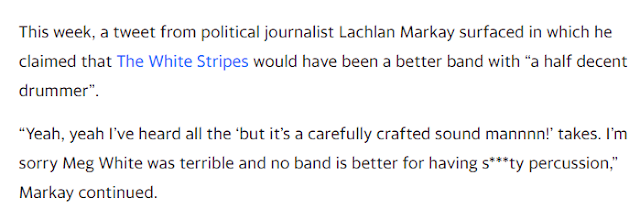
Would you believe if I told you the answer for what killed Rock is the same for what genre fiction was killed for? A combination of genre-fication and misplaced religious worship is what did it in, disconnecting it as a form of art and entertainment. And the fact that you can see it in the above recent quote should show you that it is still very much alive and the reason why the genre cannot make a return as long as cultists exist to hold it back from its true potential. It's audience does not understand it at all. This is what happens when something is not properly gatekept.


But let us get to the subject at hand.

For those unaware, the White Stripes were quite possibly the best rock band of the 2000s decade. After the 1990s had gone so far into the alternative sphere that was beginning to eat its own tail, the genre was beginning to lose focus and fire, much as it had before metal and punk gave it a shot in the arm back in the 1970s. This time, it was losing all connection with its roots for pomp and ego as it had back then, but at the same time as this was when Cultural Ground Zero was happening. Rock was beginning to lose a lot of ground to the payola-backed bubblegum acts that the major labels were pushing. It was dealing with a war on both the inside and out.

Rock music needed more than posturing and attitude to keep up--the Cobain era was long over. It didn't need technicality: Dream Theater's wild success despite lack of any true mainstream penetration should have been a clue to that. No, it didn't need aesthetics or image to reclaim its balance. It needed to remind listeners what made Rock music so endearing to mass audiences in the first place. The genre needed its roots.

Enter the Garage Rock Revival boom of the 2000s, the last time the genre fittingly had any mainstream attention. The Strokes, the Hives, the Black Keys, the Vines, and the White Stripes, were but a few of the bands that made a splash during this era. Yes, returning to the classic "The Xes" band naming was part of their success, the postmodern trend of naming your band a sentence at the time was mostly left to the emo crowd. Nonetheless, the Garage Rock Revival wave was desperately what the genre needed at the time it was starting to fly up its own rear as sales and audience attention was waning. Tradition was on the way out for endless novelty, where it still is today.

The White Stripes formed in 1997 (that's right, the very year of Cultural Ground Zero) with two members, Jack White and Meg White who played at being siblings. They were actually formerly married, but this was part of their schtick. A large part of the White Stripes sound and appeal is formed in their image as traditionalists from another time and place, playing as if the world of music had gone in an entirely different direction than it actually did.

They played blues, but it was informed by the garage, particularly kids who grew up listening to both revivalists like the Lyres and more modern acts of their time like the Replacements. Here you end up with a collision of the early days of rock with what its eventual change over the decades would become by the end of the century. It wrapped into their weird charm, especially for as deliberately luddite as their sound and presentation was. Guitar, vocals, and drums, a key feature of their obsession with the number 3: Father, Son, and Holy Ghost, as it is. Jack White being a Catholic features into the songs as Christianity was so instrumental to creating Rock music in the first place. This makes a lot of their more obscure lyrics and sound choices make more sense in retrospect, though still clever enough that you can interpret your own meaning from them.

The number 3 even spread over into their image. Red, white, and black, were the central colors the White Stripes were known for. You can see it in the image above. Just as every song rarely ever had more than three instruments (they were including vocals as an instrument, of course), the band itself never broke from their colors or their code. This helped add to their early mystique, and they never stepped away from it from their formation to their eventual disbandment.

The band put out their first two albums in 1999 and 2000, the self-titled White Stripes and the sophomore De Stijl, quickly gaining a lot of indie cred during a time when mainstream rock was... pretty bad. We can admit that by 1999 Rock music was not at its best anymore. This was that strange era of Sugar Ray and Smash Mouth, when one-hit novelty wonders suddenly overtook the charts as bubblegum began to buy the radio stations. In one corner you had lightweight pop and in the other was post-grunge sludge and misery. It was a battle of two extremes that never should have become extremes in the first place. No balance remained.

But then, in the summer of 2001, the White Stripes released their third (and best) album, White Blood Cells. It was not only a great album: it was also a surprisingly large hit. This was pre-9/11, remember: it was before Bush-era lunacy and pomp from arrogant musicians and yet just after Rock had begun its descent down the charts for its replacement. No one could have called Garage Rock storming the charts, but it did. This album seemingly made the band famous overnight, for being in the right place at the right time and also reminding everyone who made rock music what it was in the first place. And they were no flash in the pan, either.

This is the lead song off the album, the one I played back in the day to convince others that this band was worth listening to. Put yourself back in the summer of 2001 when nu metal and bubblegum was all you would hear on the radio. It does not sound as if it is from that era, and that is why it has managed to age so well.


This album hit for a very good reason, one whose context has been lost by those more concerned with bells and whistles. Let me show you how out of joint this was for the time: White Blood Cells is lean, tight, and powerful. The album is almost exactly 40 minutes long, sixteen songs total, a throwback to before CDs overcluttered albums with filler, guest-stars, and overproduction. Every song is short, concise, and punchy, never overstaying its welcome and keeping it both rooted in traditional styles while also leaning into newer ideas that could only have come in the later days of the 20th century. It is truly justice that it would be the band's third album be the one that broke them out, as the number 3 was so important to them.

This was only the beginning, however.

It was after this that they released their fourth and most popular album in 2003, Elephant, and hit superstardom with it. There they became the titans of the decade they are remembered for being. "The Hardest Button to Button," "Ball & Biscuit," "The Air Near My Fingers," "Black Math," and the mega-hit "Seven Nation Army," are only a few of the classics that adorn its track list. This is a perfect album, easily on par with White Blood Cells, and well deserving of being considered the peak of its era when Rock was on the decline. If you know the White Stripes at all, it is almost certainly because of this album. 

They didn't stop there, though. Somehow the band maintained momentum throughout the rest of the decade. They put out a total of 7 albums (6 LPs and 1 live record) before they finally called it quits in 2011 and moved on to new things. With that, the Garage Rock Revival era petered out and Rock itself faded away.

The White Stripes left quite a legacy behind them, all their releases are still high quality and worth seeking out, transcending their time. They were also a tremendous live act, and are still thought of highly today by those who managed to see them. All in all, they are probably the best overall band in the Garage Rock Revival, and one of the last that mattered culturally.

The reason I am bringing this up is to relate it back to the image with the silly quote at the top of the page. People like that are why Rock music is dead now, and is not in any way ready to rise from the grave. Their religious devotion to technicality and ego fellating goes against every single thing that made Rock connect with the common man in the first place. All they want is to convince themselves they are listening to the best music--they do not love the music for what it is or what it does. It was one of the worst aspects of the time period when music fans on message boards would have to posit themselves as music scholars to explain why it took 5 years and countless bus rides to understand the appeal of OK Computer as if they were some kind of judge in a Roman coliseum deciding over execution. This overwhelming arrogance is what Rock fans became entangled with and it seems to exist to this day.

But let us address the charge.

First, is Meg White a bad drummer? No, she is not. This is not arguable. She does exactly what a drummer is objectively meant to do: she keeps the beat and the minimalist tone that the songs call for. She is not an outlier either. There are no early Rock drummers who play over the top technical fills or rolls the 1960s brought in, so neither does she. This is the point of the band: to reclaim that era and bring its ideas to the modern age. Simplicity is the point. That it is still being argued about to this day is indicative of the undeserved arrogance Rock fans still refuse to exorcise from themselves, and refusal to understand when they are wrong.

It wasn't that those drummers from back then couldn't play like that, most of these guys were Jazz drummers and far beyond even most Metal or Progressive drummers. They didn't play that way because the songs were not about technicality: technicality was not the point of the Blues. The genre was about atmosphere, tone, and mystique. Meg White is emulating these guys because that is what the band's sound is. Without her, it loses all of that feel and the identity of the band is lost. As an example, listen to the stuff Jack White has done without her--it sounds nothing like the White Stripes. This is because her drumming is part of why they were big in the first place. That we still have to point this out over a decade after they disbanded is proof that Rock fans have yet to shed their cultism and obsessions over understanding the genre they purport to love.

Just because she doesn't play fills or rolls like newer drummers are known for doing doesn't make her a bad drummer. Nor is she bad because she plays simply. This isn't how it works. She isn't the drummer for the Shaggs and pretending otherwise is disingenuous. Technicality has nothing to do with the appeal of Rock music and it never has. Johnny Ramone is one of the most influential guitarists of all time and he never played more than a handful of chords and never played a single guitar solo. Wanting to brag about a band purely for the musicianship reeks of childish behavior.

What this comes down to is, once again, paint worship. There is nothing wrong with technicality in a Rock song, but it isn't the point of a song. The song itself is the point. Listen to what the band is doing, not what you wish it was doing instead.

Let us get to the bottom of it. What makes Rock music what it is? Is it guitar solos? No, there are plenty of bands without guitar solos. Is it a double bass drum? No, most bands don't even use them. Is it slap bass or walking basslines? No, that's a minority of bassists. Is it an operatic singer? No, there are plenty of examples of successful bands with untechnical singers. Technicality has nothing to do with what makes Rock music hit with audiences, though it can help depending on the identity of the band in question. It is, nonetheless, not what makes the genre what it is and does not necessarily make a band better. There are plenty of extremely technical bands that can't write a half-decent song to save their lives. The tools are not the point of the craft and we lost that knowledge a long time ago.

One should also mention that popular and well regarded Rock bands have existed without a vocalist, guitar player, bassist, drummer, keys, horns, harmonica, or even plugged or unplugged instruments. You can find plenty of examples of each. Therefore, the instruments themselves do not make the genre or give it an identity.

So what is it?

We can take this question to other arenas. What makes wonder stories what they are? Why did we need to cut them into genres so we could worship the parts we are obsessed with and shun what we don't understand? Because we want to put ourselves over the art itself. We do not want to understand it or connect with it: we want to rule it with an iron fist.

This is the opposite of what Rock is. A Rock band is a group of fellas coming together to make noise in a garage and get the audience moving with a fun sound that excites them. You might have your preferences in sound specifics, instruments, and styles, to get that to happen, but that is the core of what it is. Whatever gets that job done is the core of the genre--the Rock Solid center of it all.

There is no one formula to getting this done, and thinking there was is why the genre is dead now. People can now only operate in manufactured genre clichés and outdated gimmicks in place of reaching across the aisle and grabbing what they can to build their own sound and focus. Technicality can help, as a musician, but it is not why people listen to the songs. They don't listen to be impressed, they listen to be taken somewhere else.

As long as those in the genre refuse to look beyond their narrow scope, to continue in dead end fads and styles that wore out their welcome decades ago, to run off novelty and gimmicks over craft and purpose, then Rock will stay dead.

It isn't just about music, but about everything. Why we insist on holding to rotting 20th century frames at the expense of something more eternal is a mystery for the ages. We aren't here for no reason, therefore what we do can have great meaning.

What makes something what it is? That's a hard thing to define, but it certainly isn't the bells and whistles that come out of it. What makes something what it is goes far deeper under the surface into the center of it all into the core of our being. Unless we keep digging, we'll never find it. This is what makes art so special.

That is, after all, why we're here at all! To create and to grow. We need to keep on doing so. Otherwise we'll never truly find what we are really capable of.

Just don't forget that you sometimes also have to look back to trace your steps, or else get lost in the haze with everything else in the modern world. You can't move on without a clear direction forward, after all. And it is art that can help us find that path we have been seeking so desperately. We just have to keep searching for it.

As always: to those who knock, the door will be opened.


Friday, September 2, 2022

A Lost Art


There has been a lot of worry online about the modern state of the arts and entertainment. It used to be because of the attitudes of the older industry stifling creativity and connection with patrons for a system that works more or less like a creaking factory belt, pumping out generic slop with a tired brand slapped on top. Now, the worry comes from the progression in technology that supposedly will make creators of just about every sort of art redundant. Of course, the old industry's obsession with making more money for less effort caused this so-called problem, but there really isn't an issue here at all if one thinks on it. Despite the rise of automation and devaluing of artistic expression by those "in charge" of things, nothing has really changed.

Perhaps you, dear reader, are confused. I should probably start from the beginning: the subject is about the growing usage of computers and AI in the realm of art production. Less and less of it is done by human hands, and more is being filtered through automation and algorithms, something big corporations love more than anything in order to cut costs. Naturally, artists are worried about their place in this new world when they are so easily replaced.

But they are not, this is why these worries are silly. Let me explain from the beginning. We will have to go back to the start to understand how we got here.

If you've been beholden to the talk on social media recently, especially in artist circles, you might have noticed the newest topic making the rounds: that of AI-created art actually starting to shape up into a viable thing, whether for book covers or just general art. There has been a flood of new (and free!) programs offering you ways to construct art based on prompts you put into the search bar to get whatever you want. Naturally, this has become a big topic of debate among those who do such things for a living.

One such example exists at the top of this very post. Author David V. Stewart created that cover for his book using AI. There is no commissioning or Photoshop at play: he simply put it through an algorithm, He writes about the subject here

He also created a video on how he did it on YouTube:


If you are interested in how this all works, I highly suggest watching his video. This is still a fresh new concept, but it is primed to make waves in the future, and far sooner than you might think. AI art is not going away.

Should you want to see more examples of how this works or how to use it for your own benefit, I suggest reading his above post, too. It covers all the bases about where we are. Long story short: putting in the correct information might net you some solid art that can outdo both stock photos (even through photoshop) or commissioned work. And it's totally free.

I'm not going to talk about the process of how AI art works specifically, you can find all sorts of commentary on how that subject for yourself, but I am going to talk about the bigger issue that clings to this topic like smoke to a fire. New inventions like this aren't going to change the general feeling going on in certain circles about how computers have devalued art. Not only that, how audiences have been trained to expect and love such things.

Author Rawle Nyanzi has also been posting non-stop on Twitter about how easy it was for him to create characters through putting cheap and quick drawings through the AI. Check out his twitter timeline for many examples he experimented with to get his desired results. Suffice to say, this sort of thing will only get better as it develops.

One such example:


Here is the twitter thread for this post.


So the question remains: what does this invention's impact mean for artists when potential patrons can simply put a prompt into an AI and get the image they desire instead? Does this new AI source replace artists? Should those who draw for a living be worried they are being replaced? How can you compete with ease of use and a free cost, after all?

This is where it gets complicated. In this case, we have to look to short term vs long term applicability of this invention and who will primarily use it.

Let us first proceed from the unavoidable reality that these programs will eventually be able to pump out the exact picture you desire, pixel by pixel, in the future. This technology will only get better. You have to accept that much. Of course it will never be able to do anything complex like full comic pages or the like, drawings that require specific positioning and flow, and these AI pictures are put in the public domain immediately once created, (though you should look up the legality yourself, don't just take my word for it) which already limits the sort of things these computer brains can create. Putting all that in mind, what it can and can't do, what does this mean for artists of the future when the technology only improves? What can they offer that computers cannot? Well, a lot.

There are a few things that will fall by the wayside, again, should things continue forward in their logical progression. The first is that concept art for bigger projects is a lot easier with AI, at least when building from scratch and is a lot less harsh on the wallet. Finding the basic designs you need and then taking it to a living, breathing artist afterwards to spit-shine it into a proper piece would probably be a lot easier for patrons whose wallets are a bit thin. I don't think anyone would argue about this change not being good in the long run.

The other major thing that will change, and believe it or not this is mainly for the bigger artists who live off these commissions, is pornography. They will take a hit here, and for very obvious and expected reasons.

Think of it as rationally as you can. An AI can easily replicate poses, positions, skin, clothes, or locations, with no real effort except a prompt. Pornography is the most base and easy thing to make, because it is entirely clichés that have been copy-pasted millions of times in every medium. Artists get the majority of their money from commissions of those who purchase this exact smut from them. If said patrons can get their disposable porn for free, and made custom to their specific tastes with a simple AI algorithm, then why would they ever spend money to buy it? It would save them a lot of money. Whoever invents this, and they will invent it, this is how the industry thrives, is looking to make a killing on it. Artists who live off porn commissions should be aware: AI will come down hard on this part of the business.

This means that artists, should they want to survive in this new landscape, will have to work twice as hard for less return than they ever had before. You will be like us writers are today, basically. Artists need to stand out and show their own distinct identity and style that puts them above not only other artists, but machines themselves. They must prove their worth in a landscape littered with easy options. People won't stop commissioning artists, of course, but artists are going to have to put more of themselves and their vision into even the most basic commercial art in order to justify being used over a program that can replicate the basic needs for any patron who wants the base thing. In other words, we are at the point where they will have less of a return on harder work. It's only going to get tougher. This is, unfortunately, the way the industry is today.


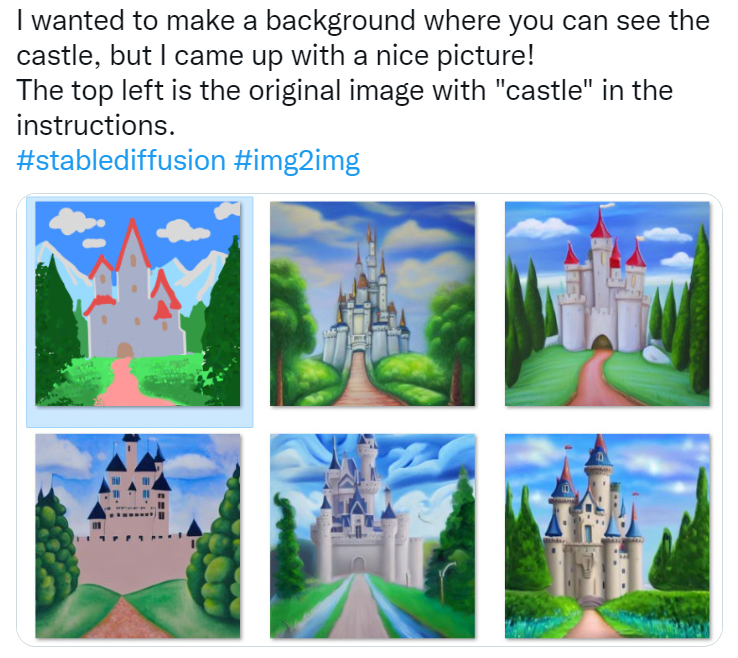
The original tweet.


It doesn't stop with artists, by the way. I should also mention that there are AI programs in the work for writers, too. I am not writing this from a place of safety or attempting to look down on illustrators. Every nook and cranny in regards to art and entertainment production is currently under the gun of AIs being trained to replace humans. Once Disney gets their own MCU algorithm, for instance, they'll be able to make movies without even having writers pen the clichés out for them. If you think the audience would care about a lack of humanity to the writing, you do not realize how disposable every aspect of creation is seen today after years of devaluing originality and soul for mindless trope worship in art. No one will care when this replacement eventually happens.

This is what happens when creativity is turned into forcing creatives to work on an assembly-line version of art and entertainment at the expense of any higher aim or connection. The end result is that it becomes extremely predictable and able to be made easily by an algorithm. What separates humans from robots is the soul, our inner workings, and outer personality that stems from it. Our observations and musing about life is something only we can do: but that has been replaced with mindless consumption and a rotating door of nihilistic themes. A machine can't replicate the former, but they can replicate the latter, which is what audiences have been trained to expect from their art and entertainment. 

Unfortunately, audiences have been trained to reject anything aside from corporate approved formulas designed to gave the top hats more in their pocket and stories that think base pleasure is all life is for. To break that conditioning that has been going on for decades at this point, creatives have to work much harder than they used to and for much less in return. You will never be a Rothfuss of a Martin in this new world: you can't afford to be.

Is that fair to creatives? Probably not, but it's reality. Much like how NewPub writers have to work twice as hard with half as many resources as OldPub, just to break even, or how independent comic book teams are ignored by supposed aficionados of the medium who report only on giant conglomerate company IP instead, unless you are focused on making the best art you can, you have little chance of finding an audience to begin with. Your audience is a lot more particular, and you have to work accordingly.

You can't compete with the deep pockets of the giant media conglomerates, but you can compete creatively. This is actually the easiest thing you can offer over them. The deficiency in the old system will be even more obvious when they begin to replace their in-house human cogs with AI that can pump their formulas out cheaper and faster. To be honest, looking at the covers and posters of everything the old industry puts out right now, one would have to find it hard to believe they don't already use primitive AI to design everything. It's already soulless.

The old industries are hollowed out as it is. Putting computers in there won't change a whole lot about how they operate. It will just make their descent more obvious for those who care about nothing but consumption and moving on to the next (not-so) new thing.

We're becoming more and more gutted in regards to higher experiences or aspirations these days, almost as if those in charge want us miserable at all times. Thankfully, we have the rise of independent spaces storming the online arena to keep you well stocked in art and entertainment. There you can still find the human touch. These new spaces might not be what you expect, especially if you were raised on corporate gruel, but it's guaranteed to be better than that tired slop the mainstream has been shoveling out for decades. NewPub is just one piece of this ever-growing pie.

Because at the end of the day, this is what your choice is going to be: safe and approved formula handed down from your betters for acceptable consumption, or wild and crazy art and entertainment from those just like you who want to go to different places. They are two vastly different choices before you, and only stands to change and grow as the years go on and the culture mutates and shifts around us all. Only one is a viable path forward.

Which path will you travel, and who will you choose to be? A consumer or a patron? The decision is ultimately up to the customers.


The tweet above is here!


Essentially all of this is just the next step down the road we were already traveling before this possibility was even a punchline in old late night comedy shows. Replacing God, family, and community, with brand labeling leads said brand labeling to be reshaped for whatever purposes those who own it desire. They know they can control you with it. As long as Product has that brand name on the box, you will consume whatever it is--and those in charge know it. This behooves them to control that brand like their lives depended on it: because it does.

This means that the only real way to offer an alternative to this vapid landscape is to offer a real alternative to it, something new and completely unlike what the mainstream offers today. In order to do this, one would have to strive to become the polar opposite of what this dead end industry is currently becoming. Eventually, they will restructure themselves into an AI-fronted factory-line of product meant to satiate the bare-minimum of audience enjoyment while parting you from more and more of your paycheck. That is, after all, what streaming already does. It's basically a click farm for those who think of art as nothing more than a drag on a cigarette.

A true alternative to this system requires going a completely different way from the mainstream. This is why it was called "alternative" rock back in the day. That is, before the mainstream consumed that into formulaic goo, too. The only difference here is that hijacking an aesthetic or a movement based on creativity and freewheeling ideas can't be co-opted to work on a belt-line. This is why, for instance, the Pulp Revolution was never actually taken over. It is built on principles and ideals the mainstream rejected long ago. They can't take over built on the opposite of what they are, because they can't make anything like that. These two paths can never converge on each other. It is impossible when they are each defined by things the other does not do, and the audience knows it. Once the audience realizes their options are a lot better than they think they are, the cultural landscape will change nearly overnight.

Should artists or writers be worried about being replaced by machines? No, because that is a mainstream worker bee problem. You were never part of the mainstream's world to begin with. They were already pushing outsiders to the margins and those with true alternative ideas were being labeled bad names by their media lapdogs long before this. They do not care about the customer, they do not care about their creators, and they do not care about either the past or the future. They just care about what makes it easier for them to part your money from your already thin wallet. There was never a scenario where you reading this (whoever you may be) would have had any control in their manufactured playgrounds or have a platform to spread your unique ideas. At best you would only be a tool for them, and then disposed of later.

All you can do, at this point, is to keep producing and showing the audience, and any potential customer, your own results. It might take a long time, but it is all that you can do. Prove to them that the NewPub arena and independent spaces are wilder, more fun, more exciting, and full of fresh ideas that the stale mainstream no longer has or wishes to engage in. It really is like choosing one of two paths at the fork in a road, and eventually one will be made for you.

Which one will we choose? In order to entice those to go down our path, we will have to give them plenty of reasons to do so. Understand? So let's give them that reason.


The original twitter thread is here!


At the end of the day, there is no reason to despair over computers "taking" your hobby or your career, because it's not and never really can, especially if you are a real artist. You aren't making conveyor belt art that can easily be replaced by a machine checking the correct boxes: the mainstream is. Your own soul shows you that you are irreplaceable.

People will never come to you for mere product they can guzzle like state-mandated soma from the mainstream. That is not what you are here to get from you. Perhaps, if anything, machines being able to sleepwalk art for easy bucks will prove to all of us how important this was to begin with. This could very well be the shot in the arm we need to reevaluate where the art landscape is and where to move forward. Truth be told, we've needed that wake up call for a long time now, and this might finally be what we need.

Times change, and they are even changing right now, but there is no reason to ever despair. The human spirit was made to endure much tougher stuff than this. Even if machines and AI become popular to the point that they consume the mainstream whole, it still won't actually matter to those who care about art. To be quite honest, this is a speed bump at best. Keep your eyes on the road.

Once we forge a new future built on the foundation of a strong past, only then can we finally show what flesh and blood can do in an increasingly artificial world that devalues both. No matter what changes in the future, we will always be human and we will always create.

There is nothing else we can be. Why worry? The future hasn't been written yet, so get creating. We've got trails to blaze.


Saturday, August 6, 2022

Weekend Lounge: Proof of Decline Edition


There's not much this weekend to discuss except this one long video to show you exactly how much video games as an artform have regressed over the last two decades. This one uses the Left 4 Dead series and what built it, contrasted with a newer attempt at the same concept from a modern AAA studio which completely misses the art behind the original classics. This is a long one, but it's a fascinating video.

This just goes to show you what happens when you overlook the soul and over focus on aesthetics, tropes, and the chrome-plating, over what truly makes something what it is. This is essentially what handing the keys over to poseurs gets you.

Such as it is in every other industry, check out the video to understand how far one can lose their way when they abandon their roots. We cannot improve until we shake this anti-art and anti-audience mentality. Things will just remain like this.

So let us be sure to learn properly from the past, and build on it. We cannot afford to keep throwing the baby out with the bathwater forever.

That's all for this week! It's been quite a bizarre one. Have a good rest, and be sure to beat that crazy heat.

Autumn isn't too far away!


Thursday, December 16, 2021

Touch & Go


We are doing everything online these days, aren't we? At least, it feels that way. Soon every single aspect of our lives will require us to be tethered to an ephemeral network or we simply will not be able to function. These days it seems that the physical world is becoming less and less important to modernity.

It hasn't, but it sometimes does feel like it. In fact, there have been plenty of changes afoot to bring things a bit more in line with where we should be. It's just harder to notice in the fog of social media, 24/7 news assault, and endless automation of smaller jobs. Things are changing, but not quite in the way we see it changing, as is usually the case.

Even though a lot has changed over the last few years, one thing that absolutely hasn't is the existence of the physical market. Particularly in the arena of movies, disc releases still exist and have only grown in the wake of the recent pandemic and rise of customer-last services such as streaming. People still value the sensation of touch.

This is a bit strange, considering you would have figured the opposite would have happened, especially with less releases of new Hollywood product. But the niche still continues to thrive regardless of what the machine does.

For the most part, you will always have folks that will jump on the most convenient, low effort way to enjoy something, which explains the popularity of streaming over technical improvements such as 4K. However, what is surprising is that despite the hard push from corporations to get these customers to own less and pay constant rental fees for everything they're interested in (and not interested in, to be honest) physical media ownership still exists. Even despite a situation where most people couldn't leave their homes for over a year, never mind go out themselves and watch or buy new movies, they still continued to buy physical objects to own.

A bit unexpected, to be quite honest. From everything that has happened, one would have figured the previous trends of increasing online product would have continued unabated. Yet it looks like for many the opposite occurred.

Take this article about the state of the newer UHD (Ultra HD) format and its bid to seize control of the physical market since its inception nearly half a decade ago. It doesn't seem to be grabbing hold or doing much to attract customers. In fact, DVD sales are still the highest among all physical formats even 25 years after their creation.

Check the chart:


Amazing, isn't it? The cheapest, most disposable form of physical media is still the majority market share to this day. That doesn't look to be changing anytime soon.

But it feels like there is a divide between different sorts of customers. Whether it is those who just want to simply own the product, those who want the best possible presentation, and those who want the best of both worlds, the majority consensus seems to be that outright owning the product is more important than any other aspect of it.

In other words, it is about the experience more so than the bells and whistles surrounding the movie. Not much has changed in the last quarter of a century for a lot of people aside from widescreen TVs. And not even large ones.

The above chart might be confusing to those who value giant 4K television sets and a small library that has no potential to reach the spread of those on lesser formats like DVD or even standard Blu-Ray. This is understandable. Why wouldn't anyone want to pay more for higher quality, even with a library that will never reach the depth and variety of those that came before?

Why indeed.


"With the competition between streaming services intensifying, it’s easy to forget there’s still a market of consumers who buy physical media, who like to collect tangible things, for a variety of reasons including pride of ownership, wanting to actually own things, fear of tampering by content owners. Is it niche? Not quite. It’s shrinking for sure, by double-digit numbers annually, but it’s still a mass market. What’s niche perhaps is the premium segment of this market – Ultra HD Blu-ray, a 4K HDR disc format introduced 5 years ago this February, 10 years after Blu-ray Disc and 20 years after DVD. It’s likely the ultimate video disc format. 

"Nielsen VideoScan, a company of the NPD Group, has since years been collecting retail sales numbers of consumer purchases in the U.S. market. I’ve tracked those numbers the past few years and they show a couple of interesting things."


For a newer format, UHD has never pierced double digit market share, and has already fallen under what it was three years ago. Meanwhile, standard Blu Ray has fallen to a quarter of the total market share, while DVD owns nearly 3/4s of the home market! Even after 25 years, DVD still reigns supreme over it all.


"First a note of caution, though. The past year has not been a normal year for a lot of things, including entertainment spending. Expenditure on streaming services has increased at an accelerated rate while spending on physical media has not. But there’s more. Because of covid measures, Hollywood studios have had to halt movie production for months. Moreover, because of lockdowns cinemas and movie theaters have had to close for extended periods of time. This dearth of theatrical releases has translated into a complete stagnation of home video releases a few months down the line, still observing the traditional windows in the staggered releases schedules. The sell-through video market is, or at least used to be, driven by such new releases. That’s the main reason why 2020 was not a great year for movie sales, and it has exaggerated certain trends."


This is a fair assessment, but what also should be taken into account is that the modern movie industry was already flatlining before the pandemic ever started. Sales had been going down for years, and movie theaters were already seeing worse and worse returns. All the last two years did was hasten that demise faster.

The #1 appeal of buying big 4K TVs and players that blow up picture on them is for newer movies, but new movies don't really sell all that much anymore. Most people interested in them will just watch it on a streaming service. UHD was never going to be much more than a niche in a niche. And it looks like the trends are bearing that out.


"The most interesting trend in my view is what’s happening to Blu-ray Disc, the 1080p HD disc format: it’s getting squeezed between DVD and Ultra HD Blu-ray. It’s clearly visible in 2020 but if you look back a little further you can see this happening more or less from the introduction of UHD BD. The split between DVD and BD was about 50/50 (in units) before UHD BD launched. This was as far as Blu-ray Disc got in trying to displace DVD after reaching maturity. It had been on the market for ten years by then. 

"This squeeze makes sense, of course. DVD is the cheapest option here, and price does matter. Ultra HD Blu-ray meanwhile is the best format in terms of audio and video quality. Blu-ray Disc is neither. It’s a decent compromise between price and picture & sound quality but it’s neither the cheapest nor the best. It’s less and less a compelling proposition. That UHD BD would mostly cannibalize BD was to be expected: The people who want the cheapest option and still haven’t upgraded to BD more than 10 years after introduction are likely to stick with DVD while those who want the best quality migrate from BD to UHD BD."


Unfortunately, this is cope. Standard Blu Ray being down a quarter comes from not much being released that takes advantage of the format over the year. It certainly isn't losing any ground to UHD when UHD has also plunged in numbers and is now under 5% of the market share without ever reaching double digit to begin with. Not to mention, Blu Ray is the best quality when you are not buying or using 4K, as most buyers still do not.

And they probably never will, especially when using it locks out much older material that cannot be released for it. Physical media buyers, from what it appears, heavily invest in old film and television. SD content that cannot be upgraded to HD (of which there is more than you realize) can not be released on UHD or displayed on 4K TVs as they simply cannot display SD. For certain audiences, this is an obvious downgrade, and denying that is part of the above blind spot.

But tech heads tend to overlook the past to their own detriment. This isn't really a new thing, but expected at this point.

Plus, and I hate to say this, but UHD will always remain a niche in a niche. Whereas one can release SD material on Blu Ray (I would suggest looking up Discotek's anime work bringing works that aren't HD out in higher quality), only a small sample can be upgraded to 4K, and even fewer of those will make enough money to justify the exorbitant expense of making a UHD to begin with. If you're planning on leapfrogging over Blu Ray from DVD then you will miss out on a plethora of material the more expensive format of UHD will never, and can never, have. Audiences apparently seem to notice it, hence market share already shrinking.

UHD is a niche of a niche and doesn't have much in the way of growth potential, especially as newer products interest customers less and less. It's exclusively for tech geeks.

Such people usually don't even understand DVDs' continued popularity after a quarter of a century in use. Shouldn't it have been replaced like VHS was?

Well, it simply isn't that simple.


"Every week when I post the weekly market share pie chart on my UltraHDBluray tweet feed, someone – in shock about the high market share of DVD – will ask “who still buys DVDs?” Well, a lot of people, is the answer. And who can blame them? Evidently the movie business and CE industry have not done a good job educating people about the differences between DVD and BD (never mind UHD BD) and persuading them to go for the premium option. These differences go further than just image resolution. Take frame rates for instance. Most DVDs contain interlaced video. The format can support progressive video but not at the 24fps frame rate that most movies are shot at. (For an explanation of the importance of frame rates, see this article on HFR.) Dolby Atmos sound and its competitor DTS:X are exclusive to Blu-ray Disc and its 4K sibling, though much more common on the latter. And naturally 4K resolution and HDR (High Dynamic Range) video are only available with Ultra HD Blu-ray."


There is this constant tendency among aficionados of some space of another to miss the forest for the trees, and the above is a clear case of that happening. The reason DVDs remain king is fairly obvious to anyone who understands art, and it has nothing to do with being uneducated. It comes from not caring about aesthetic improvements over price.

DVD was an objective step up over every format that came before it. Multiple languages, subtitles, sharper picture and sound, more disc storage, easier case storage, and it was not very expensive even at release. Tied with that is that it came included in the highest selling video game system of all time: the PlayStation 2. It was such a clear, cheap, and easy, upgrade that the public went for it almost right out of the gate. No one really thought twice about it. VHS sales plummeted almost immediately once the price came down and the PS2 was released to massive success. It was no wonder DVD was king for so long afterwards.

So what is Blu Ray's advantage over DVD? What does it do that is the equivalent of the huge improvement over VHS? What does it have that will make buyers jump for it as readily as they did for DVD back in 2001?

It does the same thing that made DVD what it is, but it does them better and it's pricier.

That's it. 

Sorry to tell you this, but that's not impressive enough to most people. Most buyers don't care about slight improvements to audio or visuals--they care about having a good reason to jump ship to a new format. I'm sorry to tell you this, but Blu Ray (and especially UHD) give no compelling reason for most people to drop their old format unless they care deeply about picture, storage, and sound. Most do not and never will. Hence why surround sound audio and 4K TVs are not owned by everyone on your block. It doesn't matter to them.

UHD suffers this issue twice over because those who collect Blu Ray already think it's enough of an upgrade, which it is if you're one of the many people who see no value in 4K, or exchanging SD entirely for a small slice of the pie in content. So you're seeing a fraction of a fraction here. Would another format after UHD occur it would then bite into UHD's already tiny percentage. It wouldn't effect the "lesser" formats. Less people care the more into the minutiae one gets. This has always been the case regarding tech. It is why most avoided the internet until 56k modems and Windows 95 became prevalent. They don't need good; they need ease of access.

Normal people are more likely to find streaming more of a revolution over UHD, and their assessment wouldn't be wrong from their perspective. "Blu Ray but better" is even less enticing than "DVD but better" when you can instead click a button to watch whatever you want at any time. The ease comes before quality.


"Another reason for the continuing success of DVD is that while just about everything gets released on DVD, that’s not the case with Blu-ray (let alone 4K). Nowadays, many TV series – even those that were broadcast in HD – are released only on DVD, not on BD. As for Ultra HD Blu-ray, many new movies get a release on the format but TV series rarely do. Also Netflix originals that are shot and streamed in 4K – series like House of Cards, The Crown, Jessica Jones and Daredevil – get a BD release at best. The only exception to that rule so far has been Stranger Things, but that 4K disc release has been a retailer-exclusive only available through U.S. chain Target."


And after five years UHD has never even risen to where Blu Ray was after the same amount of time, never mind DVD. Audiences need a bigger reason to jump ship. But they are never going to have it, especially if they care about old works.

I should go into this a bit more. There are certain things 4K TVs cannot ever do, despite supposedly being advanced. One of them is displaying any form of Standard Definition content well. They literally cannot do it.

What should also be mentioned is that most television shows were filmed on video, not film. Video does not have the materials in order to be given higher definition like film does. It can't. This means they will never be upgraded to HD, and a DVD release is the best they can ever hope for. This goes the same for a lot of things that were edited on tape too, such as properties like Mighty Morphin' Power Rangers. They will never have a HD release because of the way the elements were put together or edited.

The best one can hope for is an SD on Blu Ray release (there are no improvements except less compression than a DVD disc has), which sort of defeats the selling points of Blu Ray to begin with and is not enough of a selling point for audiences.

And on a 4K TV? It will always look like garbage and run considerably worse. There is simply too much of a benefit for DVD's continued existence when a lot of things would lose physical releases should it happen to go away. In many ways, DVD represents the entirety of the physical market, which means it cannot die or else the market will too.

It also goes without saying that streaming services will just throw old series and films up as is, because picture and sound quality isn't its selling point. If it looks bad, just hop to another one. After all, you're paying for ease of access, not quality.


"Some Ultra HD enthusiasts frequently suggest that movie studios should stop releasing DVDs, apparently thinking that consumers would then upgrade to higher-quality formats. I don’t expect that would happen. The cost-conscious DVD buyers would more likely switch to streaming options. Studios would be crazy to stop the cash cow that DVD still is. And it provides essential volume for the optical disc replication plants, of which there are fewer now than during the peak days of CD and DVD, to keep running at a decent load."


I'm always fascinated with this obsessive cult-like frothing demand that normal people acquiesce over the demands of fanatics who should be allowed to consume in peace. This is a reoccurring theme, isn't it?

Let us be honest, if DVD disappeared, audiences wouldn't be jumping to UHD. Some would go to Blu Ray while the wide majority would just be pushed faster into streaming. The wider public doesn't care about 4K when they barely cared about HD to begin with. They just want the product, and they want it cheap. UHDs will never be cheap or have the wide spread that streaming offers. As far as the wider audience is concerned, it's worthless.

I say this as someone who enjoys standard Blu Ray more for its storage capability and uncompressed SD content than anything else. It's a good format, but it's not any sort of revolution. UHD even less so due to have objective steps back in the are of art preservation that no tech head wants to admit is a fatal flaw for many. It will simply never become the majority format.


"The modest rise in market share for Ultra HD Blu-ray will likely resume when blockbuster titles are getting released again and movie business returns to normal. The best weekly market share for the format so far was when Avengers: Endgame was released: 20%. Blu-ray Disc did nearly 50% that week – also a great score. Major titles have been few and far between since the pandemic struck. The only real tentpole title has been Tenet. It sold 38% in 4K in its premiere week (pushing the format’s market share to 6.6% – above average for 2020) and around 25% in the weeks following."


I'm going to throw an opinion out there that new movies do far better on streaming than UHD, while new releases of old movies and obscure releases do far better on standard Blu Ray (based on comments from boutique distributors like Discotek, Vinegar Syndrome, and Kino Lorber), while DVD is a catch all for everything else. There are segments where certain things are simply preferable to others. These are obvious audiences sectors that have easy to understand preferences.

If you ever think UHD, a format the majority of video products can never be released on, will ever be the go-to physical platform, then I think you might be blinded by the bells and whistles over the buyers' preferences. If it ever is the standard, then we will lost a lot of films and TV series to the void. This is not a good thing.

However, this is a baseless fear because it's never going to be more than a niche of a niche. That's what it was designed to be. It's only ever going to appeal to a minority.


"The hardware market indicates that Ultra HD Blu-ray is a stable niche. The number of players sold is shrinking slightly. It’s also telling that while Samsung has actually withdrawn from the disc player market altogether, the other major CE brands Panasonic, Sony and LG have not introduced new models lately and continue to sell existing models, apart from the just announced Panasonic DP-UB9000 Mk II. Cheap, low-end, no-brand competition from China, that became massive with DVD, has not entered this market. Instead we’re seeing high-end boutique brands entering, again indicating this market is becoming a premium collectors business rather than a mainstream one. Industry watchers also predict a wave of ‘clones’ of the beloved universal disc players that Oppo made."


Case in point.

It's the same people buying more UHD, not more people buying into the format. It's already stagnated in growth despite being around for over half a decade. By this point in their lives, DVD and Blu Ray had already taken off.


"The installed base of UHD BD-capable players is sure to rise massively this year thanks to the introduction of PlayStation 5 and Xbox Series X. Discless “digital-only” versions of both consoles exist – the Microsoft one is called Xbox Series S – but millions of players will be in households in the course of this year. These devices are foremost games consoles but statistics show that console owners use the devices for many forms of entertainment including music, movies and series. A lot of that may happen in the form of streaming but the option is there. Will this impact the sales of movies on Ultra HD Blu-ray a lot? Not before major movies see releases on home media again. Once that returns to normal we may see higher volumes of discs selling than before."


If the mega-successful PS4 didn't cause Blu Rays to overtake DVDs, why would newer consoles be able to do it with UHDs? The people who buy consoles would probably just jump over to streaming since, you know, all the streaming services are right there on the console. It's PC gamers who care about tech. The audiences for consoles care more about accessibility which, as we've already discussed, is what this group cares for more.

So no, the PS5 and Xbox S will not give UHD much of a boost, especially when both Microsoft and Sony are swinging hard for the digital distribution fences. They will push streaming services long before even considering expensive movie discs.

There isn't really any potential growth in this sector of the physical market because most people just want the product for as cheap as they can get it. Better picture and sound is not going to impress them. We've long since reached saturation on picture and sound improvements over HD was introduced to the mainstream over 15 years ago. Most people flat out do not care about them anymore. The wow has worn off. What they have is good enough as it is. and that's all that matters.


"At the moment, the worldwide Ultra HD Blu-ray Disc market is worth roughly 1 billion dollars, the majority of it in North America. That may be a niche in the overall entertainment business but it's a sizeable niche with healthy margins. May it live long and prosper."


This is good news if you primarily watch big budget modern Hollywood movies. If you don't then you'll realize that for those who enjoy foreign films, b-movies, animation, old television, or things made or edited on video, have no real place in this market. It's really for big budget, large studio Hollywood releases, and little else.

I think there is a tendency to get carried away by aesthetics or technology at the expense of content. One of the reasons physical media remains popular is because audiences want that tangible connection to their art, to hold and experience on a level they can't with just bits of data. The rental store used to be such a mecca of activity back in the day for a reason. There is something about being able to hold a movie and read the box art that offers something different than scrolling through menus on an internet connection does.

The people who want that, value that experience far more than the quality of picture or sound. To them it is the art itself that matters the most, and they want it however they can get it. Despite changes in the home video market, this doesn't appear to be changing anytime soon. There will always be a segment of the audience that values touch.

And we should salute them for it.


Gone, but never really forgotten.


Nonetheless, the larger point in all this is that there is still a market for physical media. It isn't gone yet. That might change with the next few years, especially as the studios make harder strides towards streaming above all else. After all, no one benefits from it more than they do. Even if it does change, however, there will always be an audience of those who prefer physical media and direct ownership of art and entertainment detached from a nebulous online cord that could be severed at any time. Touch still matters.

Boutique labels are putting out more movies on Blu Ray than they ever have since the format started. We're seeing flicks from the likes of Cannon Films and labels like Vinegar Syndrome putting out even more obscure films that have never gotten good releases before. On top of it, they are also completing unfinished movies for the world to see. There is still a very activity scene thriving for those who appreciate these things.

Right now is probably the best (and will be the last for a long time, to be honest) time to build a library of affordable movies and TV series while the market has some stabilization. Sooner or later, you won't be able to. Time is running out, even if the audience thinks otherwise. This is a once in a lifetime chance.

Until then, we've got plenty of options. Better take advantage of it! Who knows how much time we have left, anyway? Might as well enjoy a good movie while you're waiting. Take your pick. The sky is the limit.

For now!