After an extremely successful campaign, we are now in the final stretch for Cirsova's Cosmic Courtship crowdfunding kickstarter. It's been quite the run, and now is the last chance to give it a boost!
The kickstarter has smashed every stretch goal, finally reaching the recent $15,000 one to make all the original images available. There is still time to reach the final mystery goal at $20,000, so jump in while you still have the chance!
In case you are in the dark as to what this is all about, the description is below:
The foremost goal of this project is to get an exciting, essentially lost, classic pulp story back into print and into the hands of scifi fans, pulp aficionados, and readers in general!
What do we mean by "essentially lost"? While The Cosmic Courtship is a work in the Public Domain and part of the world's common literary heritage, there's virtually no way for anyone to read it! It has only ever been printed in now very expensive and hard to find pulp magazines. Even if cost were not an object, availability often is.
This is the case for many novels and novellas from the early pulp era. Julian Hawthorne's The Cosmic Courtship is only one example.
The main issues with a project like this are the investment of time and the risk to (often nigh-irreplaceable) physical materials required to reproduce the texts.
It is important that the team be compensated for their time and work that they put into making these texts available.
Physical Reproductions of the Work
The initial goal for this project is to bring The Cosmic Courtship back into print. People who want to read this work will be able to read this novel without having to invest hundreds of dollars into 100+ year old pulp magazines as they infrequently appear on the open collector market.
All backers will be credited in an appendix for helping bring this to fruition.
We are offering both paperback and hardback formats, as well as a novelty magazine format [similar to Cirsova Magazine] and a no-frills pocket paperback edition.
Want to spread the love? Be a super backer and donate a classroom set to your favorite teacher or librarian! Help get this work into people's hands!
As for the stretch goals:
$3,000 - Bonus Materials
Not only will we be including the original text of Julian Hawthorne's The Cosmic Courtship, we will including some additional biographical materials and other works by Julian Hawthorne, including a facsimile version of "Scenes of Hawthorne's Romances," an essay on his father's writings, featuring the text as it was originally presented with numerous illustrated plates.
$8,000 - Digital Copies + Donation of a Public Domain Copy
As mentioned, there is a lot of labor, risk, and costs involved in salvaging these texts--we want to ensure that the team working on this project are compensated: if it is worth everyone's while, this will be the first of many.
The ultimate goal of a project like this is to make these available to the world because they are part of our literary heritage and everyone should be able to discover and analyze these works to better understand the patchwork history of this fascinating era of fiction.
If we raise $8,000, not only will we provide all backers with digital copies of the volume we are creating, we will create and donate a digital text version of the original story to Project Gutenberg.
These will be made available after backers have been sent their physical copies.
Please consider donating to sponsor this project, or order multiple copies, so we can reach this goal!
$10,000 - Ongoing Imprint
Michael Tierney has an impressive pulp library, filled with innumerable stories that are public domain but have never been in print since the early 20th Century. If we raise $10,000, that will show us that there is sufficient interest and support to turn this into an ongoing project where we work with pulp archivists to "rescue" these nearly lost works and make them available both in print and for the general public domain so that they can be preserved and enjoyed by future generations!
$15,000 - Original Images Available
Michael has agreed to release the images we used of the four issues of All-Story to compile this edition. Michael will host these these images, nearly 100 pages of pulp, on his website.
$20,000 - ?????
What will we do for $20,000? I don't know yet, but we'll have to think of something fast, since it looks like it's in the realm of possibility!
As mentioned, it has already achieved every stretch goal but the last one. What could it be? Make it a reality today!
For more info, you can see the campaign page here.
For more Cirsova goodies, the summer issue is now up for preorder! Be sure to put in your preorder for the quality oddness sure to come your way!
Let's talk about something bizarre today. How about an entire anthology of stories about chickens? No, I'm not pranking you, this is an actually collection of stories that really exists.
A bit of background, from the editor:
"This collection of stories is a demonstration of how a crazy but wonderful idea can go from first mention to a call for stories in mere hours. I had a great animal story already written and ready to go, it having been cut from another anthology in the final selection round. The problem? My story had cats instead of chickens. With a quick edit pass to change to chicken names and behaviors, and tie the birds into to the story a little more tightly, I had a submission turned in after a couple of hours. My story, Stray Thoughts, is about bonding in a post-apocalyptic world. And chickens."
And you know what? I'm not going to say anything else about it. Check out this oddball anthology for yourself.
The description:
Chickens Land on Mars... But what happens when authors have too much free time on their hands?
A challenge.
Craft a story featuring our favorite feathered raptors: the CHICKEN.
B'gawk!
Twenty authors deliver in some unexpected ways and live to crow about it.
From chickens in space to cozy murder mystery farm yards to schools of magickal thought...
Includes guardian angels, chicken shifters, aliens, and feathered matchmakers,
Maybe even a non-fiction adventure or two... and more!
These amazing chickens come from the minds of twenty cooped-up authors on the edge of cracking...
Read CRACKED: An Anthology of Eggsellent Chicken Stories.
The 1980s are regularly seen as either a time of optimism or unbridled materialism in the west, while the '90s are looked back on in a multitude of confusing and contradictory ways. It's hard to understand unless you lived through it, but even before Cultural Ground Zero turned everything into a flavorless soup, the decade was a very confused time.
For those of us in Gen Y, we saw our quality video games, movies, TV, and books, as beacons of the oncoming hope of a brighter future. Things were always getting better, and they naturally always would. Boomers were seizing control of the world from their retiring parents and knew exactly how they were going to fix it all. Gen Jones had finally allowed a piece of the pie due to their older brothers finally moving up, albeit a very slim one. Greats were enjoying the fruits of retirement. Millennials were toddlers. So with all this you would be forgiven for thinking everything was hunky dory. The world was about to become an even better place!
However, much like the modern media, you'll notice I'm forgetting someone. They're sort of the key to this.
To truly understand this era you need to approach the elephant in the room, which is Generation X. Looking back at the 1990s out of context, you will see an entire generation of people whose art and entertainment directly contrasted with everything else actually happening at the time. It's a bit much to take in or process unless you were there. Oh, if you were around at the time, you might have remembered how many odd potshots the media took at Gen X.
People like to point to grunge as some sort of definitive statement on Gen X, but that was a cynical cash grab intended to replace hair metal acts from getting too pricey on their record contracts. Nirvana had nothing to say and their sound had nothing original to it. You take the Meat Puppets and Replacements and mash them together; taking away Curt Kirkwood's country twang and hardcore punk leanings, and Paul Westerberg's testosterone and poignant lyrics, gives you the flavorless commercial mush of Nirvana. They had nothing to say aside from mindless nihilism, which made them very easy to sell in the mainstream. It's no wonder Cobain felt imposter syndrome as hard as he did: those that afford him legacy status today are playing right into the hands of the recording industry, and not affording him the solitude he wished for.
But amidst the Gen X dourness that was floating to the top in the 1990s, there were a few albums that were flatly ignored for making the wrong people uncomfortable. Nihilism and hedonism were cool, and no one wanted the public to be reminded of what they truly led to. They still don't. I talked about Urge Overkill's Exit the Dragon a while back, which is one such record. It is an album about bottoming out after indulging in decadence, and slowly finding the way out. The hints as to what those answers might be are uncomfortable to many in a secular setting, so the album was written off and buried.
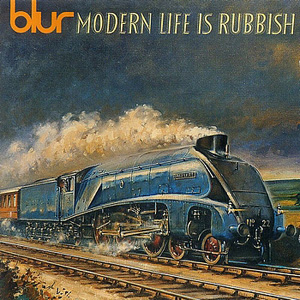
However, there is one album in this mold that did have (limited) success. That would be Modern Life is Rubbish by the alternative rock band Blur, released in 1993. This was the album that came out right before their follow-up, Parklife, became a mega-hit in their home country and brought them incredible fame, an album that is actually the flipside of this one. Many in the industry used that one as a shield to avoid talking about this record.
Modern Life is Rubbish released just as the tidal wave that was Britpop was unleashed on the world, and ended up predicting a few things that would come of it, but to this day is an album resoundingly ignored by everyone except those who listen to the band. There is a reason for that, and it isn't the quality of the album, which is phenomenal.
In fact, I would be so bold as to call it one of the best records of the 1990s. It is certainly on my list of all-time favorite albums. To explain just why, we have to do a bit of a dive into it. Clean out your ears and listen to one of the great overlooked records.
We start with For Tomorrow, the first single and first track, which states the album's uncomfortable thesis up front:
He's a twentieth century boy
With his hands on the rails
Trying not to be sick again
And holding on for tomorrow
London ice cracks on a seamless line
He's hanging on for dear life
And so we hold each other tightly
And hold on for tomorrow, singing
La, la, la-la-la
La-la-la-la-la-la, la-la-la
Holding on for tomorrow
She's a twentieth century girl
With her hands on the wheel
Trying not to make him sick again
Seeing what she can borrow
London's so nice back in your seamless rhymes
But we're lost on the Westway
And so we hold each other tightly
And we can wait until tomorrow, singing
La, la, la-la-la
La-la-la-la-la-la, la-la-la
Holding on for tomorrow
We're trying not to be sick again
And holding on for tomorrow
She's a twentieth century girl
Holding on for dear life
And so we hold each other tightly
And hold on for tomorrow, singing
La, la, la-la-la
La-la-la-la-la-la, la-la-la
Holding on for tomorrow
Jim stops and gets out the car
Goes to a house in Emperor's Gate
Through the door and to his room
Then he puts the TV on
Turns it off and makes some tea
Says, "Modern life, well, it's rubbish"
I'm holding on for tomorrow
Then Susan comes into the room
She's a naughty girl with a lovely smile
Says, "Let's take a drive to Primrose Hill"
It's windy there and the view's so nice
London ice can freeze your toes
Like anyone, I suppose you're
Holding on for tomorrow
The song is about the pursuit of progress amidst the drudgery that is modernism. How can there be hope for a future when the present is so vapid? We still have people today espousing this mindless Star Trek utopianism that isn't based on any human behavior or reality. Blur shows without having to outright say it: there is no future here.
But that is where the twentieth century ended up. And it is where we are right now.
You might have noticed that the lead singer sounds a lot like 2D from the Gorillaz. that's because that is who it is. This is where Damon Albarn got his start, in Blur, and this is the first album where he really showed his talent as a songwriter. If you do like the Gorillaz, you will see a lot of the appeal in Blur, albeit in a more traditional rock setting. Therefore, you can see why they got popular.
But it wasn't easy for the band to get their success.
The English music press were rather hostile and harsh on bands back in the day (not so much now, ironically, when the music is pure shite) and Blur was one to feel their ire early. The band's first album, Leisure, which released in 1991, was not too great, admittedly. It was a fairly generic, by-the-numbers "baggy" album from the Madchester scene, a sort of psychedelic-inspired hard rock dance sound that didn't last too long into the early '90s. They had a hit single in There's No Other Way, but already their fortunes were not looking too hot by 1992.
Blur was looked at as poseurs glomming onto a fad, and it affected their fortunes. They just had an unsuccessful US tour, the music press hated them, and they were looking to be dropped by their label. At the same time as all this, their management ripped them off and left them in debt. Things were looking dire.
To explain the genesis behind Modern Life is Rubbish, and the shift that saved Blur and made their career, one has to look into their experience at the time.
From wiki:
"The 44-date tour of the United States left Blur in "complete disarray", according to writer David Cavanagh. Dismayed by American audiences' infatuation with grunge and the lacklustre response to their music, the group frequently drank, and members often broke into fist-fights with one another. Homesick, the tour "instilled in the band a contempt for everything American", Cavanagh later wrote; frontman Damon Albarn, who "started to miss really simple things [about England]" listened to a tape of the English pop group the Kinks throughout the tour."
In other words, what Blur was seeing was a loss of all the things they thought made the world, and their home, great. Gen X was infamous for destruction, but they were even more infamous for their hatred of tradition, priding themselves on mindless hate of things they didn't understand. That Blur went in the opposite direction is probably what helped them stand out, giving them a drive that few others of the time period actually had: a hatred of the modern world.
the thing is, while it was their terrible experience in the US that set this off, the resulting album is not really about the US at all, at least not solely. They use their own experiences in their home country to show just how fall we've fallen.
But I'm getting ahead of myself.
When they got back to England, they still had a lot of work to do. Early studio sessions were disastrous, including one featuring Andy Partridge of XTC as producer. Finding their groove took a lot of time and effort. Their label fought them the entire way, too. They wanted them to stick with the old sound that was on the verge of killing their career (and ironically that almost led to their label dropping them) which left them adrift.
Basically, it appeared that it was Blur against the world to get their new vision out there. Nothing went their way, and everyone fought them.
"Work resumed on the album due to a chance meeting with producer Stephen Street, who had previously worked with the band on their 1991 single "There's No Other Way". With Street now producing the album, Blur recorded a mix of material spanning both the period immediately after the release of Leisure and their 1992 tour. While the band members were pleased with the recording session results, Balfe, after hearing the songs, told the band they were committing artistic suicide. Although dejected by his response, Blur gave Food the completed album in December 1992. The label rejected the album and instructed the band to record more potential singles. Albarn complied, and on Christmas Day wrote the song "For Tomorrow". Although "For Tomorrow" sated Food's concerns, Blur's American label SBK voiced discontent upon hearing the finished tapes of the album. To appease SBK the band recorded "Chemical World", which Blur thought would increase Rubbish's American appeal. However, Blur refused SBK's demand of re-recording the album with American producer Butch Vig, who was popular at the time for his work with Nirvana."
As you can see, the 1990s was no less better for artistic freedom than any other era. Everything listed in the above quote, aside from asking for singles, was a pretty terrible idea, and would have sunk the band. Including trying to make them sand off their edges with Nirvana's producer.
When Modern Life is Rubbish came out, no one was quite ready for the cultural shock of a band who staunchly rejected the readily-accepted modernity of the time for a pride and hope in a tradition that had been slowly disappearing. They correctly saw the dead end of the music industry ahead, and worked to make something that harkened back to other times. It was completely out of joint with the times. By the late '90s, tradition would be ejected entirely from the industry.
But what "tradition" meant to Gen Xers like Blur in the early '90s is not quite what one would expect at the time. When they meant tradition, they meant ALL of it, including musically. The album is very thorough.
In fact, after hearing the original pop single above, this was the second track on the album:
"Food processors are great!"
It's six o'clock on the dot and I'm halfway home
I feel foul-mouthed as I stand and wait for the underground
And a nervous disposition doesn't agree with this
I need something to remind me that there is something else
You need a holiday somewhere in the sun
With all the people who are waiting
There never seems to be one
Say something
Say something else
Advertisements are here for rapid persuasion
If you stare too long, you lose your appetite
And a nervous disposition doesn't agree with this
You need fast relief from aches and stomach pains
I need a holiday somewhere in the sun
With all the people who are waiting
There never seems to be one
Say something
Say something else
One, two, three, four
Five, six, seven, eight
Nine, ten, eleven, twelve
Thirteen, fourteen, fifteen, sixteen
"You can have a holiday in the sun, yes
Ladies and gentlemen, one week only, on special offer!"
You need a holiday somewhere in the sun
With all the people who are waiting
There never seems to be one
Say something,
Say something else.
That's right, it's a punk song. Surprise! It isn't even the same genre as the first track. This is actually one of those dreaded genre-hopping albums. That's not acceptable! It certainly wasn't acceptable in the early '90s.
You see, the genre trap was already a problem in the music industry just as it is in other ones. People are supposed to make punk albums, metal albums, folk albums, pop albums . . . but never are the streams allowed to cross. Why? Because it's easier to sell a concocted image based on one genre than it is to admit that all the genres are just branches of the same one: that being rock music, in this case. Everyone should instead go to their own corners and never come together.
The band had a field day taking rock tradition and filtering it through their early '90s dislike of modernity. As a result, the eclecticism merges into one strong piece.
Lyrically, however, this is when Damon Albarn came into his own. Before this he was a bit too simplistic and straightforward with his writing, but with Modern Life is Rubbish, he pulls out all the stops. Normally known for detachment and being unemotional, Modern Life is rubbish is the only Blur album where the opposite is true: he sounds very invested and passionate about the subjects. Even in the follow-up albums he uses satire and jokes to carry a lot of the weight of what he was saying. That's not that case here, at all. Modern Life is Rubbish is a very involved album. That helps make it quite unlike any other Blur album.
Below I will list a few of my favorite lyrical turns he uses.
From Colin Zeal:
While sitting in traffic, Colin thinks in automatic He's an immaculate dresser, he's your common aggressor Colin's the modern retard with a love of bombast Keeps his eye on the news, doesn't dwell on the past
The final line of the song:
'Cause Colin Zeal's ill He's Colin Zeal, and he knows
From Villa Rosie:
Across the common every day, you come across the fine line But wearing boots can prevent the leeches in the long grass Eating between meals stifles the appetite, is it healthy? Coming home, that nagging doubt there in your belly
From Pressure on Julian:
Swimming in yellow, pissy water Sand getting in between the ears No blood in head in this bloody weather Irate people with yellow tongues Only the magical transit children Sing-sing a lullaby, bah-bah-bah Falling into walls, well, what is it with you? You'd never know, never know, never know
From Resigned:
I think too much on things I want too much It makes me hateful and I say stupid things Only you can fill my blank heart And I'm resigned to that
I wish the sun could just keep me warm And I'm resigned to that I'll forget to breathe someday I've never stopped to think why
Those are just lyrical samples, but the entire album goes through the gamut of what living in modernity is like. From tracks about using drugs for escapism (Chemical World), prostitution and pleasure obsession (Villa Rosie), crass commercialism disguised as human connection (Advert), unexplainable despair in the quiet moments (Oily Water), coping with the unnaturalness of the fast paced world (Coping), and the lone bright spot on the album (Sunday, Sunday) about the last vestiges of family and tradition during this modern swirl of emptiness, which comes dead center in the album. They shine a light in the darkest corners.
Despite how scattershot it might seem when describing it, the record has a very cohesive feel of one vision. It spans rock genres from punk to classic pop to acoustic to alternative rock to even a bit of weirdness (something Albarn would be known for later), but despite that it remains locked together as a single work with a driving force behind it. The lyrics and general mood and production present a vision of the present as it actually is, without the posing of grunge or the pretension of where alternative would soon go with OK Computer. What you are left with is an honest album of what reality was for people of Gen X in the early '90s, and what it would eventually become for everyone else.
It feels like this album might be nihilistic, and it might be considered that, but Albarn's lyrics contain enough humor and just enough detachment to get it all across as plain honesty. He doesn't set off saying that the world is doomed and that there is no hope: only that this is where the world is right now. It's just the truth. There are no predictions of the future or where it might go, no solutions or messages informing you on how to "be butter", only that the world of the early '90s operates like this. You can infer that it isn't good just by what he gets across.
The real issue with Modern Life is Rubbish is that its follow-up album, Parklife, is the album with positivity, even if it contains plenty of satire, it's still a happier record overall. That is an album about the brighter side of life, even among the silliness of the modern day, centered on normal working class people, much like the ones in this album. It also contains more genre exploring, which gives it a brighter color. As a result, it was far better received, and I would say that if you like Modern Life is Rubbish then you would certainly like it, too. You might even like it more. The press and audiences did. I would even highly recommend it. Parklife is 5 star album.
However, the elephant in the room is the passage of time. Even through the satire, the world of Parklife doesn't exist anymore. Both the good and bad parts of that album's subjects were left behind in the '90s. But the world of Modern Life is Rubbish, in contrast?
Let's use an example:
Wash with new soap behind the collar
Keeps a clean mental state
Don't usually bother in cold weather
But still I'm getting into work late
And I don't need the practice
I've been making plans (For the future)
Become an unconscious man (All for the good)
I feel so unnecessary (We don't think so, you seem star-shaped!)
I have a couple at the weekend
Keeps up camaraderie
And my mind boggles in the muddle
At the possibilities
And I don't need the practice
I've been making plans (For the future)
Become an unconscious man (All for the good)
I feel so unnecessary (We don't think so, you seem star-shaped!)
I wash with new soap behind the collar
Helps keep down the laundry
And now I bother in cold weather
Because it cleans me mentally
And I really don't need the practice
I've been making plans (For the future)
Become an unconscious man (All for the good)
I feel so unnecessary (We don't think so, you seem star-shaped!)
This is still reality today. The drudgery of modern life and living from paycheck to paycheck with nothing to look forward to except being told that it is all for something. But what is that something? You are never told.
We're all special and unique, and have plenty to offer. Now become a cog with everyone else. Remember, you're replaceable! No, you're unique--Star Shaped!
How does that add up? But that's the modern world. A bunch of contradictions held together by those who just don't want to think about what they're actually doing.
Contrast this with Parklife's portrayal of vacationing to Greece that the English no longer do, or the scene from the suburban life of the title track that no longer exists, or snapshots of people that can't even be born in the current world that is England. It might be the more hopeful and positive album, even amidst the laughs, but it's also dated far more than this one has.
Even the "love" songs have a doomed feel to them:
Air-cushioned soles
I bought them on the Portobello Road on a Saturday
I stop and stare a while
A common pastime when conversation goes astray
And don't think I'm walking out of this
She don't mind
Whatever I say, whatever I say
I don't really wanna change a thing
I wanna stay this way forever
Blue, blue jeans, I wear them every day
There's no particular reason to change
My thoughts are getting banal, I can't help it
But I won't pull out hair another day
And don't think I'm walking out of this
She don't mind
Whatever I say, whatever I say
I don't really wanna change a thing
I wanna stay this way forever
If you don't mind
Whatever I say, whatever I say
I don't really wanna change a thing
I wanna stay this way forever
You know it would be with you
And don't give up on me yet
Don't think I'm walking out of this
And she don't mind
Whatever I say, whatever I say
I don't really wanna change a thing
I wanna stay this way forever
If you don't mind
Whatever I say, whatever I say
I don't really wanna change a thing
I wanna stay this way forever
You know it's to be with you.
This is a song carried by the drumming. It's a ballad, yes, but the drums are deliberately set down first to set the tone going forward. It's a heavy, claustrophobic beat, which gives an oppressive air to the song that locks it in place despite the pretty piano and acoustic guitars. This appears to be a love song but has another edge to it if you pay attention the lyrics contrasted with the light sound of the strings and keys and Albarn's delivery and what he emphasizes. It's not about love at all.
The title, Blue Jeans, should be the first clue. Look at how the title is used in the song:
Blue, blue jeans, I wear them every day
There's no particular reason to change
My thoughts are getting banal, I can't help it
But I won't pull out hair another day
It's about the realization of the numbing waking dream that modern life is, how it rewards you for killing your thoughts and molding yourself to be the above cog in the machine from Star Shaped. "Whatever I say, I don't want to change a thing" is about the fear of what it will be like if you stand out, if you are ostracized for sharing your thoughts. In the end, we will do anything to avoid being alone. This is a point that is hammered in with the final line "You know it's to be with you" which closes out the song. He is only doing this so he won't be alone, not because of love.
In essence, it's a song about someone killing himself spiritually and mentally to fit in with a society that has no use for who he really is. What sounds like the final line of a pretty love ballad is smothered, because as the softer side of the music cuts out the only thing that remains is that stifling drum beat that began the song originally. It fades out, continuing forever as the prettiness vanishes. The protagonist cannot escape this realization that he is trapped.
The narrator just doesn't want to be alone, but the track is fairly obvious that there is no way to avoid that reality unless he changes himself to be acceptable to those around him. If not, he has no place in society. He will be destroyed for not having the right thoughts.
That feels pretty close to 2021, to me.
But that's the entire album. Modern Life is Rubbish, while a snapshot of the early '90s, actually manages to be more relevant to today. It is certainly Blur's strongest album thematically, and one that still connects to where we are today. Every subject written about is far more of a problem today than when the album was written, and even the genres the album was written in were completely destroyed. Close your eyes and you'd think it was a future vision like Rush's 2112, except this one came true. We live in Modern Life is Rubbish right now.
As it goes, I think it is one of the best albums ever made. It perfectly snapshots the decay that was the 20th century and offers a perfect kaleidoscope of rock genres to emphasize just how powerful music can be. I believe it should be more listened to than it is today, especially for those who love their concept albums. There are few albums that are both as honest and as good as this one is, nor one that I actually wish was dated, but just isn't.
Here is the tracklist. Yes I am using the US version because it is the one I prefer. The rougher demo feel of this version of Chemical World fits the mood better, and Pop Scene is a brilliant single about the musical climate that fits thematically, as well. Your mileage may vary, especially if you're a purist, but this is the version I prefer.
1. For Tomorrow (4:19)
2. Advert (3:45)
3. Colin Zeal (3:16)
4. Pressure on Julian (3:31)
5. Star Shaped (3:26)
6. Blue Jeans (3:54)
7. Chemical World (3:45)
8. Intermission (2:29)
9. Sunday Sunday (2:38)
10. Oily Water (5:01)
11. Miss America (5:35)
12. Villa Rosie (3:54)
13. Coping (3:24)
14. Turn It Up (3:22)
15. Pop Scene (3:14)
16. Resigned (5:14)
17. Commercial Break (0:55)
It is fairly long, but every track has a place to form the picture that is Modern Life is Rubbish. There is no filler. This is an album about modernity, and what it does to the soul. Does it offer hope to the listener? Perhaps a bit, if you listen closely. There is a reason that Sunday Sunday is the centerpiece of the album and the only real outright positive track on it, even amidst the wrapping of modernity. That said, I don't think I'd call the album Superversive, but it isn't meant to be. It is meant to be a snapshot of what modern life actually is, and there is nothing uplifting about the state of society at the time, or now. It's just a perfectly drawn picture of reality.
Also, the album title can be taken two different ways. The first is obvious, that modern life is terrible; the second is that Modern Life is actually about ridiculous Rubbish and physical objects, because there is nothing else to hope for. Either way the album makes it clear: Modern Life is not exactly something to strive for. And that is something that has only gotten more and more obvious as time has passed. This isn't working.
Blur would eventually go on to have many more albums and hits (You've certainly heard Song 2 before, and Coffee & TV was a big underground hit with that music video featuring the weird traveling milk carton) most of which are looked at more fondly than this album is. Damon Albarn would even go on to form the Gorillaz and achieve international stardom with it, reaching more people than Blur ever did. Basically, for many involved, this album was just a stepping stone to bigger things. As a result, its quality has been overlooked by most.
But still Modern Life is Rubbish stands as one of the definitive rock albums of the '90s, and all time, managing to sum up an entire era and a strong feeling of emotion in one work. It's a work of catchy songs, spanning the gauntlet of rock styles, that manages to have ambition without pretension, and an honesty without succumbing to a nihilism that many others in this genre would. There isn't really anything else like it, even from the band.
Should you be a listener of rock music, I highly recommend Modern Life is Rubbish as one of the best and most overlooked albums of the '90s. Yes, it is up there with the likes of Exit the Dragon, Bandwagonesque, and 1977, as underrated genre classics that should be far more well known among rockers than they are. This is weird to say for an album that defined a popular band and artist that would have successful careers, but it still has to be said. It is a perfect album.
Modern Life certainly is Rubbish, but this album isn't. and eventually things will get better. We can't continue in this path forever. You'll know times have changed when this album finally feels dated. Until then, it stands as good document of its era, and one that is as cautionary is it is aural ear candy. It's got the blues, but it also knows how to rock.
And that's where I'll leave you. The times won't always be rubbish, and that's something we can hope for. For now, let us appreciate what we have.
We just need to look back, and remember what's really important.
In the tradition of weird stories, let us take a look at a particularly weird one today. This one is a fantastical detective story that stars . . . the tooth fairy? I suppose they wouldn't call them weird tales if they weren't weird.
And thanks to NewPub you can get all the bizarre stories you want. There is no one to gatekeep it out any longer. Michael J. Adams' Osseous series is no exception to that rule.
Regardless, here is the description:
Who needs detective skills when you can track down missing children by swallowing their lost teeth?
PI Tiffemory Greenstone treats each missing person case like she would her own child. But when Mallory Sanderson is kidnapped for the second time, Tiff takes it especially personally. It's hard not to when the kidnapping is her fault.
Jeck, the rogue fairy she banished six months prior, has returned and is seeking revenge. In a world that believes the tooth fairy is only a myth, Tiff is the only one who can stop him.
But finding her nemesis will be an uphill battle. And facing a foe who's more than her equal may cost Tiff her life. The other option is watching the city's youths disappear one at a time.
Sounds off the wall, I know. But you won't get fresh ideas like this in OldPub. In fact, if the writing climate wasn't as it was now, there would be no chance for things like this to even have an opportunity to be published.
There's far more to come in NewPub, and I plan to tell you about as much as I can. So strap in, this is going to be a long ride! We've got a ways to go.
Sometimes it's hard to believe how much time has passed until you look for yourself. The 20th century is long over, and we are fully into the 21st now, even if it might not feel like it yet.
Today's post is going to be a bit different from the usual one, mainly because it is a bit of a celebration! Today marks the 500th post here at the Wasteland, of which has been running for near 7 (!) years, as of this writing. We are old enough to be sent to detention for forgetting to do our homework. Though, let's be honest, they never would have let us in the front door to begin with.
It is difficult to imagine that I have maintained a blog for so long, because I'm not even really sure why I started it at the time I did. It was almost a whim. Perhaps it was due to writing so much at the time and wanting to do something new, but I can't be sure. Nonetheless, I had always been more of the pessimistic and unoptimistic sort so I'm certain I never expected it to go on this long. Nor did I expect my number of views and readers to rapidly increase as they have as the years have gone on. Output has increased, both here and behind the scenes, but that doesn't guarantee much success, in the grand scheme of things. Writers have to write, and that's what I do.
What does matter is that I wanted to create this site as a place where I could gather my thoughts and flesh them out while connecting with people. Just that alone has been worth this entire endeavor, especially since I never imagined it turning out a quarter as well as it has. I look forward to any discussion or reaction that results from what gets put up here.
To this end, I wanted to go over my Top Ten most popular posts in the history of this blog. It would go a long way to discover just what connected with people the most, and just what they are interested in talking about.
This isn't even a planned post, just one spurned on a whim while looking for statistics I tend to completely forget about most of the time. But I figure the best way to learn what connects us the most is to see what the most popular posts have been over the years. It will allow us to know just what was the most resonant among readers and allow me to stay on track delivering what people want to see and talk about.
Without further ado, let us begin with the #1 most popular post on Wasteland & Sky. I honestly don't think this one will be too surprising to anyone who has frequented here for any length of time.
I think this one still being my #1 most popular post of all-time is a good thing, since it is the springboard from a lot of what I write. Many people were more or less realizing how dead pop culture was and it led to a bunch of prophetic posts from many writers. This one was from 2017, the 20th anniversary of Cultural Ground Zero and around the third year anniversary of this blog. I think it's fairly obvious why this is far and away the #1 entry (nothing else even comes close) and that is because it touched on something we all already knew, but no one wanted to say. That being that pop culture was, and is, over.
From this point I just wanted to understand just how much was gone, and how we ended up where we were. It wouldn't be until later when we learned just how dead it had been for quite some time. For now, it was enough to know that the mainstream was completely out of gas.
One of the tipping points was the then-building backlash to the Ready Player One movie (which has already been forgotten, proving the point) in how instead of creating culture, we can only regurgitate it back at each other. This vapidity is the only shared culture remaining in the west. It was a growing problem back in 2017 among many different online circles, and one that would get worse in the next few years. But 2017 was the period where everyone was seeing the cracks.
The only question was if anyone would do anything about it. Looking back nearly four years later, the grifters and the creators both carved out their own niche to deal with the problem. Unfortunately, one still gets far more attention than the other does, though there is little to be done about that. A large and growing chunk of the audience wants to do more than mindlessly consume. They want to be able to connect.
As I put it in the post:
This has little to do with liking geeky things. It was never about that. A lot of men like geeky movies, comics, and games, but those things are not their whole world. They have families, responsibilities, friends, and hopes for the future. Their entire world is not crying into their pillow about how much they miss the 1980s and their long gone youth. While this book might have been relevant to the zeitgeist when it came out, a lot has changed since 2011 and mindless wallowing in pop culture references have finally started to lose their luster.
People don't want to hide in their man-caves and be talked down to anymore, and constantly reassured that their childhood is where they should stay. It was a nice, comfortable place to be.
But childhood is over. Star Wars movies ended in 1983. Chris Claremont doesn't write X-Men anymore. Kurt Cobain is dead, and so is radio rock. Dr. Who has been treading water creatively since its reboot. These properties have had their stories and songs written and told. They are done. Now it is time for new franchises and new stories and for the baggage to be left behind. It's time to stop pining for a childhood that is over.
Which brings us to the bigger point. What comes next?
For an example of this death, can you take a guess at what the ratings were for the Oscars in 2014, the year this blog started? It was 43.7 million.
Do you know what it was this year, in 2021? 9.8 million.
Yes, in less than a decade the Oscars have dropped over 3/4 of its ratings. No one cares about these things anymore. Pop culture is dead, and now we can move on to better things than the rotting carcass of pre-Cultural Ground Zero material.
From late last year, this post reached second place in record time. It is a bit of a follow-on to the previous post, being that it is about the cause as to what killed pop culture to begin with. I decided to look into the period where western culture flatlined, and what I found was the longest post on this blog, without question.
This has been a topic several writers, including Brian Niemeier and David V. Stewart, have been talking about a good deal over the past year or so. It is the theory that the moment Culture ended, when everything froze and metastasized into what it is now was due to a perfect storm of events across the late '90s, centering on 1997. So I decided to look into it myself.
This post was an attempt to show you a full catalogue (well, as full as possible) of this time from world events to pop culture to politics, of the things that actually changed during that 1996-1998 period--things that lead to where we are now. And there was much to go over, including a lot of surprising events I wasn't even aware of. The defining even of the '00s, 9/11, even had its roots here. It's difficult to believe just how inescapable it all is.
Of course we still have many who doubt this theory, but few can argue, outside of nostalgia anyway, that the changes that happened in these years could be considered "good" things. For anyone who can put two and two together they can see it very much didn't.
For a case as to why western culture is trapped in an endless cycle of pre-1997 nostalgia, I think you can gleam it from the post.
As I marked:
You could find millions of articles proclaiming why culture is dead written by progressives, conservatives, paranoiacs, normies, pop cultists, and everyone and everything on the fringes and in-between, but the one thing that unites them all is that they are always declaring one era or another is The Defining Point--the moment where Things Went Wrong. Whether it's the wavy gravy '60s or the materialist typhoon of the '80s, everyone has an opinion on what to go back to, and what to demonize. You could spend hours discussing such things. It causes passionate stirrings in many.
However, little is talked about the era where no one wants to go back to, regardless of background or beliefs. For even people who love the decade, few will ever acknowledge the late '90s as anything but an abysmal, embarrassing, and creatively stagnant time with little to offer. But even fewer acknowledge that these same loathed years have defined the 21st century as a whole, so far. Everything you hate, everything you can't get away from, and everything that refuses to go away--all of it metastasized in the late '90s.
Ironically, the period that few like has ended up being the one to define the current state that no one likes. It's odd, and that can't be avoided.
Now, don't get me wrong. I am not saying the source of all of evil is in the late '90s. You would have to go back centuries, even millennia, for that. What I am saying is that the root of most modern day ills could easily be remedied by admitting that we have not culturally moved on from the late '90s, and finally decoupling ourselves from that burning car. It's a problem that stems from a lack of reflection.
The reason that you are swimming in nostalgic movements from other time periods is because you are dealing with a culture that is dying to move on from being as stagnant and stuck as it is. So they've instead chosen better times to fashion their culture around. In other words, the modern world is waiting to move on.
Yes, I do see a relation between the two most popular posts. It appears a lot of others are also interested in What Went Wrong, and it remains a solid topic for exploration.
The fact of the matter is that the old system, from OldPub to Hollywood, is spent. Without a shared culture to link us together, and with a large entertainment complex that is as out of touch as they are clueless, naturally people want something better.
We're going to give them better.
I still hope, more than any other post, that this one gets outdated sooner than later. Living endlessly in the year 1997 is not my ideal existence, since I hated it even at the time. We all need to finally be free of that dead weight.
But one post I am glad was as popular as it was came in at #3 on the list.
It is one topic I didn't see anyone talking about until I compiled the post back in 2019. If you are speaking of utter destruction of art and entertainment through total incompetence and mindless hate, then you can't do worse than this . . .
Saturday morning cartoons have been dead since the early '00s after being completely gutted throughout the 1990s. This despite being around for nearly half a century, at the time. What happened, and why was no one talking about it? That was the question no one was asking. There has still yet to be any book written on the subject, despite endless nostalgia concerning the topic. For something so prevalent in millions of people's lives it is a wonder that no one is curious at just what happened to end it all.
Back in 2019, I cobbled together this post based on scraps of knowledge I had accumulated over the years as to why the practice was killed. I even did additional research. It wasn't that difficult, which made it double weird that no one else had ever done it. What I found was something similar to what is occurring this very second in just about every entertainment space today. And nobody appeared to notice it.
In fact, many were peddling revisionism they swallowed without question, just as those who went against the PMRC back in the '90s now obediently roll over for treats for their new masters today. It's amazing just how easily these rebel types were tricked into supporting the people who destroyed their own industry. You have heard many stories as to what destroyed Saturday Morning Cartoons, but you never hear about who spearheaded said destruction. I'm still not quite certain of the reason for it, but the answer lies in the post.
And you also never hear criticism of the individual responsible. No, in fact, the one who destroyed an industry was given a presidential medal of freedom in 1995 (as well as the "Women That Make a Difference Award" from the International Women's Forum) for not doing anything that benefited society in the slightest. To this day, you will hear talk about how "parents" groups were responsible for taking down this and that, when it was never the case. Every single industry, from cartoons to music to television, was attacked by government-backed groups run by those with ties to a political party and supported by the media and their lapdog journalists. They wanted to control what you watched as a kid, just as they are attempting to do to you right now.
The one who led the charge was Peggy Charren's ACT, a group that wanted sex on prime-time television but no violence in children programming. You can thank her interference for why no one in a post-60s cartoon is allowed to shoot guns, for instance. She claimed to be anti-cencorship, but it was her invalid rule that barred shows from airing and prevented certain subjects to ever be allowed to be portrayed. Wondering why North America never had its own Mobile Suit Gundam, original tokusatsu, or Pokemon-level phenomenon of its own? You can thank her made up rules that you had to follow.
But hey, you got Captain Planet telling you why you shouldn't be allowed to have more than one kid and how the government monitoring that is actually a very Good Thing. That sort of propagandist messaging was just fine. So there you go.
The reason cartoons became so anemic by the end of the 90s was because the industry was successfully crippled from all that interference. And by the end of the decade there was no more profit to be made on Saturday morning, all thanks to her interference.
This was after the 1980s was basically spent as a war-ground between Ronald Reagan and his chairman of the Federal Commission Mark Fowler against Charren's group because the former dictated that the marketplace should decide which children shows live or die and the latter decided the kids should be forced to watch only what was good for them. Of course she would be the one to decide what that entailed. She was the one arguing for good citizen propaganda while creators were still trying to put out what they wanted despite her interference. If you want to know why the '80s had so many adventure shows that previous decades didn't, this was the reason why. It was the closest they ever got to being able to make them the way they wanted due to audience demand being louder than ever. But it wasn't enough. Several shows were still successfully barred from air by ACT and many more were altered by her group's interference. So much for a group that prided itself on being anti-censorship and has been ignored by free speech champions to this day.
Peggy Charren won despite the people, the creators, and even the law at the time, being against her. She was shouted down and told she wasn't wanted. Subversives never admit defeat, they just sneak in through the back door. ACT succeeded in censoring Saturday morning cartoons entirely by government-mandated morality and the audience and advertisers left. Now they no longer exist.
And look at all those alternatives for kids around now.
What ended up killing Saturday morning cartoon blocks was nothing as obvious as changing trends or demographics, they did after all live for near half a century, but because of moral busybodies and self-proclaimed paragons of justice. You see, cartoons needed to "teach" children and instruct them in the proper ways to be a good citizen and worthwhile human being before becoming porn addicted and drug-addled adults getting drunk every night in the pleasure center. It never made sense, but then it was never meant to. The important part was that they won and you lost.
Peggy Charren, in my mind, is the shining example of everything wrong with the western entertainment industry of the 20th century. She is also one still celebrated today, even though that celebration is based on an utter lie about what she did.
She was a self-appointed moral crusader that irreparably harmed an entire industry. One that no one inside of needed and none of the customers wanted, but one that was able to influence a whole industry regardless.
And her spirit still lives on today. Just look at what all the children's networks are advocating now: educational propaganda with a total lack of self-awareness, subtlety, and tact, that would make Captain Planet blush. It's entirely vapid and robotic, meant to propagandize, not communicate with an audience. This is the industry she built, which is why it's on the way out.
So far I can understand why these above posts were so popular. One that I can't quite understand was the next one on the list.
I wish I could tell you why this ranked so high, but I really have no idea. It's mainly a sum up on what I was doing at the time, which was a lot of writing on projects that are all out (or will be, shortly) and a sort of update on where we have been since 2008 and its comparable 1998 and 1988. In essence, it might be a dry run for the stuff still to come later on.
As for 2019? It was a tough year personally, though better than 2018, and one I worked through and started to get back on track during 2020. Despite the latter's . . . obvious setbacks as a year, I did manage to wring more out of it. 2021 is still a mystery right now, but I'm hoping it will continue the upward trend again.
But the bigger thing to take away is that the '10s are finally over and in the rearview. We have a whole new decade we are wading in now, and we can push it even further to the limit than we could before. With the rise of NewPub and alternate channels for video games, comics, movies, etc., the art world's future is looking bright.
However, speaking of entries I don't understand being on this list:
For those who wonder, the main reason I stopped doing reviews on the blog is that the audience just wasn't interested in them. So instead I began folding such things into other posts. This post was actually no different when I wrote it in 2019. There wasn't much traction, at first. When it was posted it was about as popular as every other review at the Wasteland. That is to say, not at all. I actually think the reception for this post is what hastened my decision to stop writing them.
But then the anime blew up, and became the biggest of the decade so far, pretty much out of nowhere. The underrated and overlooked series i was throwing my support behind became a phenomenon overnight. It just recently had a movie that is one of the highest grossing of all time in Japan, and has a second season on the way soon.
Gotta say, I didn't quite see it being that popular when I wrote the above review. I really just thought it would be a great cult favorite that would fly under the radar like Psyren or No Guns Life. The volumes I covered in the above post show the exact moment the series went from solid to great, and I wanted to show that as best as I could.
All of a sudden, out of nowhere, views for this post took off. I can understand that much: Demon Slayer is a great series with a fantastic art style and jagged and rough battle scenes (my favorite kind) that doesn't attempt to reinvent the wheel but show you how rock solid the foundation is. And considering we have been starved for straightforward hotblooded Good Vs. Evil stories not soaked in grey mush, it makes perfect sense that it would take off like it did. It was a series that came around at the exact right time, and had the success it naturally deserved.
As for my current thoughts on the series? It's still great. Koyoharu Gotouge successfully ramped up the action and the intensity by avoiding the power creep problem in shonen. It happened by appealing to the limits of both humanity and depravity, of the human heart and both its boundless potential for love and hate. What makes a demon, and what can save them? Some complain it ended too soon or that the battles were hard to follow or that it was overall predictable, to which I disagree with just about all said complaints. This was exactly the sort of ending the series needed to have thematically to wrap everything up, and the final battle was suitably epic in scope leading to an ending that was well earned. It's going to be remembered for years because it delivered exactly what was needed at the time it came out, and because it did what it desired to do as best as it could.
Now, I'm just eager to see what she will be working on next.
This was another post that blew up out of nowhere. It's quite outdated looking back on it now, since we still had yet to know just how bad the rot in the comic industry really was. Being run by middle-aged childless urbanite consoomer hipsters, it would only get worse from 2017.
A comparison that has aged really well is the one of modern comics to the manga series My Hero Academia. MHA has only gotten better over the years, recently pulling off one of its biggest arcs so far. Next year's anime season will be huge, as a consequence. With a third movie out this year and a successful fifth season currently on the air, the series is still going strong. At the same time: as MHA has only gotten bigger, the Big Two's sales have only plummeted further into the crater and somehow manage to still get worse.
But while the manga is still trucking on, as popular as it is, it is also eventually going to end.
It really is about the Death of Superman. I’m not going to get into manga spoilers, but much of My Hero Academia is about Izuku “Deku” Midoriya learning from All Might how to be a hero in more ways than just strength. But the way All Might’s powers work is that they transfer to a new host and the old one eventually loses all their abilities as a cost. All Might is Superman passing on to a new generation. The series is essentially about how a world of heroes deals with change.
This is something the Death of Superman storyline flirted with, but chickened out with at the final moment. This also had the unfortunate consequence of killing comic book storytelling flat for superheroes. We’re around a quarter of a century removed from that storyline and the comic book world has still never managed to move past it or top it. It’s stunted.
My Hero Academia is itself about a world of heroes that is in the process of an event that could very well affect the very fate of everyone on the planet. This is something a Marvel or DC series could never do in their main books for very obvious reasons.
Recently, Kohei Horikoshi has let it be known that the manga is entering its final part. For those unaware, there have been other distinct parts to the manga so far. The beginning of the series over the first eleven volumes, the transitional period dealing with the rise of villains covering the next twenty volumes, and now the current one which just started. How long it's going to be is unknown, though it'll be a while until we reach the conclusion. Nonetheless, it will be ending.
In the above post I posit that this is why both MHA and manga as a whole succeeds where the western comic book industry fails. It tells complete stories where things matter and will never be retconned or reversed. Western comic creators lost customers' trust on this aspect back in the '80s and '90s when the industry almost (and should have) went bankrupt, and they have never tried to regain it. Instead they repeat the same mistakes to ever-dwindling audiences.
We all know this now, but unless the industry turns it around it is destined for the scrapheap. This is how a cadre of independent creators have managed to come in and stir things up by crowdfunding whole new projects the old industry never would have bothered with. It is because the big boys are on the way out.
And they are on the way out because of the next entry's subject:
This post was about poseurs, though a follow on to an earlier one where I attempted to bring back this deliberately buried term. It's really about control freak egoists who take control of something they "love" and then remake it in their own image.
I used the example of rock n' roll, and managed to piss off every rock cultist around by insinuating (correctly) that rock music is for kids. It's a deliberately juvenile form of music meant for partying and fun, the opposite of blues' focus on the downside of life. This is an outgrowth of rock's home-down, celebratory country music beginnings, which transitioned into rockabilly in the mid-'50s then into pop by the '60s.
It is and was always meant for a younger audience, and it is meant to be fun first.
And this is not a bad thing.
But it was a bad thing for the people who grew up and didn't want to be seen as childish by liking the sort of things they did as kids, so they warped their chosen medium in their image in an attempt to make seem "mature" to groups of people who couldn't care less. How did they do it? They used the deaths of Buddy Holly, Richie Valens, the Big Bopper, and other oddly similar passings like Eddie Cochran, to change the game.
Now rock was for grown-ups instead of dumb kids!
Back in the 1950s, poseurs saw a genre they could co-opt for their own ends, and they did. It took time, but they pushed their way in based on the clueless knowledge of the art from their parent's generation and the uncaring shrugs of politicians of their own. They took culture while everyone else was arguing over policies and the like. They twisted Rock music into a sad mockery of what it began as, before putting the bullet in it themselves and abandoning the genre for rap, bubblegum, and whatever electronic scene is big this week. Now Rock is dead, and in the process of being forgotten.
This all came from abandoning the music's core ambition, and its original goal of entertaining first.
Here is something that wasn't a controversial statement in the 1950s, but is now. Poseurs worked hard to subvert this truism. It is controversial, despite being factual on a level that everyone knows but won't ever say.
So here it goes.
Rock music is for kids.
Teenagers, specifically. It's juvenile at its core, and was always meant to be such as a counterpoint to the more serious Blues. There's nothing wrong with that, but self-conscious adults never wanted to admit they enjoyed silly, corny music. This is why to this day most Baby Boomers still sneer over music made before the four mop tops and are convinced their childish, overproduced self-important three chord songs are better than the previous decade's childish, under-produced goofy three chord songs. A juvenile reaction for lovers of a juvenile genre.
There was a period where rock was meant to be fun, and not up its own rear. The poseurs made sure to bury that era and throw a tarp over it. But that was a long time ago now, and the roots have since been purged from serious discussion over the form.
This is what rock was built on
I then went on to use several examples from Rolling Stone, the punchline of "Rock" magazines which nonetheless still influenced the industry for decades to come. All you have to do is look at a site like Pitchfork to see how inane their influence was on elitists who turn their noses up at material that doesn't pass their hilariously stunted sniff test. All this over actual kid music.
Well, they did it. They worked their magic. Now rock is dead, and it's not coming back.
Yes, it is dead. If you are still optimistic over the future of rock music returning to prominence then I have a bridge to sell you. Rock is not "sleeping" or "in hibernation" so drop the cope. It's finsihed and over. You will never be able to form a rock band and make a living from it again. That industry no longer exists. Thems the breaks.
But at least you got your mature music! Listen to it alone in your basement as the rest of the world moves on. At least no one will call you a stunted child for it.
There is a bit of continuity in this top 10, because the next entry is about another industry hijacked by those who hate juvenile stylings and need to be seen as mature.
I have to admit I was expecting this to be a little higher, but the entire series as whole preformed very well as a whole. However, only the first entry made the top 10.
Finding this old wide tome in the used book store back in 2018 sure led to a lot of thinking on my part, leading to this post from early 2019 that went on to be rather popular. Those in PulpRev circles had been discussing just what had happened to the field for a while by that point. After discovering the deliberately buried pulps and learning just how good they were, many of us started writing our own fiction inspired by it. I'm still doing so now.
But what we couldn't understand was just how much the industry hated their past. This is no exaggeration to say that fandom is responsible for doing untold damage to genre fiction, and it really came together when I read Sam Lundwell's 1977 book, Science Fiction: An Illustrated History which had so much bile in its pages that reading it had my jaw on the floor.
I would say this book changed my perspective on fandom, at least a little. While I disliked the entire concept before, I was now left with the feeling that it should be wiped out forever. The book was just that much of a mindset shift. All fandom leads to is cult behavior and destroying art and entertainment subcultures, mediums, and genres.
One of the earliest clashes with common sense was this section in the first part of the book:
There is one last quote I do want to go over. When discussing Lovecraft he begins to dip into black and white morality (proving he really didn't get Lovecraft) and gets to mentioning Lord of the Rings and the Christian relation to Gothic literature. Now buckle up because you're about to see why the genres got separated in the first place and why fandom cultists will do anything to keep them that way.
"An unbearable complicated reality is dissolved into simple parts black and white, of good and evil. Werewolves, witches, and vampires of popular folklore were evil, period, and a good silver bullet was an effective way of stopping them. This was an age of straight, uncomplicated emotions, and witches were burned at the stake all over Europe as the good peasants successfully liberated themselves from the Devil."
Yes.
Stories were written from a framework of a protagonist and an antagonist and the best way to make them dynamic and clash with each other was for them to have opposing views and goals. What better opposing ideals then good and evil? What better than polar opposite worldviews? Those who want to be good and have something to look up to put themselves in the shoes of the good man who defeats the evil. They relate and they understand as they live in a society where such things are clearly defined and shared among the populace. It gives them excitement, it affirms their lives a little, and is a net positive to the world. That is why such stories sell the best even today.
The age of Complicated Emotions gave rise to a generation of novels no one wanted to read, failing sales, and a fracturing of culture.
So, yes, good and evil is the correct way to go. I'm sure Mr. Lundwell was upset when Lord of the Rings was named novel of the century, too. Those stupid, dirty peasants and their unrefined palettes just couldn't understand meaningless dross like Ulysses soaked in a grey goo of nihilistic hedonism from the upper class and the wannabe elites. No one who faces real problems in life wants to engage in entertainment that makes them miserable and pulls them down. They want to be lifted out of the doldrums, not have their faces shoved in the mud by those who aspire to be invited to cocktail parties hosted by others with Complicated Emotions.
But he isn't finished.
"This is the basis of the Gothic tale and its philosophy, faithfully built upon the Christian faith and its rituals and this may be the main reason for its popularity in our complicated age when nothing is purely black or white any longer. In the Gothic tale, evil is easily recognizable, just as grotesque and deformed, loathsome and corrupted as it ought to be, but never is. It is no coincidence that the number of Black Masses is growing and the belief in the Devil as an actual fire-and brimstone person (?) is returning. The fallen Monk Ambrosio and Lucifer are so much more agreeable than Song My. Only the improbable is enjoyable in this context; when the horrors become too real, they become too unpleasant."
I'm now wondering if Mr. Lundwell had front row seat for Woodstock. I have no idea what where this passage came from.
Let's put aside the fact that he completely misunderstands black and white morality and why the public at large believes in it and always has and always will. This whole paragraph does not understand the nature of evil. Yes, evil can be hidden and good can be subtle, but that doesn't make them grey gruel that are "complicated" or complex. They still exist even if you're too morally dead to see them. The point of the Gothic tale is that good and evil are but a choice away and damnation and salvation lie on the razor's edge of decision and repentance. This is the danger and mystery of Christianity that forms the entire backbone of the genre and the weight prepackaged with it. This is what makes Gothic literature far more interesting and engaging than preachy sterilized Christian Fiction or the morally confused psychotherapy sessions of all those unsold copies of modern literary fiction lining the shelves of the closed bookstores.
To imply people like straightforward morality because gosh darn reality is just too hard is such an overwhelmingly arrogant perspective that I wonder if the writer ever spoke to a Christian in his life before writing this passage. Science fiction writers tend to write a lot about those filthy Christians without ever speaking to them, after all.
It makes sense, though. The irony of this swipe against black and white morality being written it the 1970s, the most morally dead decade of the 20th century, is unconsciously funny.
I think this is the most important part to mention, because it is the crux of the entire fake battle between the genres, the hatred of the pulps, and the reason the field has been such a volatile place for a long time. It was made this way by fandom.
Because fandom is full of anti-social weirdos who hate normal people and the concept of objective morality, they champion anything that goes against it and deride anything that holds back their corporate approved version of the future. That they run the Big Four (or is it three?) publishers of Oldpub that has successfully killed their depraved social club doesn't even cross their minds. They have their replacement religion, and that's all that matters. As pathetic as that is.
The real reason they hate the pulps, as can be seen in Lundwell's book, is because they champion that good, the true, and the transcendent. They are against everything antisocial weirdos are for. All of which are things fandom has been trying to subvert and water down for nearly a century, at this point. This means telling you that their "Golden Age", an era with no currently remaining influence, lowered sales, and no real cultural penetration, is superior to one that actually did all those things better and influenced other entire mediums from tabletop gaming to comics to music to video games. The only people who can swallow that lie of the fake "Golden Age" are those who want to feel self-important, not those who want to accept reality.
Fandom kills, and should always be gatekept out, because a control freak fanatic is always a sign of a poseur in disguise.
I don't know if I'll cover more on this subject in the future, but it is an interesting one to discuss. We're going to have to gut a lot of rot before we can set the ship right again. That is going to include displacing a lot of cultists from their high priest positions.
It should also be said that my follow-on series to these posts, the one on Cheap Thrills, just barely made the cut for this list. In that one, I took the flipside approach--from people who legitimately loved and appreciated the very medium cultists sought to destroy.
The next post is actually related, though it is different in that it is one that has random spikes in popularity. I honestly think it has to do with the term coming back into usage again, but can't be sure. Either way, I quite understand why this one has endured:
This is probably the easiest entry to talk about, because I remember exactly why I wrote it. This is because a lot of people I saw online were misdiagnosing issues in their hobbies and blaming the wrong parties for why things were going wrong. They were making things worse by aiming their ire at the wrong targets. I do understand since it had been a rough decade of IPs and mediums collapsing in on themselves, and everybody needed a scapegoat for what happened.
The thing is, there is one cause to all. The answer is right in front of you. Everyone was simply aiming their rifles at the wrong target.
Perhaps it is because I was more familiar with punk culture as it was back in the '90s before it absolutely cratered into being for greasy emo hipster types in the '00s, but the used term for "infiltrator" was very cut and dry. They were called "poseurs" and were enemies of every group, no matter who you were or what you believed. Before the '90s, hobbies and subcultures were gatekept from outsiders attempting to subvert them for their own end.
But by the end of the 1990s, that was changing. A lot of people then poopooed the idea, thinking that if we just let everyone into our subculture than everyone will get along and such things. You know, the usual utopian boomer nonsense that we're still suffering from.
It goes without saying that letting the poseurs in was a monumentally bad idea.
The fact of the matter is that a subculture exists because of a certain mentality brought about by conditions in the local community among a limited set of people. Individuals form a group and their shared interest and drive produces something new out of it. You, by definition, cannot "let everyone in" to such a thing because then it ceases to be what it is. It becomes homogenized product and diluted from its original form--the form that made it what was to begin with. Poseurs always destroy things and subvert their ideas for their own gain: they do not do it for the benefit for the subculture. They do it to benefit themselves.
The point of a subculture is that you must adapt to it in order to get the most out of it, and doing so usually tells you a bit more about yourself and your interests than you originally thought. You grow yourself by learning about something new and joining another group different from yourself. And if it's not for you? Then you just move on and let the subculture carry on as it was. This is how it always worked before. Everybody wins in such a setup.
A poseur is the opposite of this. A poseur is an infiltrator who doesn't seek the subculture to engage in it. He seeks it out to remake it in his own image. Where a subculture exists to benefit everyone; a poseur exists to make the subculture benefit himself. He is the walking definition of a subversive and the reason gatekeeping exists to begin with.
As an example, here are lyrics to an old hardcore punk song written about poseurs. This was written way back in 1980, and yet it remains just as relevant today.
You beat up Fear's bass player
You were all surfers last year
Three years ago, it wasn't cool
You spit on me, but I'm no one
Hey, Bobby Pyn had long hair
But you spit on Darby Crash
He had a fucking mohawk, man
Three years ago, "Forming" in 1975
"I'm a new waver,
My girlfriend's a surfer"
She's more poseur than you are
And she ain't going to fuck you anyway
It doesn't matter, you all suck
Know shit about punk rock
Just a bunch of fucking drug addicts
Screwing up what we call FUN
I hate everything and that means you
I hate you more than I do
I got no time to sleep, no time to get laid
I got to, but it doesn't matter
I got to, but it doesn't matter
Fake hardcore
You're fake hardcore
You spit on The Urinals.
The subject of the song is very clear, full of obscure references to the punk subculture of the time to make the point that the poseurs were the same people who hated them to begin with. Soo why are they there now? To take control, of course. This is not the action of a "normie" or whatever term they used 40 years ago.
The certain type of person being described in the lyrics is not "normal" in any sense of the word. They are someone looking for the next trend to latch onto in order to prop them up, even muscling in on the turf of people they hate. They just want the sense of control and believe they were specially made to seize it for themselves.
What the poseur sees is something of themselves in the new conquest before them, and wishes to see it reflect them further at the expense of everyone else. These are the people that need to be gatekept from a hobby or subculture. When they aren't, a scene rots away and dies. It dies because the originators and the original ideas that created the space are shoved out the door by people who have no business controlling the door to begin with.
But you let them in because you wanted to be "tolerant" and accepting, and never once stopped to think why you needed to be so in the first place.
So you lose everything instead. Good going.
Long story short: if you don't keep the poseurs out, they will keep you out. You don't have any bigger example than the above punk rock. It has become a joke. A bedrock of milquetoast fashionable mainstream beliefs held up by upper class urbanites that clap when one of their own poses with the president for photo ops. Vote for the Good Guy Party to fix the world is not a punk slogan, but you'll hear all the poseurs saying it today. Wear pink leather jackets to support the X community! Only $300! Heck, some of these poseurs even run record labels while writing their "rebellious" music that rehashes what CNN says nightly. It's hilarious stuff, honestly.
Now look at the lyrics above and what I just described and tell me if either of those two groups line up. I would post some of the band's saltier lyrics, but they would be disowned today from the same industry rebels who blacklisted a band for being offensive to a woman at the Warped Tour and cast out an influential scene member of over 30 years for being violent at a show. This how you get a genre priding itself on being caustic and dangerous into supporting safe spaces and appropriate language without anyone batting an eye.
The scene is dead now, and those poseurs seizing control is the problem. Keep the poseurs out and keep your scene. Don't, and you get the last 20+ years of creatively stagnant art and entertainment led by fakers who will keep actual talent out.
This says a lot about where we are now.
For our last post, we are also diving into a semi-related related topic. This one being nostalgia as a last result for meaning.
The most recent entry on this list literally came out last month. You guys work fast. I was a bit taken aback that this was so popular so fast.
As I look it over, I can understand why. A lot of this is sort of the second part to my most popular post above on what pop culture obsession has done to most of us, especially those in Gen Y. How it has replaced religion and community for product and a worship over the new. What this has done is lead to burnout and an untold level of depression that we've never seen before.
All this has happened because we've substituted real things for inferior forgeries, copies of copies. What this does is fracture society, creating a level of alienation and isolation that has never been seen before in human civilization.
This all came about because we as a people can't let things be what they are. We all have a little poseur inside us, begging to tweak and control things we shouldn't be fiddling with. Because, as we have seen above, it all that ends in disaster.
"[T]he rejection of art and symbol returned in the form of detached and decadent art; the rejection of supernatural healing returned in the form of bizarre charlatans and faith healers; the rejection of the confessional returned in psychoanalysis; the rejection of an international Church returned in an entanglement of international finance; the rejection of the influence of Catholic morality on family life returned in “the family being broken in pieces by bureaucracy”; and the rejection of occasional Catholic fasting returned in teetotalers and vegetarians imposing fasting on everybody all the time."
All it becomes is a pale imitation of religion. But it's just an imitation, it will never be as true as the proper one. Yet, this is what the fanatics of the modern day desire, and they wish to force it on everyone else. It's nothing but a dead end existence.
The lack of any real future vision in western culture today comes from the failure of secular humanism to instill the purpose it was designed to replace. Simply replacing the language at a whim, and punishing those who question it, isn't uniting anyone or instilling any greater purpose. It's just punishing an outgroup that wasn't an outgroup 20 minutes ago. This philosophy divisive at its core, and it's run out of gas.
This leads to the main reason why this undying zombie of nostalgia culture has persisted, especially among Gen Y. It has persisted because it is the only view of existence that shows something other than the bleak hellscape that has been the west since the late '90s. Those of us in Gen Y, the ones who remember the before time the best, are the ones who cling to it because it is the only normality we know. Those younger than us have none, and those older have lived the downhill slide far longer and have more perspective.
We don't have that. In fact, we don't really have anything but the nostalgia.
This is why we cling to it, despite knowing deep down that it has reached the end of its shelf-life. We don't want to face the future. But that future is coming regardless.
As I wrote:
Very soon, it will end. Nostalgia can't last forever.
What this has also done is left those younger than Gen Y in a bit of a pickle. Millennials were taught specifically to reject the past and revile it. So when they look at the present they are taught to plow through it to create the perfect utopian future they were erroneously taught to believe was possible. But even they can't fool themselves forever and will eventually begin to wonder what it's all for. Without a past to look towards or a present worth living in, a good future is impossible to strive for. when the nostalgic façade is gone, all that will remain is the ugly reality we've been ignoring for near a quarter of a century. The real world will eventually come tumbling through that wall like a bulldozer on a condemned building.
The problem comes with the fact that nostalgia is over with Gen Y. Generation Y more or less killed the concept of nostalgia worship due to their obsession over reliving those few fruitful early years of their life--years that came before Cultural Ground Zero existed. Younger generations not only have no context for those older eras they are swimming in, due to being taught not to have any, but also due to not even really understanding their own past. They won't carry on the nostalgic wave, because they have no nostalgia to carry with them.
In essence, nostalgia is over. There will never be another nostalgic movement, because there is no longer anything to be nostalgic for or anyone left to get nostalgic over it. There is no longer any younger generation who has a past of cultural connections that is worth reliving--all they have are personal memories and a handful of products that existed in a post-death world. There is no cultural mood or spirit left to revive, because its the same spirit and mood we have now. All that is left for younger generations to be nostalgic over is decades of the same interminable era that refuses to die. You can't be nostalgic for something that has never gone away. That's simply not enough to form a movement.
You can't be nostalgic for a time exactly like the one you are in now. It would be like being in a war for 25 years and missing the tenth year of the war because things hadn't quite been so ravaged as they are now. It makes no sense.
With the death of pop culture, and nostalgia's shelf life running out, there soon won't be anything left to pillage from the past in order to keep the house of cards from falling.
The rest of the above post details a very sad attempt at a Millennial attempting nostalgia for the '00s, and it falling completely flat, because it isn't based on anything solid. You can be nostalgic for missing a band at the peak of their powers or when a video game studio was good, but you can't be nostalgic for a social climate that is exactly like the one we have now, but not quite as bad. That can't form a nostalgic movement, and it never will.
Problem is, we would have had a '00s nostalgia movement by now. There was '80s and '90s nostalgia in the early '00s. I know, because I was there. That was a mere handful of years after the decade was already over and we were ankle deep in a new terrible decade. The '00s were so bad at the time that no one wanted to be there, even at the time. However, it's also been over a decade since the '00s ended, but still nothing in the way of a nostalgia wave for it. So where is it? It's not here because it's not happening. Nostalgia is over.
Gen Y is the last generation to pine for and remember the past. The generations under them either hate the world that existed beforehand or have absolutely no knowledge of it. Once we go? That's all gone. Then so will traces of what the world was like beforehand.
So it is up to us to act. Instead of reveling in nostalgia, we should be sharing our experiences and striving to create something better. Hiding away and melting to nothing just isn't an option. Especially not for a generation that is currently self-destructing.
There is a future ahead, we just need to fight for it.
And that more or less sums up the experience here at the Wasteland. I can't tell you if I ever expected to write about the sorts of things I did when I started, but I can say it's been fun thinking up all this stuff and sharing it with you over the years.
No, I do not intend on walking away anytime soon. Writing is an outlet that I enjoy far too much to give up, both fiction and nonfiction, and is a part of who I am. It's simply a surprise to see that I've been doing it for so long now.
So thank you for 500 posts! It's been a blast, and quite the journey. I can't imagine being anywhere else. Here is to 500 more!