Been a crazy February, and March isn't looking to slow down. Here's hoping the weather does, at the very least. I'm still working slowly on various projects and dealing with some annoying real life things, but I'm also still thinking about topics to discuss with you all.
And today's is a good one, so let's get right to it.
Recently, one of the topics that has been running through my head (to the point it became a topic on my podcast), is the subject of Edutainment. It's more about how the definition of Edutainment has stayed the same over the years, but its perception since I was a kid has changed, and not for the better. What was once seen as a joke is now taken seriously, and it has made entertainment and art as a whole considerably worse and less inspiring. I don't think anyone can deny this with a straight face: Edutainment is lame, but now we insist it's not..
The reason for this change is still quite unclear to me, though it's undeniable that a shift exists, at least with those around my age and slightly younger. At some point we came under the delusion that Edutainment was not only extremely effective (it isn't), but it's also worth defending and reshaping entertainment around (it's not).
But there is no reason for this silly belief. Edutainment is a perversion of both entertainment and education, taking the worst parts of both without offering anything in return to make up for its deficiencies. An invention of the 20th century in an attempt to subvert the mass media landscape, all Edutainment has ever done is fail and leave no mark on the minds of its viewers beyond mockery and a neutering of both Entertainment and Education. It just doesn't work.
The reason for this is because both Entertainment and Education exist to do different things, and cannot be crossed over with the other in a satisfying way. Of course this does not mean you cannot be entertained while learning or learn something from entertainment, but that those are secondary to the primary reason said things exist in the first place. You can't prioritize both. It's simply impossible.
Entertainment exists to entertain, it is primarily for leisure. It is meant to allow the audience to relax and unwind, to allow the audience to rest in the place they have chosen to lay their head down. Art exists to allow the patron to appreciate a slice of reality from an angle they might not have expected. There is a sense of trust between the artist, the art, and patron, that involves both understanding and like-mindedness. They all come together to connect for a wider purpose for everyone involved.
No one engages in art and entertainment to be educated: they come to be enlightened. There is a very subtle, but important, difference here. Enlightening means to be shown a world apart and yet close to the one we live in and seeing a new side of it. It does not mean teaching or lecturing the audience about a specific subject. This difference is not as appreciated these days, but it's still reality, and one of the reasons the audience trusts the mainstream industry less and less.
We have lost the original point of what we're doing.
Education, on the other hand, exists to instruct and teach. It requires a very specific type of relationship between the two parties, one above the other. This cannot be an equal relationship where one gives and one takes: it involves one side deliberately speaking down to another party in order to educate them on the subject the student agreed on in order to be there in the first place. This is why so many kids don't learn much in school: they not only didn't agree to this relationship, they also aren't looking to learn in the first place. Education only works when the relationship is agreed upon and the student and instructor are engaged and on the same page. It cannot work otherwise.
This is the opposite of how art and entertainment works. One is done on even ground, the other is not. It's a fundamental difference which precludes any sort of mashup from working, and they clearly do not from any example we have seen over the past decade especially.
Edutainment dilutes entertainment by making its focus on that unequal partnership with the audience. It also dilutes education by masking it in a fog of entertainment and blunting any point that is supposed to have been gotten across through learning. In essence you're getting entertainment without the wonder and mystery, and you're getting education without the focus and clearcut language and relationship between a student and teacher. You are getting the worst version of both at the same time.
And everybody knows this.
This is why obvious propaganda like Captain Planet was a punchline among all the kids when it came out. Everyone knew what it was and it was terrible at doing what it wanted to do. The lessons were unsubtle and not very clever, and the entertainment value was stunted so that those kids wouldn't get the wrong impression of violence or adventure as anything but controlled and neutered. Neither of these approaches satiate childhood wonder.
It was much like how Peggy Charren and her ACT group forced educational content into kids shows and was never not a punchline in the schoolyard. Remember the GI Joe lessons at the end of episodes? The ones that had nothing to do with the show and were crammed in? That was because of her and her ilk. If you don't remember that then there is also the Sonic Sez segments in the Sonic cartoon which had marvelous lessons such as "Don't climb into the dryer" which is as ridiculous as it sounds. You can also find them on YouTube with a comment section filled with people laughing at them, some of which weren't even around when said shows aired.
This is how you know they failed at what they were doing.
All this aside, an other issue is that this lame moralizing occurs while at the same time executives and parent groups keep dictating what sorts of "lessons" shows should be taught to the kids, thereby affecting the creation of these series from people that had nothing to do with their creation. Again, all this was supposedly for kids but no kids liked them and they were always treated as lame punching bags, which is how they stayed for decades.
But recently that changed as the people now in charge of the entertainment industry have decided they want to lecture the customers in everything, because they see themselves as above those they are supposed to entertain. It doesn't matter what gets put out, if it has the correct message then it is considered a net good and anyone against what they are doing, for whatever reason, must be a Bad Person. There is simply no other explanation for this madness. This would be like if those parent councils browbeat all the kids back in the day who made fun of Captain Planet for being lame: Who cares if it's lame, it's right!
The thing is, it actually doesn't matter if it's right or not: it has failed as entertainment. It has focused on the lecturing first and left the entertainment a distant second in consideration, and the audience can tell. This approach is a dead end, and it's why no one in charge of these industries can produce anything of value that connects with a wider audience anymore. They can't do this because their priorities are backwards and they have no intention of being humble and realizing that.
This doesn't mean you can't "say something" in art and entertainment. It's more that what you say is meant to be baked in to the piece you're creating. The themes and meaning come from the story the artist has to tell. It comes from the music, the art, the creation, itself. This is how you sometimes get interpretations of pieces not originally intended by the creator. It isn't because either party is wrong but because they see reality from different angles and are able to come together over the piece and find new wrinkles in it together. Regardless, it is impossible to create art without meaning, but it is possible to miss the meaning in the creation process. This is because the primary importance is in the creation: not the intended meanings.
Another way to put it is that education is about learning what you can and can't do when learning about a subject; entertainment is about seeing all the subject has to offer. They are entirely different approaches that cannot mix together.
Edutainment is one of the worst and most embarrassing failures of the 20th century and it is one that has no business carrying over in the 21st. No one learns anything from it, and no one is entertained by it, and yet we pretend it is successful when both the least imaginative and most didactic people are the ones who push for it, thereby proving its failure right out of the gate. If this is the kind of people edutainment produces then it's clearly well past its expiration date.
Instead, let's strive to improve both the dismal state of modern education and create a new ecosystem for art and entertainment. They both need it instead of us constantly hiding behind a failed mutation that has no place in today's climate.
And maybe we can finally leave the failures of the past behind us. We can finally have those better ways we were promised long ago. We're well past due for a new golden age of art and entertainment. Let's make it, together!
It's the last weekend of the year, and boy has it been quite the 2025. I'll talk about that in one last post on New Year's Eve to close off the year, but not right now. Today I wanted to focus on one last straggling topic I've wanted to cover but could never quite figure out how to. As you can tell I wanted to talk about a more recent phenomenon.
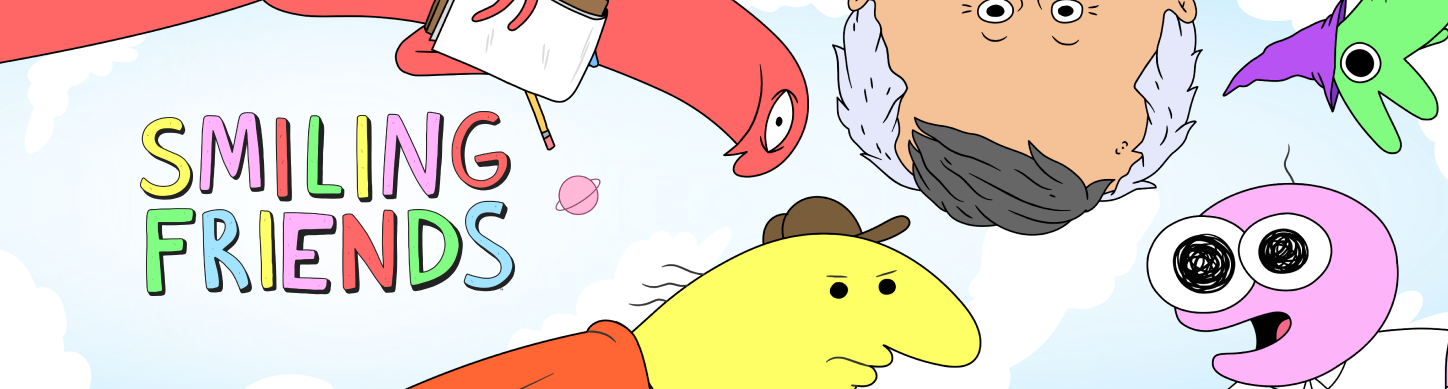
Today's topic is simple: Why is Smiling Friends popular? This might seem like a silly topic but it's one that's been at the back of my mind for a while now. This random show has seemingly taken the internet by storm in a way we haven't seen since probably Rick & Morty's initial explosion, and that was a while back now. Where did this show come from?
Now in case you don't know what Smiling Friends is, I'll try to go a bit into the background of it. The first thing to know is that this is a cartoon they debuted on Adult Swim with a pilot way back in 2020. Season 1 premiered in late 2021 with 8 eleven minute episodes (and one special), season 2 in 2024, and season 3 just this year, with two more seasons to come. The show was created by Michael Cusack and Zach Hadel, animators with a past on Newgrounds and YouTube, and an understanding of older internet culture and humor divorced from current trends. As a consequence, its comedy and animation style has managed to connect with not only older audiences but younger adults as well. Smiling Friends has a strangely universal appeal despite its very niche existence.
The series itself is about a pair of friends named Charlie and Pim who work for the titular company. Their job is to do what the title implies and bring joy to their client's lives no matter what it takes. The universe is a sort of a Roger Rabbit-like one where both people and weird animated races live side by side, and all the chaos that would unfurl from such a place. As a consequence the show also experiments a bit with character designs and animation styles, making its visual style very dynamic and adding to the unpredictability of the series itself.
You never really know what each episode will bring.
[Counterclockwise from Top: Mr. Boss, Alan, Charlie, Pim, and Glep]
All of these factors help contribute to what it is that makes Smiling Friends such a success. Its budget is also miniscule, an entire season purportedly being less than a single episode of Family Guy or The Simpsons, and its odd tone and sense of humor also sets it apart from the tidal wave of Adult Animation that we've been inundated with since the 1990s. That being that it has a truly original sense of style and execution the industry has been lacking for ages.
To understand how this is, I should explain with a comparison. Let me give you an example using a recent animated film I saw.
Back during the summer I viewed Genndy Tartakovsky's Fixed, an animated film about a dog that was about to get fixed by his owners for, well, being a dog. The film is animated extremely well in 2D, some great designs and shots, and some scenes (the one with the cats in the alley, specifically) are extremely well done. All in all, it has all the makings to be a good cartoon.
That said, I didn't quite enjoy the movie. The reason? Oddly enough, it's entirely centered on the writing. The writing was been there done that and dated '90s shock humor I've seen a million times with no new wrinkles. It's hard to be shocking when you've been outdone by things the writer himself did (A Simpsons writer from the classic era wrote this movie, by the way) a quarter of a century ago. As a result, the film is hard to recommend unless you literally don't care about seeing the same thing you've seen a million times just animated really well this time.
That is my controversial opinion on this controversial movie, and that's that there isn't anything here controversial. It's just tired. I guessed everything that was going to happen before it did, because I've seen it before. Even the "moral" is straight out of the 1990s. Good animation can't save boring execution, and this movie is boring.
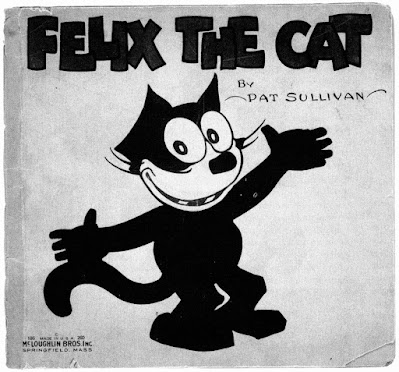
The problem is that western animation is still stuck in the 1990s irony-poisoned cynical and depressive mode its been since that time. Something like Fixed compared to Smiling Friends reminds us that Fritz the Cat wasn't well received for being shocking, but because it was literally doing things in animation we hadn't seen before. It is nice seeing an animated show with a unique identity trying to aim for something actually interesting for once. No therapy writing or pointless nihilism as a punchline, no reliance on shocking through tired gags to get by, but an identity that is uniquely built for the series itself.
The above video describes it more in depth, but what makes animation such a great medium is the expressiveness in drawings you can't get with other mediums. We've spent so long watering down what makes every medium what it was for the past 30 years we've gotten to the point that being the medium itself is considered criticism (see the terms "videogamey" and "overanimated" that did not exist back in the 1990s) because something dares to do what the medium does best and was always built to do. It's all backwards.
It's as if we've been taught that abandoning the medium itself for some kind of blob of non-identity, of generic Content, the kind that fills the corners of modern corporate slop, is the highest aspiration. How long can a medium keep itself locked into a time that is a quarter of a century old without dying? That's the question. And I think we have our answer via the current stagnant state of things.
And it's part of why the creators of Smiling Friends created their own studio. ZAM Studios was made in order to combat what the founders deem a stagnancy in the medium and in the industry itself. They are hoping to bring back some of the spark the industry has been lacking for some time. You can read the linked article to learn more.
Here is the work they did on the Billy Idol song from his recent documentary:
So what comes next? Well, it seems like underground animation has been making a lot of strides over the past few years. Perhaps the medium will soon dislodge itself from this stuck rut its been in for much too long and start delivering uniqueness again. We can only hope.
Until then, we have at least two more seasons of Smiling Friends to look forward to (probably more than that, honestly) and hopefully a new direction for the western industry that tries to take after its success. It would be nice to have an actual good trend spring up for the first time in ages. I sure hope it happens.
Animation is a greatly unique medium that deserves its respect. Not in the sense of making it "mature" or "serious" or whatever warped perception we have of art divorced from reality, but in the sense that it offers a way to communicate differently than any other one, and that is one that should be cherished and cultivated. We do not need anymore subversions or inversions of what makes the medium what it is: we just need to want to have it at its best. No more Peggy Charrens or endless subversions of her disastrous work as the be-all end-all of the medium.
We need to build, not tear down. And to do that, we need a new perspective on how we got here in the first place, and how to move on from it.
That's also what art is supposed to be: a celebration of life, of being alive, and what we're all capable of doing and being. We don't need crusty, dated 20th century principles and subversion to guide us anymore. We can finally aim for something better than that dead era.
We're finally in the autumn season, the season of change, so let's look back at a past that has long since been left behind.
I apologize for the lack of a post last week. Things merely got out of hand. Hopefully it'll happen less and less as we get out of the warmer season. I can only hope.
Today's subject is particularly niche, so I don't blame you if you find it hard to understand. That said, it is quite an interesting topic to look over, especially with the passage of time.
Anime's explosion in the West was a strange one. First slipping into the fringe underground in the '80s before becoming a part of alternative culture in the '90s, and then finally achieving mainstream recognition in the '00s, it was a bizarre series of events to get it to its current worldwide dominance that would arrive in the decades to come. No one would have imagined its gigantic size way back when passing around old badly subtitled episodes of Dragon Ball Z in class and school clubs. It was a much different world.
Speaking of a much different world, I wanted to highlight exactly one that sprang out of this subculture. During that odd transition between underground alternative culture to mainstream in the '90s and '00s came this odd era of the '00s when young audiences tried their own hand at actually making anime. Yes, we are talking about the strange world of Fanime that you have missed entirely. It was a niche of a niche, so it's very possible you never encountered it.
This short era, in retrospect, is an interesting glimpse into how a niche subculture affects a generation growing up entirely on the internet increasingly separated from the mainstream. At the same time, one can see which tropes, styles, and ideas resonated with younger audiences of the time period. Interestingly enough, most of these projects were made by girls, not guys, giving a very different idea of one might expect from such a thing. Few of them were also ever completed, which, again, in retrospect is not all that surprising for the generation in question.
The kids who grew up in this time related more to this foreign art form than they did anything in their own, and it's obvious why they connected to it more at the same time the artificial Geek Culture was at its cultural high. This stuff was simply more honest. It's also why anime would eventually overtake culture entirely. Everything else at the time was dying.
Looking back on it, where we are today was the obvious endpoint of that time, and those raging against it simply aren't trying to understand how it came about. We can't wish away reality, it simply is what it is. And this is how we got to where we are today.
The above video goes much more in depth showing many of these projects, what happened to them and their creators, and the sorts of things that would come out of it later on. Fanime still exists and still gets made, but the priority of the creators is much different in the scene than it once was. In fact, it wasn't long after the initial growth period that it would change entirely. It is funny however to see this scene contrasted with the fanfiction one from the same era. The Fanime one clearly contained those with more creative drive and potential, yet its the fanfiction one that spilled into the professional writing industry and helped drive it into the current ditch its in.
That aside, the entire subculture is much smaller than it was back in the day, splintering like every subculture has over the last two decades into a niche of a niche, but it's still an interesting subject to look over. It's something that could only have happened at one point in time in one age demographic, and it did. We will never see something similar arise again.
In a sense, Fanime still exists beyond its niche, it has just moved into other spaces. The amount of independent creators who work in other mediums from comics to animation inspired by anime only grows by the day and does not seem to be stopping anytime soon. You can see it everywhere, especially considering how anemic the mainstream western industry became pandering to fangirl shipping and trends from angry urbanites who hate their audiences, the alternative would always be much more appealing.
So take a look for yourself and see just what it was all about, and what this time period was like. Maybe you'll even be a little inspired yourself. Who knows? Things aren't always as simple as we might think they are, and this subject is one such topic.
Inspiration can strike anywhere at anytime, and it ways you might never expect. Let's just hope the next bout lasts a little longer and finally shifts this culture into better directions, and hopefully finally brings us back together again.
A very short and slow one this week. I just wanted to point you to this episode of a bunch of older YouTube guys from the old internet relaxing and messing around while talking about nothing important at all. That's right, today it's just something fun and breezy with nothing special going on. Enjoy yourselves!
The reason for this is mainly because so much nonsense has been going on recently, some of it way too heavy for this place, that I figured it would be better to take it easy just for today. Not everything has to be serious and intense all the time. Sometimes you can jut not think about anything at all. This is one of those times.
Besides, next week's post is going to be a lot more explosive, so I wanted to build up to it a little. In that one we're going to really dive into a subject that will ruffle a lot of feathers. Until then, let us actually use a weekend lounge for what it is for: lounging.
I'm not kidding about next week either. It's going to be kind of a big one, covering an issue that a lot of people might not be comfortable about. To give you a hint, it's about an old mouse that has seen better days, and will not be seeing better ones anytime soon.
And that's and all I'll say!
In other news, there is currently another Based Booksale this week, and I have once more put up the entire Gemini Man series for cheap. I chose it again because last time I heard reports that not everyone could get them all, so here is your chance to rectify that weird glitch in Amazon's system. You can find the sale here.
And that's all for this one. Very short piece this week, but again I think it's good to have lighter ones every once in a while. Just kick back as September finally rolls in to hopefully finally take this endless summer away.
It's been quite a week. Here's hoping the weather stabilizes soon because it's been pretty rough in my neck of the woods. I hope it's been better where you are. If only I could pick one temperature and weather pattern and be able to keep it for a week straight that would be great. It's been a real pain to adjust to.
Before we start, I wanted to remind readers that both the next chapter of Phantom Mission is up for patrons and the next podcast episode is also out. Phantom Mission is on Chapter 9 and we're heading towards the climax at breakneck speed. In the podcast episode I talk about The Pulp Mindset for over an hour. It's close to the fourth anniversary of the book (Wow, it's already been that long) so I wanted to go into it a bit. You can find it all at the Patreon here.
For those who are curious about the podcast specifically, there will be another free episode of it in the near future to give you a better idea of what it's about for those who are still debating on joining. Regardless, if you enjoy talking and hearing about the world of art and entertainment it's a fun project to engage in.
That's all for that. Now, let us get into today's topic!
Part 1
We talk a lot about the art and entertainment of the late 80s and early 90s as sort of a transformative period, an era of uncertainty but hopefulness and experimentation before it melted into generic muck by the time the latter decade ended. For those of us who were born before the end, we experienced firsthand as we were growing this period that was almost instantly erased and paved over once the new millennium hit. However, it only stands to reason that as Gen Y, the last group that connected to that era, got older, we would also begin to forget as we aged ourselves.
And that's why blogs like this exist. We need to keep context, we need to remember what it was like, and we need to not be steamrolled by those who wish to throw out all that came before for the next trend. The only way to make good new art is to build on those who came before, and we can't do that if no one properly remembers what actually did come before.
So let us go all the way back to a period simultaneously the most cherished and most hated, the 1980s, as we begin this story. It's about that maverick generation, the one that faded away from the mainstream without a peep as the 2000s came along. Perhaps you remember them; perhaps you are one of them yourself. Today's subject is the lost Gen X.
You probably generally know who they are, but what you might not know, or remember, is their true legacy as artists. That image has been almost lost to time. Much of that disappearance has been a victim of intentional revisionism and self-mythicization from the cohort, but there is more to it all than you might expect.
The truth is that as Gen X kids were coming of age in the 1980s they were entering the art world and putting their stamp on it. They were going to outdo their Baby Boomer parents and take on the world, leaving their mark on it as they did so. However, that aforementioned stamp is not quite what the mainstream narrative sells it as these days. It wouldn't be as profitable to be honest about what Gen X was or what happened to them.
The video series we are discussing covers today's topic in its own story. The series is called "Gen X Hate Revisited" by a YouTube channel called Cartoon Aesthetics. This series is a three part exploration of that transitional time where Gen X kids, the last fully analog generation, came of age, put their stamp on the world of art, and then slowly faded away into the crowd almost overnight. Specifically, this series covers one artist as he rose to fame with his own creation during this very period and shows just how it all sort of fell away as time passed and the market shifted. In fact, his story contains the perfect encapsulation of that generation's story.
As someone born and labeled as a member of Gen Y (someone who falls in the crack between the fully analog Gen X and the fully digital Millennials), and was the first cohort who grew up on this of sort of material back in the day before witnessing it fading as the 1990s wore on to be replaced by bland corpo slop, I've always been fascinated with what exactly that group of young adults were trying to do. It wasn't as if you could ask them--Gen X were mysterious and cool, and prone to be embellish or talk around their own motives. If anything they truly are the unreliable narrator generation. Though unlike the Boomers, it's definitely a voluntary attitude they grew up with and put out of their own accord. They were the older brother generation.
Gen X weren't their parents, but, despite what the memes might say, they didn't full reject them, either. They weren't staunch traditionalists, but they also did not hate the idea of new approaches to old mediums. What they were doing back in the day had a lot of nuance that has been lost over time. What has been traditionally labeled as "cynical" in regards to this generation of so-called "slackers" might not have been anything like that at all.
At least, it didn't start there.
In the first part of this series linked above you can see the shift in comics, music, and, eventually, animation, as a younger generation filled with vigor and spirit to travel new trails took charge of industries that weren't yet subverted and locked up by washed up cliques. Truly, if you engage in Gen X art up until the early '90s you notice a distinct identity, an originality, that sticks out and puts its own unique stamp on the art world.
Then the growing swamp of pop culture noticed their existence.
The video series does a very good job tracing the changes of that transitional period as well as the attitudes of a lot of the people around at the time before self-awareness and ego took the wheel and sent everything down a path that would culminate in the dead-end known as Cultural Ground Zero. Of course, the series being discussed doesn't go into that mess, it's out of the scope of the subject, but it is fascinating to see some of the mentalities that would eventually lead their industries into the ditch before the 21st century hit.
A comic that perfectly encapsulate the uncertain Gen X era in question is the comic called Hate starring underground favorite character Buddy Bradley. This is a series about the young Gen-Xer in question as he moves away from home to Seattle in the early 1990s in the same period it all exploded to mass appeal. You might imagine how that goes. Though the writer was part of the cohort known as "Gen Jones" (a label rarely used today), it made his observations come from a slightly different perspective than you might think as he wrote his younger character living through the time period they all were living through at the time. It's a time capsule of an era few seem to discuss much anymore. Though perhaps there is a reason for that.
The second part of the series covers Hate itself more in-depth here:
Part 2
I recommend watching the videos for yourself, as it is a great look at a time period long gone and currently being sold as something it's not in order to both sell to Zoomers who have no context for it or for crusty Gen-Xers (and Ys) who have bought into the revisionism so they can consume more product and feel more important doing so.
The truth is actually not in the plentiful "Gen X is tough and younger generations are all weak" memes floating around like old Boomer jokes on Facebook, but in how they dealt with how rapidly the world was both changing through technology and, even though no one really noticed at the time, how it was breaking down socially. Things were "weird" and insane because the old ways were being forgotten and tradition and ambition was starting to fall through the cracks. It turns out it wasn't really a new era being born, but the beginning of the end of the old one. This is partially why it's been a subject of scorn and deliberate burial over the years since the '90s ended.
This is the trickiest part a lot of formerly Authentic (capital "A" like they would have wanted) Gen X era artists have when creating art today. They built themselves back in the day on Authenticity as the highest good and key to being Real, but so many have since bought their own hype and locked themselves into preset personality patterns that they forgot who they once were, where they started from, or why they did any of this in the first place, all to keep up with the Joneses of modern trends and attitudes. Their distinct identity is long gone and lost with the passage of time. I could name countless examples but I'm sure you can think of them yourself. There is no shortage of Gen X artists that have lost their edge for Safetyism and modern mainstream acceptability.
What the "Gen X Hate Revisited" video series does is present a good case with Peter Bagge's Hate just what that Authenticity would grow to be without the influence by artificial pop culture hype and untethered to nostalgic expectations of those who want this cohort to be a certain way in Current Year. Bagge remained authentic to his original vision and, as a result, managed to create a piece that works both well as both a time capsule and a series removed from it to stand on its own feet. You get to see that generation in a way you never really get to anymore and he does it by never forgetting where he came from in the first place.
This is mostly because, for all intents and purposes, as I hinted at before, that Gen X cohort doesn't actually exist anymore. Those people are all gone, the party's over, everyone got in line and marched in file out of town, into corpo world as the 1990s drew to a close. They deliberately made themselves irrelevant the very moment they could, almost like a final jest on their old image. Where they went, nobody knows, but the people left who still use that label are hardly who they used to be, and what they tend to be is unrecognizable to what the cohort once was.
So much Gen X art as a whole has simply vanished over the years and has since been absorbed into the safe muck of the ever-creaking corporate mainstream (See: Tim Burton. There, I gave an example) that it's hard to wonder if that Authenticity ever really existed in the first place or maybe it just needed a few bucks to be guided in the Right Direction. The question still remains: where did everyone go since the millennium pulled them all into a vortex of bland? Whatever happened to that distinctive identity? What did it become? Where are they now, and where are they going?
You might get some examples in the third part meant to wrap the Gen X Hate Revisited series up. You can watch it below:
Part 3
I'm not going to comment on the third part and will instead recommend watching it for yourself and coming to your own conclusions. There is little point making judgement on a generation that is still around and still young enough to really do anything or go anywhere. The point is more to see where they are now and where they might go while they still have the chance to do it. Baby Boomers might be locked in to their current path due to their age and inability to change. For Gen X, however, the road is still very much open.
I will say one thing before we wrap it up here, and that it is strange that the Authenticity displayed here, one that was so common with Gen X back at their peak, today feels even more like a relic of a generation that once refused to stay dead. They definitely aren't dead, but sometimes it feels like they were always meant to be, and clinging to the mainstream was the one way to avoid that fate. Does that make sense? I'm rambling at this point, just trying to figure it out. Regardless, they aren't dead, and they aren't done yet. No one really is. There's always a chance to change.
I don't want any of this to sound like I'm throwing stones here. Gen Y has done just about everything I talked about. Our "authenticity" was "objectivity" and leading the charge for materialism acceptance through long-dead trash like New Atheism. In pursuit of relevance and acceptable corporate trends to base our identities around we allowed ourselves to turn to bland inoffensive goo--our legacy is melting down in the 2000s to allow the current state of product worship to be the baseline in appreciating art and entertainment. We basically helped create the current monster of corpo slop worship. Anything negative I can say about Gen X can be applied just as harshly to me and mine. We have not been the preservationists we once saw ourselves as.
The generation that were the excited younger brothers of Gen X back in the '90s turned into wannabe Millennials, hipsters, and consoomers, over the last quarter century, clinging to dead childhood brands that are the last thing around to remember our existence from when we mattered. And all we want is to be left alone to die in the corner with as much cheap plastic crap as we can. What a glorious legacy that will be!
If anything, my generation is worse at all this. Gen X might have faded away, but we threw ourselves off the train before we even got to the stop we were being dropped off at. They still have much to offer, even today, that we could have passed on ourselves if we weren't too busy hoarding corporate products and useless baubles instead.
All that aside, it was an interesting look into generational trends of modernity. Nothing has really changed, it's just gone faster and faster beyond the speed of stability since the back half of the 20th century. Sooner or later (certainly sooner) the wheels will come off and the whole thing is going to derail and fly off a cliff. It's not sustainable, and everyone knows it.
Generations of people can't live separated from each other only to be disposed of when the next trend in line comes around to be cashed in on, rinse and repeat. There is more to us than what we can offer for some corporate monolith that doesn't care either way what happens to us. Whatever the future holds, it won't be in that. It can't be--the 20th century is over and that train is long out of steam. It won't always be this way, whether we want it to be or not.
But that doesn't mean there isn't plenty to learn from the past to help us carry forth to tomorrow. Even if the world ends, we can't stop. Art doesn't stop. We don't, either. We have to keep the torch alive and burning and continue passing it on. That is every generation's duty to the next. It will never change, no matter how different we see ourselves as.
Perhaps that's the question to ask in all of this. Can we keep that torch alive and burning, or are we destined to finally be the ones to fumble it into the ground and leave the future generations in the dark? Is there still time to adjust and recalibrate our aim?
Welcome to the weekend! Let us talk about adventure, though not the sort one usually talks about these days. We're going way back to the late 20th century today.
I don't think I have to reiterate how big the Disney Afternoon was in the late '80s and early '90s. While the company itself did not do so hot during the 1980s, they still tried whatever they could to try and stand out from the crowd. Some of that stuff holds up better than others. One of its projects was to create a block for syndicated cartoons (airing every day of the week) called the Disney Afternoon which had the goal of producing near theatrical quality animation for an entire two hour block at 65 episodes. They carved out a two hour block on the ABC network (this was before they bought it) and spent the next decade more or less owning the after school timeslot. As a result, it ended up being one of the most impressive projects of its time.
But what was more impressive were the series it produced. You see, a bunch of simple gag cartoon series wouldn't be enough to hold kids' attention every day of the week (a lesson they would unfortunately forget by the end of the block's run), so why not make full-throated adventure series in the style of popular Disney comics from years past? You could also mix and match it with well known Disney characters as well as new creations. That is exactly what they did, and the final result was a smash hit.
Much has been said about some of the more popular entries of the block, though truth be told it was all uniformly great up until the time of Gargoyles, which would end up being its crowning achievement and the peak of the entire project. Believe me, that one is still great today. However, you've heard about most of these many times before: DuckTales, Rescue Rangers, Gummi Bears, Darkwing Duck, Bonkers, the aforementioned Gargoyles, and even the more slapstick-inspired Goof Troop. But little is said about what is probably the hidden gem of the entire block: TaleSpin.
Though the series was based on the movie based on the Kipling stories, it took quite a bit of inspiration from other sources to produce its unique setting and style. It's not quite as comedic as Darkwing Duck, as high energy as Rescue Rangers, or as full of danger as DuckTales, but it has its own groove where it comfortably sits in the middle of them all and can bend in different directions depending on the episode airing that day. This makes it quite an interesting series to revisit because you never quite know what you're going to get.
The interesting part about TaleSpin is that it was probably every kid's least favorite series on the block at the time it aired, but now as adults they would easily consider it one of the best if not the best one. It wasn't even that kids didn't like it at the time--they liked it a lot. It was more that it was surrounded by DuckTales, Rescue Rangers, and Darkwing Duck, for most its run, series that appealed more to their youthful sensibilities. It's really as you grow to appreciate things like pulp adventure serials, screwball romance comedies, and general wonder, that you truly grow to get it in a way you couldn't when younger. It's aged extremely well.
I linked the above video talking about the show's production and how it was received when it aired, and you could tell that critics even at the time disliked adventure stories. The number one criticism of the series (and pretty much the block as a whole) is how it was aping and reheating "Spielberg/Lucas adventure stories" for dumb kids. Such a thing, again, is indicative of the hatred of the pulps the mainstream press has pretty much always had, since they did not even know DuckTales did not originate as a cartoon in the first place. None of these series were reliant on movie formulas--they were reliant on old comic book and serial storytelling that had worked countless times before them. It was an attempt to update an old style for newer audiences. They also proved that it could still work on audiences that had no nostalgia for the format.
Of course, Disney had major success in the '90s thanks to moves like this, but it would eventually go to their heads and by the 2000s would almost implode in on themselves, relying on John Lasseter era Pixar to carry them for a good while. But for my money, the studio itself peaked here with these productions and would never quite hit these highs again. Many people consider A Goofy Movie a swansong to the Disney Afternoon era (since it had so many of the same people working on it) and I'd probably agree since not long after the film the block caved in on itself, dying out with the very decade it helped usher in. Perhaps it was a sign of things to come.
Regardless, if you've not seen these old series in a while, or have young ones or relatives that have not experienced any of them, they really do hold up surprisingly well. Check out the video above for proof of that. I would still call them some of the best things the studio ever put out.
Adventure and wonder never fall out of date.
That's all for this weekend, and I'll see you next week!
Every industry today works on an overly corporate belt loop of product without regard to much aside from cost cutting. We've talked about how kid cartoons aren't even made for kids today, but not so much why every cartoon looks the same. Sure, it's cheap, but its never been this blatant before. What is the moment that lead to this downfall?
The above video merely goes into the greater trends in the industry, but doesn't really talk about the root issue. Where did it come from?
I have to be honest, it's that the industry has never really cared that much for creativity except when trying to establish a foothold. Whether the Disney Afternoon, early Nickelodeon, or the early imports of Japanese anime, these hits all came about from risks taken by putting trust into the creators to do what they do best.
With the way the industry is now, risk is forbidden and to be avoided at all costs. Even worse when there is no audience growth as they aim for older audiences who want childish animation instead of animation for kids or adults. There is no incentive for creativity anymore, and therefore the industry is in a death spiral. It won't actually die, but it will continually mechanize itself until the point that AI can replace a creative team that isn't hired to be creative.
Perhaps that is the end goal. Who knows? But every since the introduction of flash animation, industry insiders have defended every move their bosses have made to cut costs, streamline processes, and mechanize creativity.
When machines can be programmed to do what they themselves dumb down their own industry to do, should we be surprised? You can make the argument that "at least there was human input" but don't forget that every change since the millennium in animation has to remove the human element. A machine taking charge is just completing the cycle already begun long ago. If you don't like the loss of humanity then you should have questioned why every change made since digital came in has made the industry more sterile.
Why can nothing still look as good as old Tom & Jerry or Popeye shorts? Why is anime allowed to have more variety of genres? Why do hand drawn cells and traditional animation at their peak still blow away even the best CG over a quarter of a century after being replaced? Why is "better than nothing" considered a worthy standard worth maintaining? At what point should you demand more instead of accepting constantly lowering standards?
Until we address that, nothing is going to change.
In other news, the Gemini Man Kickstarter was funded! If you are a backer, check out the recent update and see just what is happening next. I'm still deciding on some things, but I'm still planning on sending out the first book of the series for digital backers once I've got all my ducks in a row. This has been a long time coming!
That's all for this week, hopefully I can get the blog back to normal again. I know some of you are probably sick of hearing about Gemini Man by now, so don't worry. I'll be heading back into other subjects again now that the campaign is over. I've got some subjects I definitely want to go over in the near future.
We've talked many times about Cultural Ground Zero or Dead Internet Theory in many of these spaces, but one thing we do not discuss is Dead Hollywood Theory, the theory that the former masters of our art and entertainment are not only not around anymore, but there is a constant attempt by those that remain to trick you that they in fact, are not.
One of the most recent examples of this was the revelation that Cartoon Network, once the home for children's entertainment in mass media, no longer appeals to their main demographic. In fact, children do not even watch television anymore (just as we've posited that they do not watch modern movies either) but instead stick to online spaces from YouTube to short video content on other multi-billion dollar sites, but none of these things are run by Hollywood. No, not at all. Oddly enough, it appears that their only audience is a quickly shrinking chunk of the cohort that gave them attention as children. All these old industries are dying.
The reason Hollywood and every other ancient industry keeps sticking to reviving old IP is because they only know how to scrapie for money from the old audience they still have: Millennials who demand constant updated moral revision to their sacred texts, thereby refreshing the old scripture of their youth. They have no new customers coming in.
What do I mean? I mean the fact that the average viewer of the Cartoon Network television station for children, is now nearly 30 years old. Believe it or not, this is the reality we live in now.
And this is their daytime audience, the time when the majority of that age demographic are at work or indisposed with real life activities. Even there they overwhelm the children audience.
This doesn't even mention the recent revelation that Cartoon Network is also expanding their Adult Swim block (a block that has been around since Millennials were children) up to 8pm and into Primetime viewing. In other words, they are catering to adults now, not children. This revelation raises a lot of questions about the maturity level of the content on the network being so much lower than when they were for children, but I digress. Just like the comic book industry, they have given up on growth. All that remains is a slow circling of the drain until death.
But this is not the reason for today's post.
I only bring that up as an example of a wider trend currently occurring. There is an effort among those in charge to puff their chests and pretend the emperor's clothes are not only spotless, but grander than they've ever been before.
Did you know how much of what Hollywood puts out is actually fake? How much of their advertising is a misfire, how much of their revenue is misreported, how much of their streaming watch stats are absolutely botched?
It turns out, nearly all of it. Not only that, but their self-imposed feedback loop of egoism and advertising dollars thrown into the furnace of their own delusions has lead them into a spin cycle into irrelevance. Cartoon Network isn't the only old relic of Cultural Ground Zero that is little else but a husk for a generation that has nowhere else to turn to.
Hollywood is dying. Technology is changing, but so are audience's tastes, and it is all thanks to a system that has taken to chasing its own tail than engaging with whatever dwindling crowd still gives them attention. It's all fake.
Check out the above video to see just how artificial modern Hollywood is and how bad things really are there. It should also tell you just how little it provides what the audience wants. They aren't actually catering to anyone, just indulging in mindless egoism in their own shoddily constructed mirror. Forget Dead Internet Theory (which is quickly proving itself real with events like this), let us instead see this as proof of Dead Hollywood Theory.
The old ways are ending. It is time to prepare accordingly.
Welcome to the weekend! Hopefully you're having a good one.
This above video was posted on Twitter just a few days ago, found on a VHS tape from 1999. It really shows you the different about how things were back then versus how they are, especially anime. They were also advertised much differently, as well.
For those unaware, anime was known as the alternative underground option that was sold on hardcore action and adventure and the weird. Throughout the '90s, thanks to companies like Streamline Pictures, ADVision, and Manga Entertainment, anime quickly became the source of bizarre, wonderful, new worlds, as the mainstream western industry was slowly being swallowed up by the changes brought on by the ACT and the streamlining of animation as safe, corporatized, edutainment product. Even by 1999, anime hadn't fully broken out in the West, but it was on the cusp, as the video shows. People wanted actual variety.
This was still the time period where there was a sizeable audience for animation aside from those wanting "comfy" shows where nothing happens and everyone learns a Captain Planet-style lesson at the end. This was all that existed even though viewers still had a hunger for wonder. They still do, but it's not as obvious today was it was then. Back then the western industry's take on animation was completely one note and harmful to creativity. It led to the dire state of things today.
At the time, animation itself was caught in a false dichotomy between "kid" and "adult" instead of just being a medium to translate ideas and new worlds. It was not really treated as a place of possibilities, and it still isn't today. This shallow dichotomy only worsened over the years to the point where now Adults primarily watch programming for Kids, and Kids primarily watch programming for adults . . . if they watch modern western media at all. It has gotten that broken over the years. This is what decades of letting a problem fester instead of addressing it does.
You didn't read that wrong. The majority of people watching the network where the material "isn't made for them" but for children, are nearing middle age. Children are no longer watching.
This comes hot on the heels of Cartoon Network's Adult Swim block now taking over all of the prime time slots on the channel. This is a channel on its death bed. Children no longer watch television, never mind cartoon channels. All that remains are adults who want to watch children's programming (ostensibly) aimed at them instead. So children are consumed in the once adult internet and adults are consumed in the once childish network. Though CN still is kid focused in their material, it is just adults wanting to watch Captain Planet-level material instead of demanding more things in the vein of Gargoyles or even old HBO fare like Spawn, something that could be built on. They want children's programming, for whatever reason. This is a weird backwards mentality currently dragging the whole industry down and keeping anything original from being made. Eventually the independents will be all that is left. The mainstream did this to themselves
The above world of 1999 isn't around anymore. It's trapped in the same cliché product mill that things like Isekai are currently trapped in. There is no attempt to reach wider audiences or try new things. There isn't even an attempt to do justice to old things. It's just the same things rehashed over and over again to dwindling audiences. The only animation trying anything at all in the vein of what used to exist, are independent creators. The mainstream has decided up is down, down is up, adult is childish, childish is adult, and everything is backwards, and the people still there, what little remains, likes it that way. There is a reason these industries are only shrinking and dying: there is no growth here. There is no future down this road.
Anime's obsession with "comfy" also exists, but at the very least they are trying things like the new ONA idea to bring back some of that wonder again. There are still some new projects being attempted. They have not completely given up like the West has. There is a reason Japan has consumed the West in their animated and comic book mediums, and isn't just because Japan is better at it. It is because the West has given up entirely. Hopefully we will be able to right the ship sooner than later, but it will only happen in the underground. The mainstream West is done.
All that is left are the mavericks. Be sure to seek them out and support them when you can! That is where the future lies.
That's it for this time! Have some more promos, this time from 1997, to tide you over. Enjoy your weekend!
Today I just wanted to share a quick project for you. This is an animated pilot called Lackadaisy, an animated pilot that takes place during prohibition era St. Louis, starring quite the cast of characters. One glimpse of this and you'll be able to see: Animation isn't dead.
Somewhere between Don Bluth and the Disney Afternoon, Lackadaisy aims a bit heavier than how artificial the medium has become, but still manages to try for an All Ages approach. Thing is, All Ages used to mean a different thing before the ACT got involved and splintered what the industry was even able to be.
It's only a half hour of your time, and down completely independent, so be sure to give it a shot. At this point, it should be obvious to anyone that the mainstream has no interest in anything aside from the same degrading formula they have stuck to for decades now. Anything outside of that would seem like a breath of fresh air, even more when it's quality like this.
As we've been saying in the PulpRev for years, any change that is going to happen will come from outside the system. We have to explore new frontiers.
It is the only way forward.
That's all for this time. April is finally here, and warmer weather is just around the bend. Have a good weekend and I will see you next time!
The weekends are important. You already know this, and there is no point telling you that as if you don't, but there is a specific greatness to this time of the week that goes completely overlooked in this age of constant activity, bad shiftwork, and unending job hopping. That being, the importance of leisure and relaxation.
For kids, the existence of Saturday Morning Cartoons were the perfect encapsulation of such a thing. Before they were destroyed by the very same people currently censoring everything unchecked today, Saturday Morning Cartoons were the one place where kids could relax and have fun after a long week of work.
This is what things like TGIF used to tap into, though for the entire family in that case. There is something to a thing as a simple as a television block being so capable of drawing out so much excitement and anticipation from an entire set of people that hasn't truly ever been studied by all these supposed Pop Culture scholars of today.
Here is a brief piece on the history of Saturday Morning Cartoons found online. It's short, but a good primer for those who might be unfamiliar with the time period.
Saturday Mornings were the closest things kids have to a true rest day, at least in the modern world. No other day really came close, especially not the way parents would treat the rest of their activities as time blocks to be filled in. We all knew kids like that back in the day. Perhaps we do that ourselves today. Regardless, it's no way to live.
There is a reason commercial compilations still exist on YouTube
Think about it.
After the dreary "reality" you have been forced to endure all week, you finally survive and make it back home to rest. After emerging from said rest you awaken into a world of wonder and excitement, taking you to new worlds and possibilities far away from what you know. Not only that, but you also share it with your friends and families, your entire community. You all experience this together, and you all grow to experience the same sensations as you get older and older.
This is how, even nearly a quarter century from their unceremonious implosion, Saturday Morning cartoons remain such a positive memory for everyone who experienced them. Everyone who was alive for the short period those blocks were around still remember and thinks highly of them. You won't find anyone who lived with them calling them down. They were important, and they remain so, even years after they were shut down and taken away.
In an age where we don't see much of a purpose to most work, leisure doesn't quite seem like the reward it once was. Now it merely is treated as a break between the dreariness of modernity. There isn't much there these days.
Do we have an equivalent to Saturday Morning Cartoons today? Is there an adult equivalent to bring us together into a shared experience?
No, there is not. There is nothing at all that unites us, not even for one morning out of seven in a full week. Even putting aside cartoons, we are less united as a culture than ever before. In an age of remote work, never ending job hopping, and low societal trust, there is little true escape to be had. Suffice to say, we've completely lost any sort of connection between us on any level and it harms the sort of escapism we can indulge in.
But that doesn't mean we can't learn from this example of a dead practice and apply it to the future. Even something as simple as a television block has something to teach us about the importance of leisure. Perhaps something will come about in the future to eclipse those experiences we had long ago. Who knows? The future is wide open.
Until then, we can work for something better. There are no limits, after all. We should start acting like there aren't!
A lot of talk has focused recently on mediums. What exactly causes a piece of entertainment or an idea to fit in a specific medium? Is it stubbornness from the creator, or is there more to it than you might think? Their decision would depend on many factors, but mostly on whether or not the medium fits the story they are trying to tell. Thus, action stories work better in prose when the story involves more than focus on set pieces, and cartoons work better when the animation allows movement and focus that requires the visuals other mediums cannot rely on. Everything has a purpose. (Except CG! It still looks fake and doesn't carry any story to best any other medium. Everything CG does would look better with practical effects or 2D animation. Sorry, guys!)
One thing we have to remember: every story has a reason to be the medium it is, even if you don't see it yourself. The bigger problem are those on the outside that will prejudge any creation solely by the medium it is created in. This is a fear of art, and it is not healthy in creating a sustainable scene or building any future.
We need a reassessment. Not just on mediums, but on what art is meant for in the first place. We have lost the plot.
There are still people in this day and age that refuse to grasp the purpose of art and entertainment as either more than a silly waste of time or propaganda meant to rouse the troops to your side. Even worse when it can be weaponized against you and your own neighbor by an industry that's sole purpose of existence is supposed to be to serve you. Now they exist to turn family against family and friend against friend, all over issues that can't even be discussed in private company or rational conversation. Everyone else is the enemy, all the time. How did it get so backwards?
The problem is that art and entertainment, even though it is meant to connect, is frequently made by either an individual or a smaller group of like-minded folk who have the herculean task of breaking through the wall of noise around the culture to make any impact. The industry, whether music, movie, book, or whatever, was supposed to do the heavy-lifting of breaking through while the creators worked on creating. Theoretically, this is so the artist can focus on the art.
Theoretically. We know how well theories not based in reality turn out. We're living it today as we are ruled by industries that hate us.
In essence, those in charge are deliberately going against their purpose. Therefore, it is rather useless, not able to give creators anything to justify their existence.
Much is told about how these industries have stifled creativity in the past, but not much on how the original purpose was to keep creators focused with their eyes on the prize without having to be distracted by nonsense. They were supposedly made to allow art and entertainment a place to thrive. Obviously, they don't do that anymore. Eventually that purpose warped into them becoming master over a slave caste that is so buck-broken it will do anything for scrap of clout in an industry that wouldn't care if they were found dead in a ditch tomorrow. All to live the myth of artist as some sort of priest class.
We've seen this happen in the book, comics, music, and movie, industries, but we haven't talked much about another key one: animation. This is mostly because a lot of people still to this day undervalue it as an art, including those actually in the industry. They will make and defend the lowest quality work (cheap work their corporate masters assigned to them, by the way) and attack anyone who points out the emperor's lack of clothes. Especially if it's the audience complaining. Why aim or strive for higher standards when you can live off scraps and make substandard product? At least they preach the right messages to the cattle, though.
But how did this happen? When did animation get to be so easily controlled and thrashed into obedience like a whipped dog? Wasn't this the medium back in the 1990s known as the wild maverick space where anything could happen? It was. This obvious yet ignored shift goes back a long time. But it has always had a reason, mostly because it was ignored as an artform by the mainstream. It still is, actually.
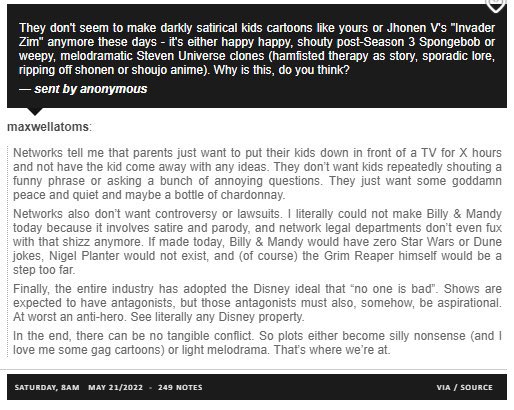
Author Rawle Nyanzi recently brought this piece from animator Maxwell Atoms to my attention, creator of personal favorite cartoon The Grim Adventures of Billy & Mandy. Here he is asked about the shift in the animation industry from trying to entertain into trying to educate over the last decade or so. The question and response aren't framed that way, but this is how it comes off, especially years after Mr. Atoms' series was forcibly ended despite its popularity.
That industry doesn't really exist anymore.
What he describes is exactly what the entire western industry has become: safe corporate product meant to educate children. But is that ever what animation was made for? Is that the only thing it is allowed to be? Why, and who decided this?
It comes down to lack of respect for the form. There isn't anyone in charge of the industry anymore who cares about the art of animation, and the people let in by the suits see it as nothing more than a tool to be exploited. So that's what it has become, much like every other form today. It is a weapon to be used against the audience, and not one to work for them.
You'll also notice that the "Disney ideal" he mentions is not an ideal of Walt Disney. This is a modern invention. Walt Disney's works contained villains and objective evil to contrast his good. His very first feature film's villain is based off the most well known villain of all-time and was suitably slain to reach the happy ending the story needed. This ideal Mr. Atoms is speaking of is the one the corporation has now, and wishes to foist on everyone else.
Many will say that these companies are just trying to make money, but they are not. The moral shaping and attempts at ideological propaganda exist to create utopia. You are dealing, once again, with Utopians. They believe that by portraying the world in a certain specific way in their art that they will change existence to be "correct" and all world ills will be solved. Who cares if it is barely animated with bad designs and cliché-ridden scripting: it is doing Good Work for the Cause. If you doubt there is a Cause I would suggest you look up any interview with any of the people currently with a series at Cartoon Network or Disney. They will quickly spout all the correct buzzwords and propaganda their masters require of them. They certainly aren't going to complain about pay or working conditions when they are doing the task assigned to them by their masters! FIAWOL!
All of this is because the clout and the image of priest class is too enticing for certain people to resist, and the industry enables it.
If this writer sounds a bit bitter over the issue it is because I love animation as an artform. It can depict entire worlds and ideas in a visual way that movies, not even with computers, can do, and it allows a level of freedom that live action or "realism" can't quite manage. In essence, of all the visual mediums, it offers the most potential. And it is currently being utterly squandered by juvenile materialists who just want their ideological fix.
Nothing about this form, by the way, precludes that it must be a "kid" thing, but neither does it mean it has to be a subversive thing like it is today. There is a middle ground that has been lost along the way, probably with the 20th century's obsession with discarding everything before we've even bothered to try to tap into its full potential. By rushing towards the future, we forgot the past. Animation is one of the crown jewel inventions of the 20th century that came in with cinematography, and yet we've let it become this. The form can be far more than just dick and fart jokes or bad political and social programming. But it hasn't been that in a long time.
Where did that shift start? Many would argue it has always been there, underneath the surface. After all, animation was made by normal people with urges, faults, and passions, of their own. Certainly they had thoughts or ideas they wanted to express outside of the status quo of their day. They did it through their animation, and this all eventually shaped the perception of what the form still is for some people to this day.
The below four part series on "subversiveness" in animation is worth watching. It was aired sometime around the year 2000, so it was near the time "adult animation" became infected with South Park and Family Guy clones, where it has been trapped ever since. I suggest watching it while keeping in mind the contents are very graphic and NSFW. I am not joking, a lot of the material can get as close to XXX rated as you can without getting removed from YouTube. Oddly enough, most of that material is actually black and white.
This is "Cartoons Kick Ass: A History of Subversive Animation" and it goes a long way in showing how the medium got to where it is today.
Part 1/4
Part 2/4
Part 3/4
Part 4/4
If one still wishes to dismiss animation, or any artform, as useless or not worth paying attention to after seeing this, then they are not serious people. Even by the time you get to the end of the above documentary you can see how unchecked subversion divorced from any conversation or relation to reality can lead to a dead end of insanity. There wasn't anywhere left to go. It's no coincidence the western industry is dead now.
Tables can only be flipped so many times before they break apart. By the end of the documentary, you can see the sign of the times of audiences "no longer being offended" and "everything being on the table" to shock and awe the audience. You certainly don't see that now, so where did all those people go? What even was the point of all this to begin with?
Two decades later, and what did that attitude build? What did it lead to? Even the documentary basically says it lead directly to internet porn and therefore took most of the appeal of the subversion away. What can be more shocking than outright pornography? This is what happens when you put the most important aspect of your medium on anti-social aspects instead of any higher aim. It isn't that you can't use elements like blood or sex appeal to reach wider audiences, you very much can, but it must be part of a bigger plan than just to "shock" like some cheap gimmick. Gimmicks only work a few times before they grow old and stale.
Just being "free" to do "whatever you want" means little if it's not attempting to connect with anyone except to inflate your own ego. Unfortunately, this is the one thing that has carried forward from the subversive days so many see as a Golden Age. What you want is all that matters, and anyone who complains is some kind of chud normie or whatever that is getting in your way. At no point is there an attempt to try to understand or appeal to someone outside of yourself. This is what leads to death, especially in art scenes. You can't grow if you deliberately cut off all your roots.
A lot of people, especially in the west, get mad when you bring up Japan, but they have always known how to use these over the top and potentially "dangerous" elements far better to tell a story than the west has. At least in the comic book and animation world, they have always been far better at using offensive and dark subject matter to connect with their audience. Partially because their motives do not seem to come from such an obviously angry and bitter place.
As an example, there is a manga series called Apocalypse Zero (the Japanese title is "Kakugo no Susume") from a ways back. It was given a short anime OVA back in the day, but it's practically unheard of in the west today. This is a series that uses both hyper violence and sexual content, two things very easy to get wrong, in a way the glorifies neither while also not demonizing violence or sex at their base level. Confused? Don't worry, I will try to explain it. This series is in fact is so good at what it does that it manages to bake this balance into the general themes of the story itself which is very impressive. All of this exists in a simple hero tale that takes place at the end of the world.
I'm not the most knowledgeable on Apocalypse Zero outside of having read the manga, but this is a work that ran from 1994-1996 and manages to feel like one that is much older. Taking in the tradition of Violence Jack or Fist of the North Star, Apocalypse Zero uses the end of the world post-apocalypse setting to establish a breakdown of modernity which leads the story to focus on what it is about civilization that truly matters, and what it is that drags us down. Such a thing can always be an excuse for soapboxing, especially in modern OldPub, but this one avoids that minefield pretty handily while giving the audience exactly what they came for.
The main character is Kakugo, a trained monster slayer, who roams post-Earthquake Japan with a battle armor (named Zero) given to him by his father. Here he comes across "Tactical Fiends" which are mutated humans that have become little more than beasts ruled by their urges and sick desires. This is where a lot of the extreme content springs from, showing the twisted minds and desires of those given in to hedonism in their despair at existence. They must be stopped before they kill even more of the swindling number of innocents still alive.
Kakugo, however, only has his code of honor and manhood to drive him forward. He is a very masculine character, devoted to justice and protection of the innocent, where evil must be stopped at any cost. Despite the end of the world, he embodies an aspect of human dignity and courage that everyone else struggles to maintain. Kakugo is seen as even more of a relic in a world that is full of them, at this point. His focus on truth at the expense of worldly distractions (or unworldly, as it may be at times) is what allows him to be the warrior and guiding light that people need. He is the direct opposition of everything he faces, which is perfect for a hero story.
Where this is reflected in is the antagonist of Apocalypse Zero, Kakugo's brother Harara. Harara is trained in the art of killing monsters much like Kakugo is, except he wishes to destroy humanity and has gathered the tactical fiends and many other warriors under his wing to do it. The real contrast, however, is that for some reason Harara's body has been morphed into that of a woman, on top of his complete attitude shift of who he once was. In every way, he operates as Kakugo's mirror opposite willing to use anything and anyone as a tool in his bid to wipe humanity off the map. I'd explain why that is, but it's fairly involved as an explanation and would more or less require explaining the events across all 100 chapters. What is important is that their conflict will decide the fate of the world. Which character's ideals are stronger?
The hyperviolence and sexual content also relates to how their martial arts work. Much like Fist of the North Star involves exploding insides or diced flesh, Apocalypse Zero involves a sort of energy wave that goes through the body to expel organs forcefully. This plays into the theme of Guts in the martial arts and action sense that drive such stories and how one must control themselves or be lost to their baser urges. The sexual content works much the same way, usually as either temptation (hilariously ending one scene as Kakugo literally tells said character to get out of his kitchen because she is unhygienic) or as someone who has given into their primal lust. It says a lot that despite this content, the series never feels dirty because it all has a purpose in the overall piece.
If this sounds similar to how series such as Berserk or Vagabond do such things then you would be correct. The main difference is that Apocalypse Zero is a lot more in your face about it in a way that makes a lot of people uncomfortable. It is a hot-blooded action series, and being extreme as can be in relation to the tone is important. Unless you have a strong stomach you will not make it past chapter 1, never mind making it through all 100.
It should also be stressed that violence is justified if it is necessary, and wholesome relationships are considered good to have. There is no rejection of either as "wrong" or however they would portray such things today. The story ends basically saying this all could have been avoided had a single family had not torn itself apart for base material glory. Temptation is a weakness, as is greed and lust for power. You are here for much higher things.
There is more I want to talk about, but can't without really describing everything that happens. Apocalypse Zero goes to some crazy places, but it never falls off the wagon or gets too out there. Nonetheless, life and death, God and salvation, good and evil, and corruption and purification, all play a role in what elevates the story to higher places. As it goes along it gets harsher and more over the top, but the themes only strengthen as you watch Kakugo put through the ringer of this dying world in an attempt at one last chance to save it from its baser urges. Apocalypse Zero is so good at this that I had to remind myself it didn't actually come out years before it did, especially when you remember the types of western comics that were being made at that time.
The greater point here is that Apocalypse Zero contains all these things "subversive" works claim they want to have and thrive off of putting in their material, but is far better at using them than pretty much all the above examples in the documentary. There is no comparison. It does this by having a purpose, themes, and a general aesthetic that is uniquely its own. Even if it has similarities to manga classics like the already mentioned Violence Jack and Fist of the North Star, surely big inspirations for the writer, it stands completely on its own and should probably be just as big as they are. Why it hasn't yet reach that level yet is anyone's guess.
This is an example of art through entertainment. It is meant to be entertaining and pleasing to an audience, but has a bit more to it for those who wish to dig in and find it. This is more than just trying to mindlessly tweak people's noses and not much else. The west would do good to understand that instead of just flipping the same table over for an eternity.
There has to be more to art than just being shocking and subverting. At some point you have to have some sort of aim, even if it's a basic one like Tom & Jerry with a barebone rivalry or Fleischer Superman with a simple hero plot. They hold up due to this and much of the material in the above documentary does not, because it was never meant to. You cannot sustain a scene like this and, lo and behold, they didn't.
Nonetheless, it's all over now.
You have one side of the aisle that sees animation as a tool to fix or even warp people, and the other side that dismisses this artform entirely as trivial and disposable. Now where have you seen that before? Neither side is attempting to create art--they are either fighting against reality, or ignoring it. Animation could be so much more than it is today, but it's not, because one side cares more about subversion and propaganda against normal folks and the other side thinks it's meaningless kiddy fluff meant to be a babysitter. Hint: it's not either. It's an artform. It's only as good as you let it be, and we've not let it be much for a long time.
Once again, if we wish to grown beyond where we once were, we're going to have to see things from a different angle, to consider ideas and tactics we never even considered before. Art needs to be able to inspire, and it can only do that if it is given the support to thrive. This can't be done if those in charge see it as nothing but a tool for ideological subversion, a paycheck, or a waste of time for dumb people. Art is not a gimmick, so stop treating it as one.
We have many more roads to travel ahead of us. It's time to stop blocking them all off for no real reason. Art, like God, always wins in the end. We just have to let it through.