Showing posts with label animation. Show all posts

Saturday, March 7, 2026

Learing Lesons


Welcome back to the wasteland!

Been a crazy February, and March isn't looking to slow down. Here's hoping the weather does, at the very least. I'm still working slowly on various projects and dealing with some annoying real life things, but I'm also still thinking about topics to discuss with you all.

And today's is a good one, so let's get right to it.

Recently, one of the topics that has been running through my head (to the point it became a topic on my podcast), is the subject of Edutainment. It's more about how the definition of Edutainment has stayed the same over the years, but its perception since I was a kid has changed, and not for the better. What was once seen as a joke is now taken seriously, and it has made entertainment and art as a whole considerably worse and less inspiring. I don't think anyone can deny this with a straight face: Edutainment is lame, but now we insist it's not..

The reason for this change is still quite unclear to me, though it's undeniable that a shift exists, at least with those around my age and slightly younger. At some point we came under the delusion that Edutainment was not only extremely effective (it isn't), but it's also worth defending and reshaping entertainment around (it's not).

But there is no reason for this silly belief. Edutainment is a perversion of both entertainment and education, taking the worst parts of both without offering anything in return to make up for its deficiencies. An invention of the 20th century in an attempt to subvert the mass media landscape, all Edutainment has ever done is fail and leave no mark on the minds of its viewers beyond mockery and a neutering of both Entertainment and Education. It just doesn't work.

The reason for this is because both Entertainment and Education exist to do different things, and cannot be crossed over with the other in a satisfying way. Of course this does not mean you cannot be entertained while learning or learn something from entertainment, but that those are secondary to the primary reason said things exist in the first place. You can't prioritize both. It's simply impossible.

Entertainment exists to entertain, it is primarily for leisure. It is meant to allow the audience to relax and unwind, to allow the audience to rest in the place they have chosen to lay their head down. Art exists to allow the patron to appreciate a slice of reality from an angle they might not have expected. There is a sense of trust between the artist, the art, and patron, that involves both understanding and like-mindedness. They all come together to connect for a wider purpose for everyone involved.

No one engages in art and entertainment to be educated: they come to be enlightened. There is a very subtle, but important, difference here. Enlightening means to be shown a world apart and yet close to the one we live in and seeing a new side of it. It does not mean teaching or lecturing the audience about a specific subject. This difference is not as appreciated these days, but it's still reality, and one of the reasons the audience trusts the mainstream industry less and less.

We have lost the original point of what we're doing.


Education, on the other hand, exists to instruct and teach. It requires a very specific type of relationship between the two parties, one above the other. This cannot be an equal relationship where one gives and one takes: it involves one side deliberately speaking down to another party in order to educate them on the subject the student agreed on in order to be there in the first place. This is why so many kids don't learn much in school: they not only didn't agree to this relationship, they also aren't looking to learn in the first place. Education only works when the relationship is agreed upon and the student and instructor are engaged and on the same page. It cannot work otherwise.

This is the opposite of how art and entertainment works. One is done on even ground, the other is not. It's a fundamental difference which precludes any sort of mashup from working, and they clearly do not from any example we have seen over the past decade especially.

Edutainment dilutes entertainment by making its focus on that unequal partnership with the audience. It also dilutes education by masking it in a fog of entertainment and blunting any point that is supposed to have been gotten across through learning. In essence you're getting entertainment without the wonder and mystery, and you're getting education without the focus and clearcut language and relationship between a student and teacher. You are getting the worst version of both at the same time.

And everybody knows this.

This is why obvious propaganda like Captain Planet was a punchline among all the kids when it came out. Everyone knew what it was and it was terrible at doing what it wanted to do. The lessons were unsubtle and not very clever, and the entertainment value was stunted so that those kids wouldn't get the wrong impression of violence or adventure as anything but controlled and neutered. Neither of these approaches satiate childhood wonder.

It was much like how Peggy Charren and her ACT group forced educational content into kids shows and was never not a punchline in the schoolyard. Remember the GI Joe lessons at the end of episodes? The ones that had nothing to do with the show and were crammed in? That was because of her and her ilk. If you don't remember that then there is also the Sonic Sez segments in the Sonic cartoon which had marvelous lessons such as "Don't climb into the dryer" which is as ridiculous as it sounds. You can also find them on YouTube with a comment section filled with people laughing at them, some of which weren't even around when said shows aired.

This is how you know they failed at what they were doing.


All this aside, an other issue is that this lame moralizing occurs while at the same time executives and parent groups keep dictating what sorts of "lessons" shows should be taught to the kids, thereby affecting the creation of these series from people that had nothing to do with their creation. Again, all this was supposedly for kids but no kids liked them and they were always treated as lame punching bags, which is how they stayed for decades.

But recently that changed as the people now in charge of the entertainment industry have decided they want to lecture the customers in everything, because they see themselves as above those they are supposed to entertain. It doesn't matter what gets put out, if it has the correct message then it is considered a net good and anyone against what they are doing, for whatever reason, must be a Bad Person. There is simply no other explanation for this madness. This would be like if those parent councils browbeat all the kids back in the day who made fun of Captain Planet for being lame: Who cares if it's lame, it's right!

The thing is, it actually doesn't matter if it's right or not: it has failed as entertainment. It has focused on the lecturing first and left the entertainment a distant second in consideration, and the audience can tell. This approach is a dead end, and it's why no one in charge of these industries can produce anything of value that connects with a wider audience anymore. They can't do this because their priorities are backwards and they have no intention of being humble and realizing that.

This doesn't mean you can't "say something" in art and entertainment. It's more that what you say is meant to be baked in to the piece you're creating. The themes and meaning come from the story the artist has to tell. It comes from the music, the art, the creation, itself. This is how you sometimes get interpretations of pieces not originally intended by the creator. It isn't because either party is wrong but because they see reality from different angles and are able to come together over the piece and find new wrinkles in it together. Regardless, it is impossible to create art without meaning, but it is possible to miss the meaning in the creation process. This is because the primary importance is in the creation: not the intended meanings.

Another way to put it is that education is about learning what you can and can't do when learning about a subject; entertainment is about seeing all the subject has to offer. They are entirely different approaches that cannot mix together.

Edutainment is one of the worst and most embarrassing failures of the 20th century and it is one that has no business carrying over in the 21st. No one learns anything from it, and no one is entertained by it, and yet we pretend it is successful when both the least imaginative and most didactic people are the ones who push for it, thereby proving its failure right out of the gate. If this is the kind of people edutainment produces then it's clearly well past its expiration date.

Instead, let's strive to improve both the dismal state of modern education and create a new ecosystem for art and entertainment. They both need it instead of us constantly hiding behind a failed mutation that has no place in today's climate.

And maybe we can finally leave the failures of the past behind us. We can finally have those better ways we were promised long ago. We're well past due for a new golden age of art and entertainment. Let's make it, together!

That's all for this week! See you all next time!


Saturday, December 27, 2025

Weekend Lounge ~ Are You Smiling?


Welcome to the weekend!

It's the last weekend of the year, and boy has it been quite the 2025. I'll talk about that in one last post on New Year's Eve to close off the year, but not right now. Today I wanted to focus on one last straggling topic I've wanted to cover but could never quite figure out how to. As you can tell I wanted to talk about a more recent phenomenon.

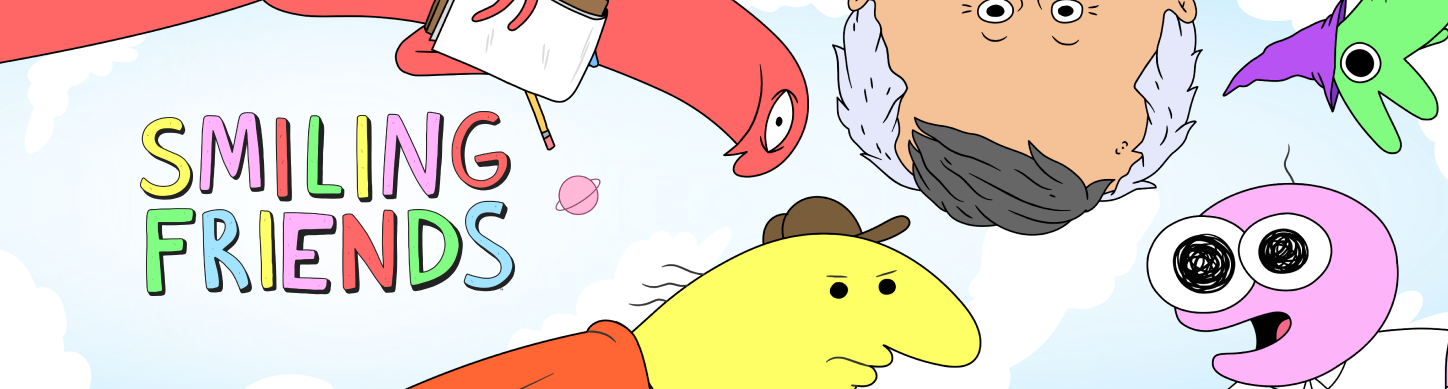
Today's topic is simple: Why is Smiling Friends popular? This might seem like a silly topic but it's one that's been at the back of my mind for a while now. This random show has seemingly taken the internet by storm in a way we haven't seen since probably Rick & Morty's initial explosion, and that was a while back now. Where did this show come from?

Now in case you don't know what Smiling Friends is, I'll try to go a bit into the background of it. The first thing to know is that this is a cartoon they debuted on Adult Swim with a pilot way back in 2020. Season 1 premiered in late 2021 with 8 eleven minute episodes (and one special), season 2 in 2024, and season 3 just this year, with two more seasons to come. The show was created by Michael Cusack and Zach Hadel, animators with a past on Newgrounds and YouTube, and an understanding of older internet culture and humor divorced from current trends. As a consequence, its comedy and animation style has managed to connect with not only older audiences but younger adults as well. Smiling Friends has a strangely universal appeal despite its very niche existence.

The series itself is about a pair of friends named Charlie and Pim who work for the titular company. Their job is to do what the title implies and bring joy to their client's lives no matter what it takes. The universe is a sort of a Roger Rabbit-like one where both people and weird animated races live side by side, and all the chaos that would unfurl from such a place. As a consequence the show also experiments a bit with character designs and animation styles, making its visual style very dynamic and adding to the unpredictability of the series itself.

You never really know what each episode will bring.


[Counterclockwise from Top: Mr. Boss, Alan, Charlie, Pim, and Glep]


All of these factors help contribute to what it is that makes Smiling Friends such a success. Its budget is also miniscule, an entire season purportedly being less than a single episode of Family Guy or The Simpsons, and its odd tone and sense of humor also sets it apart from the tidal wave of Adult Animation that we've been inundated with since the 1990s. That being that it has a truly original sense of style and execution the industry has been lacking for ages.

To understand how this is, I should explain with a comparison. Let me give you an example using a recent animated film I saw.

Back during the summer I viewed Genndy Tartakovsky's Fixed, an animated film about a dog that was about to get fixed by his owners for, well, being a dog. The film is animated extremely well in 2D, some great designs and shots, and some scenes (the one with the cats in the alley, specifically) are extremely well done. All in all, it has all the makings to be a good cartoon.

That said, I didn't quite enjoy the movie. The reason? Oddly enough, it's entirely centered on the writing. The writing was been there done that and dated '90s shock humor I've seen a million times with no new wrinkles. It's hard to be shocking when you've been outdone by things the writer himself did (A Simpsons writer from the classic era wrote this movie, by the way) a quarter of a century ago. As a result, the film is hard to recommend unless you literally don't care about seeing the same thing you've seen a million times just animated really well this time.

That is my controversial opinion on this controversial movie, and that's that there isn't anything here controversial. It's just tired. I guessed everything that was going to happen before it did, because I've seen it before. Even the "moral" is straight out of the 1990s. Good animation can't save boring execution, and this movie is boring.

The problem is that western animation is still stuck in the 1990s irony-poisoned cynical and depressive mode its been since that time. Something like Fixed compared to Smiling Friends reminds us that Fritz the Cat wasn't well received for being shocking, but because it was literally doing things in animation we hadn't seen before. It is nice seeing an animated show with a unique identity trying to aim for something actually interesting for once. No therapy writing or pointless nihilism as a punchline, no reliance on shocking through tired gags to get by, but an identity that is uniquely built for the series itself.

The above video describes it more in depth, but what makes animation such a great medium is the expressiveness in drawings you can't get with other mediums. We've spent so long watering down what makes every medium what it was for the past 30 years we've gotten to the point that being the medium itself is considered criticism (see the terms "videogamey" and "overanimated" that did not exist back in the 1990s) because something dares to do what the medium does best and was always built to do. It's all backwards.

It's as if we've been taught that abandoning the medium itself for some kind of blob of non-identity, of generic Content, the kind that fills the corners of modern corporate slop, is the highest aspiration. How long can a medium keep itself locked into a time that is a quarter of a century old without dying? That's the question. And I think we have our answer via the current stagnant state of things.

And it's part of why the creators of Smiling Friends created their own studio. ZAM Studios was made in order to combat what the founders deem a stagnancy in the medium and in the industry itself. They are hoping to bring back some of the spark the industry has been lacking for some time. You can read the linked article to learn more.

Here is the work they did on the Billy Idol song from his recent documentary:


So what comes next? Well, it seems like underground animation has been making a lot of strides over the past few years. Perhaps the medium will soon dislodge itself from this stuck rut its been in for much too long and start delivering uniqueness again. We can only hope.

Until then, we have at least two more seasons of Smiling Friends to look forward to (probably more than that, honestly) and hopefully a new direction for the western industry that tries to take after its success. It would be nice to have an actual good trend spring up for the first time in ages. I sure hope it happens.

Animation is a greatly unique medium that deserves its respect. Not in the sense of making it "mature" or "serious" or whatever warped perception we have of art divorced from reality, but in the sense that it offers a way to communicate differently than any other one, and that is one that should be cherished and cultivated. We do not need anymore subversions or inversions of what makes the medium what it is: we just need to want to have it at its best. No more Peggy Charrens or endless subversions of her disastrous work as the be-all end-all of the medium.

We need to build, not tear down. And to do that, we need a new perspective on how we got here in the first place, and how to move on from it.

That's also what art is supposed to be: a celebration of life, of being alive, and what we're all capable of doing and being. We don't need crusty, dated 20th century principles and subversion to guide us anymore. We can finally aim for something better than that dead era.

And we can also have fun along the way.


Some examples of the show in action


Saturday, October 4, 2025

Weekend Lounge ~ Fanime!


Welcome to the weekend!

We're finally in the autumn season, the season of change, so let's look back at a past that has long since been left behind.

I apologize for the lack of a post last week. Things merely got out of hand. Hopefully it'll happen less and less as we get out of the warmer season. I can only hope.

Today's subject is particularly niche, so I don't blame you if you find it hard to understand. That said, it is quite an interesting topic to look over, especially with the passage of time.

Anime's explosion in the West was a strange one. First slipping into the fringe underground in the '80s before becoming a part of alternative culture in the '90s, and then finally achieving mainstream recognition in the '00s, it was a bizarre series of events to get it to its current worldwide dominance that would arrive in the decades to come. No one would have imagined its gigantic size way back when passing around old badly subtitled episodes of Dragon Ball Z in class and school clubs. It was a much different world.

Speaking of a much different world, I wanted to highlight exactly one that sprang out of this subculture. During that odd transition between underground alternative culture to mainstream in the '90s and '00s came this odd era of the '00s when young audiences tried their own hand at actually making anime. Yes, we are talking about the strange world of Fanime that you have missed entirely. It was a niche of a niche, so it's very possible you never encountered it.

This short era, in retrospect, is an interesting glimpse into how a niche subculture affects a generation growing up entirely on the internet increasingly separated from the mainstream. At the same time, one can see which tropes, styles, and ideas resonated with younger audiences of the time period. Interestingly enough, most of these projects were made by girls, not guys, giving a very different idea of one might expect from such a thing. Few of them were also ever completed, which, again, in retrospect is not all that surprising for the generation in question.

The kids who grew up in this time related more to this foreign art form than they did anything in their own, and it's obvious why they connected to it more at the same time the artificial Geek Culture was at its cultural high. This stuff was simply more honest. It's also why anime would eventually overtake culture entirely. Everything else at the time was dying.

Looking back on it, where we are today was the obvious endpoint of that time, and those raging against it simply aren't trying to understand how it came about. We can't wish away reality, it simply is what it is. And this is how we got to where we are today.

The above video goes much more in depth showing many of these projects, what happened to them and their creators, and the sorts of things that would come out of it later on. Fanime still exists and still gets made, but the priority of the creators is much different in the scene than it once was. In fact, it wasn't long after the initial growth period that it would change entirely. It is funny however to see this scene contrasted with the fanfiction one from the same era. The Fanime one clearly contained those with more creative drive and potential, yet its the fanfiction one that spilled into the professional writing industry and helped drive it into the current ditch its in.

That aside, the entire subculture is much smaller than it was back in the day, splintering like every subculture has over the last two decades into a niche of a niche, but it's still an interesting subject to look over. It's something that could only have happened at one point in time in one age demographic, and it did. We will never see something similar arise again.

In a sense, Fanime still exists beyond its niche, it has just moved into other spaces. The amount of independent creators who work in other mediums from comics to animation inspired by anime only grows by the day and does not seem to be stopping anytime soon. You can see it everywhere, especially considering how anemic the mainstream western industry became pandering to fangirl shipping and trends from angry urbanites who hate their audiences, the alternative would always be much more appealing.

So take a look for yourself and see just what it was all about, and what this time period was like. Maybe you'll even be a little inspired yourself. Who knows? Things aren't always as simple as we might think they are, and this subject is one such topic.

Inspiration can strike anywhere at anytime, and it ways you might never expect. Let's just hope the next bout lasts a little longer and finally shifts this culture into better directions, and hopefully finally brings us back together again.

The last thing we need is to keep drifting.


Saturday, May 17, 2025

Weekend Lounge ~ Character Rot & Unchecked Ego


Welcome to the weekend!

It's been a bit since we did one of these, so I wanted to pick something of a bit more obscure subject to cover. This time I wanted to cover the current practice of character rot currently plaguing modern mainstream franchises and revivals. It isn't just an ignorance problem, it's an ignorance problem brought about by stubborn ego.

A lot of talk is spent about why so many properties forcibly change old things to "fix" them while a loyal cadre of people who got into it for what it originally was always complain about it. Contrary to popular belief, it isn't the customers who are wrong in these cases: it is the creators who willing ignore what they don't like or understand about the property and set about to "repair" its perceived problems. All while pop cultists who will consume anything let them uncritically demolish it because they too do not care much about the issue.

For an example of this very problem I suggest the above issue from the Sonic the Hedgehog franchise, and franchise itself that has had one nasty identity crisis its entire existence, but only really became a problem when a certain sect of western obsessives got their foot in the door and started making demands instead of approaching the assignment with pure intentions. What you get is the mess above that completely misses the original intent of the project.

We go on a lot about how ideology is responsible for these trends, but the truth is that it all stems from an ignorant misunderstanding of a subject then, instead of correcting course, doubling down the way the ideology tells you to. In the end, it's ego. While artistic ego is real, when working with others one is meant to reign it in and collaborate to make the best of both worlds. At no point should you consider it carte blanche to run roughshod over everyone else and assume you are the final arbiter of what is right and good.

It's a strange narcissism that runs in this generation of creators that seems to be just about everywhere, even when it's completely undeserved. Whether in comics, TV, video games, and even books, there is a disturbing lack of humility to be found in it, even in something like an old stalwart property from the 1990s. Every 20th century IP is infected with this mentality now, and it appears to be completely inescapable.

However, what's not inescapable is the change in the independent spaces and NewPub. There you don't have to go through any of this decay because it's all owned by the original creators who have no aspiration to sell out to a dead industry for a quick buck. It's about building, not cashing in and going home. We have a duty to create, and we're going to do it.

In other news, there's a new podcast episode on the Patreon. This one is over an hour long and is about tertiary characters and creations and how they matter more than we might think. I also go on a bit where I think the industry is heading beyond this modern rut. It's an exciting one!

We've got quite a lot to look forward to.

Thanks again for all your support, and I'll see you next time!


Saturday, January 11, 2025

Weekend Lounge ~ Animated Past


Welcome back! I hope the new year is working out well for you!

For 2025's first proper post, lets take a look at the above video. It shows a bit of the evolution and changes of the animation industry in both the US and Japanese animation industries. Why certain things happened and why others did not. It's more of a general summary and history, so you won't get specific details on certain things, but the general gist of why things happened the way they did. Worth the watch just for the comparison.

That said, the main thrust of it can be gathered pretty clearly. Japan thought of animation as a medium to explore with stories and new techniques while the US never really considered animation as anything but kid stuff. This didn't change as the years went on. Even the "adult" animation we talk about these days was simply "adult" because it was subversive and winking at you that it was doing what it was because it was playing in a "kid" medium. As a consequence, exceptions aside, it never really grew up. It neve really wanted to.

I'll go a bit further than the video and name at least one of the culprits. If you've read here for a while than you probably know who I'm going to blame.

The US industry was also run by secular prudes like Peggy Charren since near the beginning, and this is an unavoidable subject. People that fought for complete censorship (No shooting villains, showing blood or death) for children while simultaneously fighting for complete freedom for adults to watch everything short of (and it would eventually include) pornography after a certain timeslot for adults. Where such people got the idea that poison stopped negatively affected you just because you turned a certain age is a mystery, but also completely nonsensical for moral crusaders to believe in. This is what happens when your morality is empty on the base of it. This helped contribute to the oddly stunted maturity of the industry that never really, and still hasn't, ever tried to grow up. This is what has led it into the wall it crashed into some time ago.

Of course, Japan has its own issues with over-corporatization and an increasingly rigid reliance on tired formulas, but it doesn't change that their base is still a lot stronger under them. They can still make things like Pluto or Frieren. This side of the pond can't make anything but "Billion dollar corpo/ nostalgia franchise slathered in late 20th century grey morality" which runs out of steam incredibly fast every time. The only new thing it has is cramming ever-changing modern sexual morality into whatever they do to make it more predictable. It cannot compete with the East, and we all know it. It can't even compete with its own past, at this juncture.

The most exciting US animation is entirely underground at this point and done by people who are passionate about the medium in a way the mainstream simply isn't (some examples here), despite how the individual workers might feel. The US isn't hopeless or finished in regards to the medium, but they are behind, and thankfully the newer generation, the one least enthralled with nostalgic throwbacks to dead days and constant subversion, are looking ahead. They are the ones who will steer the ship in the right direction.

Despite what the tone of this post might indicate, I am vey optimistic for the future of the medium, but I do think all the more interesting projects at this point (particularly in regards to the US) are coming from the younger generation in the indie sphere. Such seems to be the case for a lot of things these days, but it's particularly true here.

What we need going forward is our entertainment industries run by people who not only want to push things to the next level, but also hold no bitterness towards the past; people who think art has a meaning or purpose being consuming or giving the finger to someone they are bitter towards. Create something new, something fresh, and want to show it to both the young and old. Art can bring us together, it does not always have to divide or tear down.

Until we figure that out, I'm afraid a lot of industries are just going to remain stuck. So here's hoping 2025 is the year we make strides to turn that around.

Thanks for joining me in this fresh new year! It's going to be a good one.


Saturday, November 16, 2024

Weekend Lounge ~ Delinquent!


Welcome t the weekend. Short one today!

The following is a three hour video that covers the delinquent genre of manga. It starts from the beginning and purports to be definitive as it is meant to go through the the past to the present. In a sense it does because the creator covers a lot of material to the point where it's actually a bit overwhelming to watch the full thing.

That said, I don't actually recommend watching the entire thing. The first third of the video about the beginnings of the genre and what is considered a "delinquent" manga is the best material. After that the creator gets far too opinionated and misunderstands the appeal of many genre staples (and misses many crossover hits that expands said definition) because he has a very narrow view and specific set of expectations he wants out of it. So if you are interested in learning about what the delinquent genre is and its appeal, you're not going to get much out of watching the whole. Particularly if you've read some of the series covers and find his opinions on them off or bizarre.

But the first hour or so is very informative and a good sum up on where it came from and what the general appeal is. It also show the difference from other forms of delinquent culture across the world.

You see much of the appeal of delinquent stories isn't from bad kids doing bad things but from teenagers learning what it means to live in a world that doesn't have much use for masculine behavior, leaving the young stranded and alienated on how they are supposed to fit in. This atomized feeling is that heart of the genre which then can lead in any direction: from the split between good and bad kids, to traveling down the wrong path, or even learning to channel that energy in a direction that benefits everyone.

You can go in many directions, and the genre definitely has over the years. It's how you get entries as varied as Ashita no Joe, Akira, Yu Yu Hakusho, Tora Dora, and Slam Dunk, and characters from other related and bordering genres like One Punch Man, School Rumble, Fruits Basket, and Saiki K. Its themes are universal enough to be folded into even series that don't focus on delinquents. They remain an important staple in their stories.

The closest equivalent I can imagine in the West would be the works of S. E. Hinton. Most other stories over here tend to miss the appeal of these sorts of stories or characters, opting instead to make them heartless monsters or generic villains. Probably because we tend to see such characters as "bullies" and bullies are treated as very one dimensional. But while there can be overlap, they are usually not the same archetype. Regardless, that is usually how they are used and they always strike me as being very boring characters with not much to say.

That is a shame, because in my opinion, these kinds of characters always end up being my favorites, and I assume they do for many others as well. Feels like a missed opportunity.

Not to say Japan always does them well either. A large chunk of them simply stop at making said character a loud idiot with no redeeming features, and that's as far as it goes. But dig a little deeper and you usually find, in my eyes, the character who always ends up being the best one. I would be ecstatic if we would write more characters like these over here. In case you are wondering, yes, I actually do have many characters like this. And I probably always will. They highlight a specific failing of modernity that more writers need to touch on.

Plus they are always the coolest and funniest characters. There has to be a reason for that! Why else would they be such an important staple in so many stories?

Anyway, that's all for this week. In case you missed it, check out the new post from earlier in the week! It's a good one.

Have yourself a good weekend and I will see you next time!


Saturday, September 14, 2024

Weekend Lounge ~ Zillion, Revisited!


Welcome to the weekend, I hope it's been a good week for you. Here is a last minute change of plans! I was not expecting this, but a perusal of my spam folder (if you sent me something and I didn't answer you, this might be the reason!) showed me a message from the creator of today's project. Stick around, because this is a good one!

Today we're covering a brand new fandub of the classic anime Zillion, a series that I covered on Wasteland & Sky ages ago. However, I believe the edition I covered is out of print now that Funimation has been absorbed by Sony. If you haven't seen the series, the first two episodes of the new fandub are up right now and as good a time as any to get into it. You can find the channel currently hosting the project here!

For those who need a refresher, Zillion was one of the original modern multimedia projects back in the day, being a light gun game by Sega on the Master system as well as one of the first anime produced by Production IG (in cooperation with Tatsunoko Productions) and is a great old time. Though a late '80s production, it has a sort of warmth and excitement to it that ran through anime in the '70s into the '90s before dying out in the new millennium. The series also holds up very well today despite not being very modern. That just helps it stand out all the more.

So what's Zillion about? One word: Adventure!

It's the future and humanity is expanding out into the galaxy. An unstoppable alien force has emerged out of nowhere, threatening our very way of lige, and now humanity's hope rests in the skills and quick trigger-fingers of a group of good-natured teenagers with attitude. With their super guns, ATVs that turn into mecha suits, and episodic adventures featuring exciting and inventive action set pieces every week, join our main trio as the get closer and closer to saving humanity and get better and better at doing just that.

They don't make 'em like that anymore, and, to be honest, they were already starting to turn away from making them like that even when Zillion was around and doing well. Regardless, this series is an easy recommend, especially for kids, and has a vibe that anyone can get into. The series is just unbridled joy and fun to watch with a surprisingly high production value and animation quality for a show that only ran slightly longer than a typical anime season of its time. Perhaps its multimedia origins helped it stand out, but it also helped it age very well.

Give the series a chance. It's still a great watch today.

The second episode of the brand new fandub is below. If you sub you can even watch more as they come out in the future! Unfortunately the original series is not available for streaming, and with Funimation gone the physical release is certainly out of print and not being released again anytime soon, so who knows if there will be another way to watch it in the near future. As well all know, streaming is not a good way to preserve anything as it is, so options are dwindling for a lot of things that should be much more easily preserved. Anyway, I digress.

Here is episode two:


Once again, the channel is available here.

That's all for this week! As a writing update, I just received an acceptable from two different magazines and will talk about those when I can. At the same time, there is one chapter of Phantom Mission left for next week, so get on the Patreon and catch up! 

At the same time, I just put the cap on another short story that will release in the future. It's been a productive time. I've got a few more I want to finish off for the end of the year, so send some prayers out that I'll be able to do it. We all know as we get into Autumn that things start to get trickier both weather-wise and in other things.

Lastly, I just put out a new episode of the podcast for backers, as well. This one is on Y Signal and '90s Nostalgia. I talk quite a bit about how they mix in the episode here. If you ever wanted to know more about the behind the scenes on that weird tale, this is the place to hear it!

Thanks again for your support, especially in this tenth anniversary of Wasteland & Sky! I never thought we would be around this long back when I started, so it's very humbling to see that not only are we still around, but still thriving at the same time.

There's also a lot more to come, so stick around, and just wait! You're going to love it. We've only just begun.


The underground city reveals its true form! Can our heroes stop the madness and reach the surface again? It's time for the final encounter! One Chapter left until the finale!

Saturday, August 10, 2024

Weekend Lounge ~ X Generation

Wow, that's a throwback in many ways


Welcome to the weekend!

It's been quite a week. Here's hoping the weather stabilizes soon because it's been pretty rough in my neck of the woods. I hope it's been better where you are. If only I could pick one temperature and weather pattern and be able to keep it for a week straight that would be great. It's been a real pain to adjust to.

Before we start, I wanted to remind readers that both the next chapter of Phantom Mission is up for patrons and the next podcast episode is also out. Phantom Mission is on Chapter 9 and we're heading towards the climax at breakneck speed. In the podcast episode I talk about The Pulp Mindset for over an hour. It's close to the fourth anniversary of the book (Wow, it's already been that long) so I wanted to go into it a bit. You can find it all at the Patreon here.

For those who are curious about the podcast specifically, there will be another free episode of it in the near future to give you a better idea of what it's about for those who are still debating on joining. Regardless, if you enjoy talking and hearing about the world of art and entertainment it's a fun project to engage in.

That's all for that. Now, let us get into today's topic!


Part 1


We talk a lot about the art and entertainment of the late 80s and early 90s as sort of a transformative period, an era of uncertainty but hopefulness and experimentation before it melted into generic muck by the time the latter decade ended. For those of us who were born before the end, we experienced firsthand as we were growing this period that was almost instantly erased and paved over once the new millennium hit. However, it only stands to reason that as Gen Y, the last group that connected to that era, got older, we would also begin to forget as we aged ourselves.

And that's why blogs like this exist. We need to keep context, we need to remember what it was like, and we need to not be steamrolled by those who wish to throw out all that came before for the next trend. The only way to make good new art is to build on those who came before, and we can't do that if no one properly remembers what actually did come before.

So let us go all the way back to a period simultaneously the most cherished and most hated, the 1980s, as we begin this story. It's about that maverick generation, the one that faded away from the mainstream without a peep as the 2000s came along. Perhaps you remember them; perhaps you are one of them yourself. Today's subject is the lost Gen X.

You probably generally know who they are, but what you might not know, or remember, is their true legacy as artists. That image has been almost lost to time. Much of that disappearance has been a victim of intentional revisionism and self-mythicization from the cohort, but there is more to it all than you might expect.

The truth is that as Gen X kids were coming of age in the 1980s they were entering the art world and putting their stamp on it. They were going to outdo their Baby Boomer parents and take on the world, leaving their mark on it as they did so. However, that aforementioned stamp is not quite what the mainstream narrative sells it as these days. It wouldn't be as profitable to be honest about what Gen X was or what happened to them.

The video series we are discussing covers today's topic in its own story. The series is called "Gen X Hate Revisited" by a YouTube channel called Cartoon Aesthetics. This series is a three part exploration of that transitional time where Gen X kids, the last fully analog generation, came of age, put their stamp on the world of art, and then slowly faded away into the crowd almost overnight. Specifically, this series covers one artist as he rose to fame with his own creation during this very period and shows just how it all sort of fell away as time passed and the market shifted. In fact, his story contains the perfect encapsulation of that generation's story.

As someone born and labeled as a member of Gen Y (someone who falls in the crack between the fully analog Gen X and the fully digital Millennials), and was the first cohort who grew up on this of sort of material back in the day before witnessing it fading as the 1990s wore on to be replaced by bland corpo slop, I've always been fascinated with what exactly that group of young adults were trying to do. It wasn't as if you could ask them--Gen X were mysterious and cool, and prone to be embellish or talk around their own motives. If anything they truly are the unreliable narrator generation. Though unlike the Boomers, it's definitely a voluntary attitude they grew up with and put out of their own accord. They were the older brother generation.

Gen X weren't their parents, but, despite what the memes might say, they didn't full reject them, either. They weren't staunch traditionalists, but they also did not hate the idea of new approaches to old mediums. What they were doing back in the day had a lot of nuance that has been lost over time. What has been traditionally labeled as "cynical" in regards to this generation of so-called "slackers" might not have been anything like that at all.

At least, it didn't start there.

In the first part of this series linked above you can see the shift in comics, music, and, eventually, animation, as a younger generation filled with vigor and spirit to travel new trails took charge of industries that weren't yet subverted and locked up by washed up cliques. Truly, if you engage in Gen X art up until the early '90s you notice a distinct identity, an originality, that sticks out and puts its own unique stamp on the art world.

Then the growing swamp of pop culture noticed their existence.

The video series does a very good job tracing the changes of that transitional period as well as the attitudes of a lot of the people around at the time before self-awareness and ego took the wheel and sent everything down a path that would culminate in the dead-end known as Cultural Ground Zero. Of course, the series being discussed doesn't go into that mess, it's out of the scope of the subject, but it is fascinating to see some of the mentalities that would eventually lead their industries into the ditch before the 21st century hit.

A comic that perfectly encapsulate the uncertain Gen X era in question is the comic called Hate starring underground favorite character Buddy Bradley. This is a series about the young Gen-Xer in question as he moves away from home to Seattle in the early 1990s in the same period it all exploded to mass appeal. You might imagine how that goes. Though the writer was part of the cohort known as "Gen Jones" (a label rarely used today), it made his observations come from a slightly different perspective than you might think as he wrote his younger character living through the time period they all were living through at the time. It's a time capsule of an era few seem to discuss much anymore. Though perhaps there is a reason for that.

The second part of the series covers Hate itself more in-depth here:


Part 2


I recommend watching the videos for yourself, as it is a great look at a time period long gone and currently being sold as something it's not in order to both sell to Zoomers who have no context for it or for crusty Gen-Xers (and Ys) who have bought into the revisionism so they can consume more product and feel more important doing so.

The truth is actually not in the plentiful "Gen X is tough and younger generations are all weak" memes floating around like old Boomer jokes on Facebook, but in how they dealt with how rapidly the world was both changing through technology and, even though no one really noticed at the time, how it was breaking down socially. Things were "weird" and insane because the old ways were being forgotten and tradition and ambition was starting to fall through the cracks. It turns out it wasn't really a new era being born, but the beginning of the end of the old one. This is partially why it's been a subject of scorn and deliberate burial over the years since the '90s ended.

This is the trickiest part a lot of formerly Authentic (capital "A" like they would have wanted) Gen X era artists have when creating art today. They built themselves back in the day on Authenticity as the highest good and key to being Real, but so many have since bought their own hype and locked themselves into preset personality patterns that they forgot who they once were, where they started from, or why they did any of this in the first place, all to keep up with the Joneses of modern trends and attitudes. Their distinct identity is long gone and lost with the passage of time. I could name countless examples but I'm sure you can think of them yourself. There is no shortage of Gen X artists that have lost their edge for Safetyism and modern mainstream acceptability.

What the "Gen X Hate Revisited" video series does is present a good case with Peter Bagge's Hate just what that Authenticity would grow to be without the influence by artificial pop culture hype and untethered to nostalgic expectations of those who want this cohort to be a certain way in Current Year. Bagge remained authentic to his original vision and, as a result, managed to create a piece that works both well as both a time capsule and a series removed from it to stand on its own feet. You get to see that generation in a way you never really get to anymore and he does it by never forgetting where he came from in the first place.

This is mostly because, for all intents and purposes, as I hinted at before, that Gen X cohort doesn't actually exist anymore. Those people are all gone, the party's over, everyone got in line and marched in file out of town, into corpo world as the 1990s drew to a close. They deliberately made themselves irrelevant the very moment they could, almost like a final jest on their old image. Where they went, nobody knows, but the people left who still use that label are hardly who they used to be, and what they tend to be is unrecognizable to what the cohort once was.

So much Gen X art as a whole has simply vanished over the years and has since been absorbed into the safe muck of the ever-creaking corporate mainstream (See: Tim Burton. There, I gave an example) that it's hard to wonder if that Authenticity ever really existed in the first place or maybe it just needed a few bucks to be guided in the Right Direction. The question still remains: where did everyone go since the millennium pulled them all into a vortex of bland? Whatever happened to that distinctive identity? What did it become? Where are they now, and where are they going?

You might get some examples in the third part meant to wrap the Gen X Hate Revisited series up. You can watch it below:


Part 3


I'm not going to comment on the third part and will instead recommend watching it for yourself and coming to your own conclusions. There is little point making judgement on a generation that is still around and still young enough to really do anything or go anywhere. The point is more to see where they are now and where they might go while they still have the chance to do it. Baby Boomers might be locked in to their current path due to their age and inability to change. For Gen X, however, the road is still very much open.

I will say one thing before we wrap it up here, and that it is strange that the Authenticity displayed here, one that was so common with Gen X back at their peak, today feels even more like a relic of a generation that once refused to stay dead. They definitely aren't dead, but sometimes it feels like they were always meant to be, and clinging to the mainstream was the one way to avoid that fate. Does that make sense? I'm rambling at this point, just trying to figure it out. Regardless, they aren't dead, and they aren't done yet. No one really is. There's always a chance to change.

I don't want any of this to sound like I'm throwing stones here. Gen Y has done just about everything I talked about. Our "authenticity" was "objectivity" and leading the charge for materialism acceptance through long-dead trash like New Atheism. In pursuit of relevance and acceptable corporate trends to base our identities around we allowed ourselves to turn to bland inoffensive goo--our legacy is melting down in the 2000s to allow the current state of product worship to be the baseline in appreciating art and entertainment. We basically helped create the current monster of corpo slop worship. Anything negative I can say about Gen X can be applied just as harshly to me and mine. We have not been the preservationists we once saw ourselves as.

The generation that were the excited younger brothers of Gen X back in the '90s turned into wannabe Millennials, hipsters, and consoomers, over the last quarter century, clinging to dead childhood brands that are the last thing around to remember our existence from when we mattered. And all we want is to be left alone to die in the corner with as much cheap plastic crap as we can. What a glorious legacy that will be!

If anything, my generation is worse at all this. Gen X might have faded away, but we threw ourselves off the train before we even got to the stop we were being dropped off at. They still have much to offer, even today, that we could have passed on ourselves if we weren't too busy hoarding corporate products and useless baubles instead.

All that aside, it was an interesting look into generational trends of modernity. Nothing has really changed, it's just gone faster and faster beyond the speed of stability since the back half of the 20th century. Sooner or later (certainly sooner) the wheels will come off and the whole thing is going to derail and fly off a cliff. It's not sustainable, and everyone knows it.

Generations of people can't live separated from each other only to be disposed of when the next trend in line comes around to be cashed in on, rinse and repeat. There is more to us than what we can offer for some corporate monolith that doesn't care either way what happens to us. Whatever the future holds, it won't be in that. It can't be--the 20th century is over and that train is long out of steam. It won't always be this way, whether we want it to be or not.

But that doesn't mean there isn't plenty to learn from the past to help us carry forth to tomorrow. Even if the world ends, we can't stop. Art doesn't stop. We don't, either. We have to keep the torch alive and burning and continue passing it on. That is every generation's duty to the next. It will never change, no matter how different we see ourselves as.

Perhaps that's the question to ask in all of this. Can we keep that torch alive and burning, or are we destined to finally be the ones to fumble it into the ground and leave the future generations in the dark? Is there still time to adjust and recalibrate our aim?

I guess we'll just have to wait and see.


Saturday, January 13, 2024

Weekend Lounge ~ Old Tales Spun Anew


Welcome to the weekend! Let us talk about adventure, though not the sort one usually talks about these days. We're going way back to the late 20th century today.

I don't think I have to reiterate how big the Disney Afternoon was in the late '80s and early '90s. While the company itself did not do so hot during the 1980s, they still tried whatever they could to try and stand out from the crowd. Some of that stuff holds up better than others. One of its projects was to create a block for syndicated cartoons (airing every day of the week) called the Disney Afternoon which had the goal of producing near theatrical quality animation for an entire two hour block at 65 episodes. They carved out a two hour block on the ABC network (this was before they bought it) and spent the next decade more or less owning the after school timeslot. As a result, it ended up being one of the most impressive projects of its time.

But what was more impressive were the series it produced. You see, a bunch of simple gag cartoon series wouldn't be enough to hold kids' attention every day of the week (a lesson they would unfortunately forget by the end of the block's run), so why not make full-throated adventure series in the style of popular Disney comics from years past? You could also mix and match it with well known Disney characters as well as new creations. That is exactly what they did, and the final result was a smash hit.

Much has been said about some of the more popular entries of the block, though truth be told it was all uniformly great up until the time of Gargoyles, which would end up being its crowning achievement and the peak of the entire project. Believe me, that one is still great today. However, you've heard about most of these many times before: DuckTales, Rescue Rangers, Gummi Bears, Darkwing Duck, Bonkers, the aforementioned Gargoyles, and even the more slapstick-inspired Goof Troop. But little is said about what is probably the hidden gem of the entire block: TaleSpin.

Though the series was based on the movie based on the Kipling stories, it took quite a bit of inspiration from other sources to produce its unique setting and style. It's not quite as comedic as Darkwing Duck, as high energy as Rescue Rangers, or as full of danger as DuckTales, but it has its own groove where it comfortably sits in the middle of them all and can bend in different directions depending on the episode airing that day. This makes it quite an interesting series to revisit because you never quite know what you're going to get.

The interesting part about TaleSpin is that it was probably every kid's least favorite series on the block at the time it aired, but now as adults they would easily consider it one of the best if not the best one. It wasn't even that kids didn't like it at the time--they liked it a lot. It was more that it was surrounded by DuckTales, Rescue Rangers, and Darkwing Duck, for most its run, series that appealed more to their youthful sensibilities. It's really as you grow to appreciate things like pulp adventure serials, screwball romance comedies, and general wonder, that you truly grow to get it in a way you couldn't when younger. It's aged extremely well.

I linked the above video talking about the show's production and how it was received when it aired, and you could tell that critics even at the time disliked adventure stories. The number one criticism of the series (and pretty much the block as a whole) is how it was aping and reheating "Spielberg/Lucas adventure stories" for dumb kids. Such a thing, again, is indicative of the hatred of the pulps the mainstream press has pretty much always had, since they did not even know DuckTales did not originate as a cartoon in the first place. None of these series were reliant on movie formulas--they were reliant on old comic book and serial storytelling that had worked countless times before them. It was an attempt to update an old style for newer audiences. They also proved that it could still work on audiences that had no nostalgia for the format.

Of course, Disney had major success in the '90s thanks to moves like this, but it would eventually go to their heads and by the 2000s would almost implode in on themselves, relying on John Lasseter era Pixar to carry them for a good while. But for my money, the studio itself peaked here with these productions and would never quite hit these highs again. Many people consider A Goofy Movie a swansong to the Disney Afternoon era (since it had so many of the same people working on it) and I'd probably agree since not long after the film the block caved in on itself, dying out with the very decade it helped usher in. Perhaps it was a sign of things to come.

Regardless, if you've not seen these old series in a while, or have young ones or relatives that have not experienced any of them, they really do hold up surprisingly well. Check out the video above for proof of that. I would still call them some of the best things the studio ever put out.

Adventure and wonder never fall out of date.

That's all for this weekend, and I'll see you next week!


Saturday, January 6, 2024

Weekend Lounge ~ Mechs, Blood, and Rock n' Roll


January might be the coldest and most boring month of the year, but it doesn't have to be. Typically it's the time to form new habits because there isn't much to distract you yet before the year starts rolling on. At the same time, it is also the time to revisit old forgotten things and learn from them before they get lost in the flood of everyday life.

For the first lounge post of the year I wanted to focus on one of the strangest, yet perfectly understandable at the time, phenomenon of the late 1980s and early 1990s. No, not the Japanimation boom you might or might not remember, but s specific popular creation from it. I wanted to share with you the story behind the very unique and of its times anime OVA, Bubblegum Crisis.

This is the story of four women working as mercenaries wearing specialized mecha/power armor called "hardsuits" to battle evil threats in a cyberpunk future world. There is also a lot of killer music, action, and heartfelt emotions along the way. It only lasted for 8 episodes before production troubles split the team of this once in a lifetime project up, but it has still remained a classic of the genre for anyone who remembers it. The series was also highly influential in ways that are still felt in the industry today.

How do you appeal to guys? Pretty simple. Incredible action directed by some of the best animation of the time, attractive women that still blow away the ones in the mainstream industry today, and some of the most exciting music of the time period (in ways you might not expect), all team up to form a complete package of cool.


Motorbikes, power armor, and beautiful women!


Appealing to the male audience can sometimes lead to things you might not expect. Bubblegum Crisis is one of those seminal works of Japanese anime that will probably never fully disappear. It's simply too unique and too well done to over be forgotten.

Now, saying Bubblegum Crisis is of its time seems redundant. It looks 80s, feels 80s, and oozes 80s from every orifice. That said, its roots go back further than that, and its impact lived on beyond that cultural high decade for Japan.

This is why I am sharing the above video with you detailing its entire wild production history. It's a crazy story, unlike any other, and in it you will see not only the importance of cultural osmosis, but the importance of imagination and wonder to really affect people in ways that truly count. This is why younger guys can watch it today and still find a lot to take from it while being blown away by what it does.

Nonetheless, if you are either a creator yourself, looking into a very specific time in culture like the 1980s, or just generally enjoy wild real life stories, I highly recommend the above history of Bubblegum Crisis. There was nothing quite like it and will never be again.

Of course that doesn't mean there is no anime worth your time today. Last year's Pluto was excellent and one of the best anime releases in recent years, and this year seems to have than a few interesting projects on the way.

It's just not quite the same as this era, and will never quite hit the same way. Not that it can, but that makes this time all the more valuable to remember. The past might be a different country but it should still be the same world. We are meant to carry on from it, and help build in new directions for generations to come.

Regardless, Bubblegum Crisis is still very cool today and you should still watch it. And really, that's all that matters.

That's all for this weekend! See you next time!


Saturday, November 4, 2023

Weekend Lounge ~ Scrap Metal


"But it did get worse."

What if you learned an entertainment company you enjoyed fondly as a young one fell apart? Even worse than that: what if you saw the entire thing coming from a mile away, but not only could you do nothing to stop it, the people in charge thought they were succeeding instead? How exactly what something like that come about?

Well, it turns out that we have no shortage of such examples in the modern world, many I've even highlighted before on this blog. However, today I wanted to highlight one project in particular that was such a specific sort of failure that it can only have happened to one company on one project in particular. That's right, this is about RoosterTeeth and Gen:Lock.

For those who don't know what either of those are, and there are plenty these days, RoosterTeeth started out back in the 2000s as one of those user-created content mills based on the properties of others, much like Machinima was (remember them?), who started with the comedy series Red Vs. Blue. RvB was a Halo parody using in game assets to make comedy skits and observations about the video game and pop pop culture itself. It was very much a 2000s era product, as its very name shows, and could not have been made at any other time.

Red Vs. Blue did well, eventually leading RoosterTeeth into trying something more ambitious. Using their talents, they endeavored to make an original universe spearheaded by a man named Monty Oum. He worked on the last few seasons of RvB and was responsible for such viral videos as Haloid (a Metroid/Halo crossover) and Dead Fantasy, (a Dead or Alive/Final Fantasy crossover) which is a 2000s era project if there ever was one. This new project, of course, would be RWBY.

I'm not going to bother to go into RWBY, that whole thing is a story in itself, but suffice to say it was popular. It was so popular that RoosterTeeth attracted a lot of attention from outside parties, many eager to see if they could cash in on this burgeoning "new" form of entertainment. Naturally, this meant more projects would come about.

One such product is the now infamous Gen:Lock, their attempt at a "modern" mecha series. It is now more well known for its failure than anything it did while it was around. There is a lot to go over, so I recommend watching the video above to get the entire experience. Suffice to say, it was an unbridled disaster, spurring from both the worst aspects of independent creators AND the worse aspects of corporate interference. Gen:Lock runs the full gamut of mistakes, bad luck, ineptitude, and does it in such a way that is almost impressive.

As you watch it keep the events in mind for whatever it is you are passionate about, and remember them. Things can always get worse--don't choose to make them worse yourself. Remember what the purpose of art and entertainment is and try your best to not fall into this hole yourself. A lot of the problems described, especially those that happened near the end, are very much turning into common mistakes today in the here and now. This whole event is becoming far too common, and we should not fool ourselves into thinking it should be acceptable.

That's all for today! November is here, and the weather is turning chilly. Be sure to keep warm and have yourself a rest.

Have a good weekend, and I'll see you next time.


Saturday, June 3, 2023

Weekend Lounge ~ The Stagnation of Western Animation


Every industry today works on an overly corporate belt loop of product without regard to much aside from cost cutting. We've talked about how kid cartoons aren't even made for kids today, but not so much why every cartoon looks the same. Sure, it's cheap, but its never been this blatant before. What is the moment that lead to this downfall?

The above video merely goes into the greater trends in the industry, but doesn't really talk about the root issue. Where did it come from?

I have to be honest, it's that the industry has never really cared that much for creativity except when trying to establish a foothold. Whether the Disney Afternoon, early Nickelodeon, or the early imports of Japanese anime, these hits all came about from risks taken by putting trust into the creators to do what they do best. 

With the way the industry is now, risk is forbidden and to be avoided at all costs. Even worse when there is no audience growth as they aim for older audiences who want childish animation instead of animation for kids or adults. There is no incentive for creativity anymore, and therefore the industry is in a death spiral. It won't actually die, but it will continually mechanize itself until the point that AI can replace a creative team that isn't hired to be creative.

Perhaps that is the end goal. Who knows? But every since the introduction of flash animation, industry insiders have defended every move their bosses have made to cut costs, streamline processes, and mechanize creativity. 

When machines can be programmed to do what they themselves dumb down their own industry to do, should we be surprised? You can make the argument that "at least there was human input" but don't forget that every change since the millennium in animation has to remove the human element. A machine taking charge is just completing the cycle already begun long ago. If you don't like the loss of humanity then you should have questioned why every change made since digital came in has made the industry more sterile. 

Why can nothing still look as good as old Tom & Jerry or Popeye shorts? Why is anime allowed to have more variety of genres? Why do hand drawn cells and traditional animation at their peak still blow away even the best CG over a quarter of a century after being replaced? Why is "better than nothing" considered a worthy standard worth maintaining? At what point should you demand more instead of accepting constantly lowering standards?

Until we address that, nothing is going to change.

In other news, the Gemini Man Kickstarter was funded! If you are a backer, check out the recent update and see just what is happening next. I'm still deciding on some things, but I'm still planning on sending out the first book of the series for digital backers once I've got all my ducks in a row. This has been a long time coming!

That's all for this week, hopefully I can get the blog back to normal again. I know some of you are probably sick of hearing about Gemini Man by now, so don't worry. I'll be heading back into other subjects again now that the campaign is over. I've got some subjects I definitely want to go over in the near future.

That's all for now. Have a good weekend!


Saturday, May 6, 2023

Weekend Lounge ~ Strange Journey into Forgotten Lands!

Find the rare dub at the Internet Archive!


Welcome to the weekend! I hope your week has been as wild as mine has been. Starting a Kickstarter campaign and having it fund in 24 hours is exciting stuff. It wasn't quite what I expected to happen, but I can't say it's not a pleasant experience.

Nonetheless, it's the weekend. Time to unwind!

Today, I wanted to go over two things in particular, but before we get to the update on the Kickstarter, I wanted to share a rare find I recently stumbled across.

Years ago, back during Japan's bubble economy, the anime landscape was known for wild and weird OVAs unlike anything you had ever seen before. From weird projects like California Crisis to Megazone 23, it looked as if the sky was the limit. I want to share one of these with you today. Once such anime was known as Leda: the Fantastic Adventures of Yohko, one of the most influential OVAs of its time. This is an older portal story in the vein of A Princess of Mars or Escaflowne, meant to reach a more classic state of wonder. This OVA is not very much like a modern Isekai as we know them today, and that is much of what makes it great.

In Leda, a young woman writes a song for boy she likes, and her love transports her to a new world where an evil sorcerer wishes to use her talents for his own ends. It is her love that is the true power in this anime. Our main character must don the sword of the goddess and cross the land to put an end to this evil so she can get home and present her true feelings to the one she loves the most. It is the sort of romance one does not see too much in anime anymore, never mind one with this much wonder.

Some have complained that her crush isn't well defined or that there isn't any heavy worldbuilding on this one, but both miss the point of the OVA. It is love that transcends time and space and gives us the power to be the best we can be, no matter who we are. The particulars are not the point of this influential anime.

What you might not know about Leda is that, while it was popular and well respected in its day, is fairly unknown in the west even back when it released. However, there was a very rare, infamous dub that was once thought lost to time. That is, until it was put up on the Internet Archive. Now you can see this influential OVA and the rare dub in the same place since no one knows if it'll ever get released again. Rights issues with old OVAs are kind of dicey these days, never mind ones like this that never had much presence over here to begin with.

Nonetheless, Leda is a good watch and holds up well today, especially in a post-Pulp Revolution era where old OVAs are getting more attention in the west than they have in years. You'll have a good time with this one.

You can find the rare dub version of Leda: The Fantastic Adventure of Yohko here. Better check it out before the archive gets gutted thanks to certain OldPub authors scrounging for pennies to give to their masters. We might soon lose preservation efforts like this forever if such folks get their way. No legitimate artist should be for such things.

But that is just one of the things I wanted to mention today.

In other news, here is a new update on the Gemini Man Kickstarter! We funded within the first 24 hours and are now looking towards extras, including new stories and art to be included in the overall package. The initial campaign was to fund cover art for the big magazine-style omnibus release of the trilogy, and that will be commissioned once the campaign has ended. This is all thanks to the generous backers who jumped in so early.

The artist for the cover will be Manuel Guzman, the man who did the cover for Book 3, Gemini Outsider! He went above and beyond on that one. You can see the cover art process for Book 3 below. He did great work on this and I can't wait to see his work on the full trilogy cover! It's been a long time coming and we're so close to the end.


As for the final release, I just got my pre-release copy (without a cover or bonus content) of the paperback copy in the mail recently to look it over, and this thing is a behemoth! We're talking three novels and over 200,000 words and 300 wide pages. This thing is unwieldy, but that is how you want a full trilogy to be. It's definitely stuffed to the brim, though should we hit the stretch goals it will be even more packed.

That's a bit hard to believe from my perspective, but it's been a wild campaign so far. Let us see just how wild it will get be the end! There is plenty of time left to go!

Like I said, this is one huge project. That is why I wanted the readers to be a part of the process and help shape the final project. A full trilogy release like this is an undertaking unlike any I've done before. It's been a real strange journey.

But we have even more of the campaign to look forward to. We still have a month left and I have other surprises to share with you before we get to the end. Check out the campaign page and back today! You're going to love this one.

Wild times are just ahead!