I told you that NewPub would be on fire this year, and it continues today with yet another new project for you to look out for! It feels like there is something new to point out every day. Maybe because there is! It's actually getting very tough to keep up with it all.
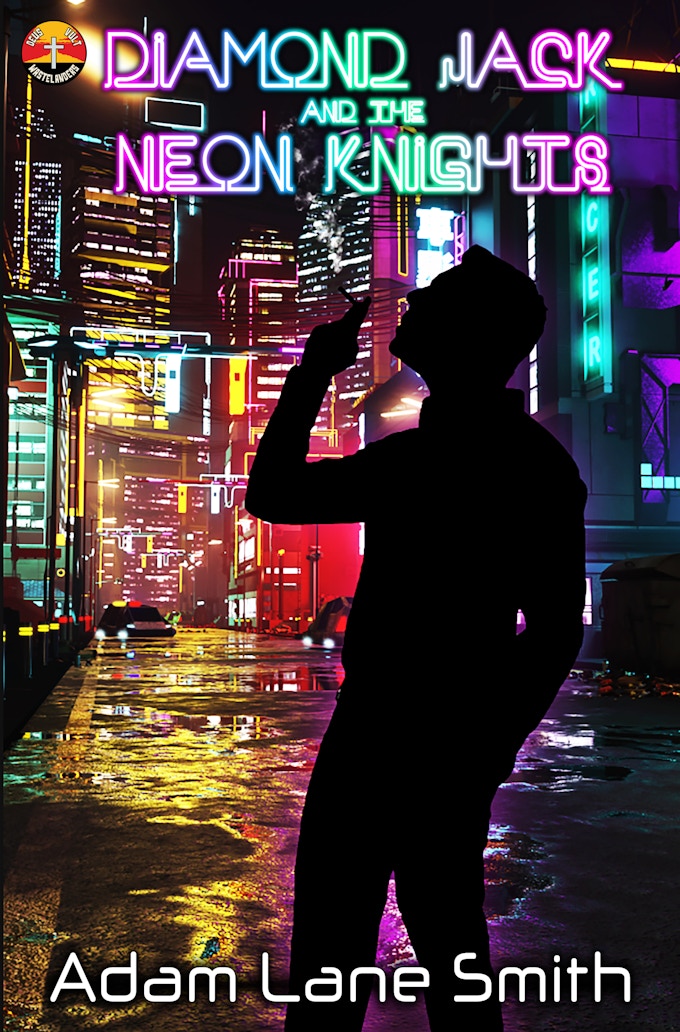
This time I want to share with you a new crowdfund project by author Adam Lane Smith. He is known for his recent works portraying a sort of Masculine Christian fiction of the sort you rarely used to see before NewPub came around. The genre of "Christian Fiction" used to consist of corporate mandated formulaic drivel meant to preach hackneyed postmodern swill that was the equivalent of soma. This genre did not even attempting to reach those who might have a hotblooded faith, or even those who no faith at all, ignoring much of the potential audience. The point of art is connection, so art not attempting to do that fails at the basic level.
That is the way it used to be. But this is definitely no problem with NewPub. Here is the description of Adam Lane Smith's new crowdfund:
Cyberpunk: Blood and smoke drenched in neon
They killed her. Now he’ll slaughter them.
The demonic apocalypse ravaged the surface. The surviving dregs of humanity crowded into nine neon-soaked caverns deep within the earth where scraps of technology barely hold society together.
Jack Vega spends his perpetual nights as a bouncer at a zero-gravity strip club run by the local crime syndicate. But all the alcohol in Hell can't block out Jack's nightmares, constant reminders of the exotic dancer he loved and helped bury. When her ghost returns, this time armed with heavy firepower, Jack's neon world turns blood red. He and his murderous crew must face off against soldiers, combat mechs, rogue AI, and deranged cyborgs as Jack carves a bloody scar across the putrid undercity.
Sometimes revenge is all a man has left.
Doesn't fit too well in OldPub's infinitesimally small Christian Fiction section, does it? Heck, it doesn't even fit into OldPub's non-Christian fiction. That might be because this isn't your great aunt's Christian Fiction or OldPub modern genre muck. This is the sort of pulp-influenced storytelling NewPub has been built for, the kind that was ejected way back in the 1940s.
We haven't been allowed to write fiction like this in a long time, and many writers took that personally. It's been a long-time coming, and the pendulum is swinging back hard.
I doubt that you haven't seen it yourself, especially if you're one who reads the modern fiction coming out of NewPub these days, but in order to grow this shrinking art form, we need more projects like this. We need to get people excited about reading again, something the big corps have entirely given up on. And this is just the sort of project to do it.
The author goes on:
Diamond Jack and the Neon Knights is the 5th book in the overall Deus Vult Wastelanders series. I have several different lines of Christian fiction in this core universe, with characters crossing back and forth between the lines. This is still only the beginning, and you can help make this series available for more Christians to be encouraged and entertained.
The main themes of the Deus Vult Wastelanders series are:
Uncompromising obedience to God's laws even in the face of horror
Charity to others, even former enemies who've surrendered and repented
Fierce courage in battle against the forces of the Enemy
Prayer as a weapon against evil
Service to others regardless of personal cost
Readers dissatisfied with the usual sickeningly sweet Christian fiction found in most bookstores will enjoy this divergence from the usual crowd. Instead of weak main characters who waffle back and forth over even the smallest decisions while every character around them is overly cheerful and encouraging, the Deus Vult Wastelanders world sees cannibals lying in wait to dismember and devour wayward travelers, cultists of Ba'al and Moloch combing the wilds for human sacrifice to their dark masters, and towering demons seeking to tear apart the faithful with their bare claws.
That's definitely quite hardcore!
You can check the crowdfund for tiers aside from the basic one that might interest you,. There are quite a few, even those offering the author's previous books in a bundle. No stretch goals are listed yet, if any are forthcoming, but funding is always the first goal of any crowdfund. Who knows what the future will hold? See what strikes you and seize it.
This is the sort of high-octane action that NewPub is built to offer, so be sure not to miss it! NewPub always delivers, and will continue to do so.
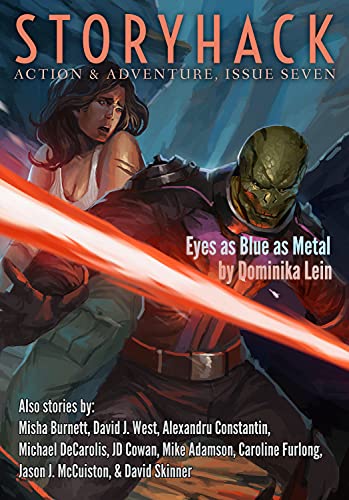
For more new action adventure stories, be sure to pick up the just-released StoryHack #7! The old industry cannot contain this level of spirit of adventure!
It's the time again; time for some StoryHack and more tales of action and adventure! Just like every other issue, you're in for a good time when you flip open one of these bad boys.
As you can tell, I'm also in this one, but so are other great authors, as well. Issue #7 has been some time coming, but I can definitely say it will be worth the wait!
The lineup:
StoryHack is back with another batch of thrilling stories in a variety of genres. StoryHack is a short fiction magazine heavily inspired by the great pulps of yesteryear.
Eyes as Blue as Metal by Dominika Lein
After discovering a human upon a worn-torn planet, an alien commander is betrayed by an ambitious underling.
That Summer's Evening Long Ago by Misha Burnett
How do you catch a criminal who uses magic to erase the memory of the item he stole?
Titan Up by David J. West
Can a modern man rise to the challenge when a muse mystically summons him to mythic Greece to rescue her from a titan?
Song for Melienope by Alexandru Constantin
Oswin the Magnificent and a bawdy monk find refuge from a terrible snowstorm in a mysterious lodge. However, all is not as it seems and a frozen death may have been preferable to what awaits them on this dark night.
The Berserker's Son by Michael DeCarolis
The city of Bero is hit by a surprise attack, leaving renowned berserker Furth to choose between defending the city or fighting his way back to his wife and son.
Golden Echoes by JD Cowan
An agent goes undercover on a hidden planet to thwart a mad cult leader who is about to unleash a device that splits open the universe itself.
Third Time Lucky by Mike Adamson
Spring, 1941: the RAF is stretched tight on the Channel Front, and Johnny Carstairs finds himself battling a mysterious German pilot who seems to have a score to settle.
Scylla's Lair by Caroline Furlong
Muriel gave her voice to marry her true love and gain a human soul. But has it cost her more than she can pay?
The Tombs of Osiris Prime by Jason J. McCuiston
The search for a missing archeologist on a long-dead planet leads the Last Star Warden into conflict with an ancient galactic threat, and may uncover the origins of the human race.
An Uncommon Day at the Lake by David Skinner
A selfish diversion to the Martian desert attracts some outlaw trouble -- and leads to a revelation in the hills!
For mere peanuts, you get ten top notch stories of action adventure--with some fantastic illustrations, to boot. If you haven't checked out an issue of StoryHack yet, now is a very good place to jump in. Every issue has a ton of great action adventure to experience, and this one is no different.
My story, Golden Echoes, is one of my favorite that I've written. It's a futuristic tale where a madman has found a way to merge myth and material together to form an untold horror unlike any you've ever imagined! It is up to Galactic Enforcer Ronan Renfield to put a stop to it before military ships either bomb the planet to dust or the universe itself cracks in two. Find out if he succeeds in this issue of StoryHack! It doesn't get more exciting than this.
I'm delighted that even amidst all the madness of OldPub dying and NewPub taking off that we can still get classic magazines like this and fromCirsova. It shows that not only are action, wonder, weirdness, excitement, and adventure, here to stay, but that they definitely aren't going anywhere anytime soon. NewPub has got you covered.
I'm currently working on a new series of posts, but I've got a few lighter ones until we get there. This time I want to talk about one of my favorite video games and series. The subject will be Contra on the NES, a genre classic.
In 1987, during the Golden Age of video games, Konami was on top of the world. With games like Time Pilot, Twinbee, Yie Ar Kung-Fu, Gradius, Devil world/Dark Adventure Shao-Lin's Road, Goonies, Jackal, Life Force, Blades of Steel, and Castlevania, they were showing themselves as the masters of just about every genre under the sun, both in the arcades and at home. that familiar logo was just about everywhere.
If you had an NES then you are fully aware as to just how good Konami was at this time, contributing especially well to the rising shooter, beat 'em up, and platformer, genres. They only got better at it as the years moved on. It felt as if their ideas were as endless as the new games they were putting out. Next to Capcom, they were probably the most trusted third party developer of the time period, which is saying quite a lot. There isn't anyone else who came close in the level of consistent quality and varied ideas that Konami did.
One such idea was the Contra series, a run and gun game fashioned after 1980s action movies. It's hard to imagine now, but few companies tried as hard as Konami did to turn such things into video game fodder. There were attempts, but they always felt half-hearted. This series? Not so much.
Contra isn't the first run and gun video game, but it is the first one to really solidify how the mechanics should work and how much the player should have control over their character in order to achieve feats. The original arcade game released in 1987, and was decently popular, being a big looking game with surprising gameplay variety that ostensibly allowed players to become action movie heroes. There was a lot of shooting, dodging, and tough enemies to battle, which made it tough to walk away from. Needless to say, it was a hit.
However, it was in 1988 with the NES home version that Contra cemented itself as a true classic. When people talk about the original Contra, this is usually the game they mean.
Though the graphics couldn't be as powerful as they were in the arcade, the game manages to look much better than the original version. The simplistic art style allows easy visibility of enemy attacks and bullets without any of the clunk found in the arcade original. It's an all around better playing experience. The music also uses the NES soundchip to create a far more energetic soundtrack than the original, allowing for sharper and clearer sound effects on top of it. Then there is the player movement and the controls which are both far tighter here than in the arcade version. The characters can aim and jump in every direction with speed and ease of maneuverability that the genre would use as a base for years to come. No one who has played both is going to argue that the arcade original is superior.
The NES version is also longer. Though it has 8 stages compared to the arcade's 9, many of the arcade stages were short and were combined into one on the NES which then expanded whole segments of the final arcade level into four separate full stages. There is also no time limit in this version. In other words, it's also a longer game on top of being a better playing one.
All in all, whenever anyone talks about how great Contra is, they are talking about the NES version. And so will I.
The NES Contra is still regarded as a classic today. Let us start with why that is.
So what exactly is Contra about? Well, it is a run and gun game: a run and gun is combination of two specific popular genres of games from the 1980s. That being the platformer and the shooter. Contra uses both of these halves to form the bulk of its gameplay time. You are tasked with playing as two action heroes as they avoid enemy fire and slaughter the villains, not unlike Arnold in Commando. you are the ultimate male!
But the story and setting add a bit to the flavor. It isn't just Commando meets Predator and Aliens starring Arnold Schwarzenegger and Sylvester Stallone, even though that is the main gameplay hook, and what the box sells you. There is more than you might think.
The plot, as told by wiki:
"Contra is set in the distant future of the year 2633 A.D., when the evil Red Falcon Organization have set a base on the fictional Galuga archipelago near New Zealand in a plot to wipe out humanity. Two commandos, Bill Rizer and Lance Bean of the Earth Marine Corp's Contra unit (an elite group of soldiers specializing in guerrilla warfare), are sent to the island to destroy the enemy forces and uncover the true nature of the alien entity controlling them. The promotional materials for the US arcade version downplays the futuristic setting of the game, with the manual for the later NES and home computer versions changing the game's setting from the future to the present day and the location from Galuga to the Amazon Jungle."
Why North America tried to retcon this awesome setting is beyond me, but they put it back by the third game, Contra III: The Alien Wars, after first attempting to say the game starred Bill and Lance's descendants Jimbo and Sully (Why they did this I don't know) before giving up and admitting they are all futuristic shooters with an obvious timeline.
It actually makes for an interesting setup. you aren't just dealing with terrorists or aliens. You're dealing with alien-infested terrorists with possible demonic ties as you attempt to save the human race. In a lot of ways, it is not too dissimilar from Castlevania in how it pulls inspiration to make something new. The two series actually do have quite a bit in common, but that is from mostly being made by the same company.
In the distant future, an alien force called Black Viper has slipped into Earth undetected and is slowly amassing power through the darker parts of society. They create the group Red Falcon run by their puppet human terrorist organization to sow chaos around the world. Bill and Lance, guerrilla combat experts, are sent in to stop this supposed human group. What they find is something much worse than they first expected. Each entry reveals more and more of what Black Viper really is, escalating the series as time goes on into one of the spirit of good against the twisted machinations of unknown evil. At least, before the canon goes right off the rails, but that's a whole other conversation.
What Black Viper actually is, aside from a vague alien force, is never actually stated, though they are definitely meant to be demonic terrors far beyond normal enemies. Putting the player up against something so obviously evil and frightening gives the added bonus of having them want to succeed even more. Few people give up after their first Game Over in Contra for a very good reason. these alien freaks are going down!
Konami knew what they were doing.
Nonetheless, Contra is fantastic because of two key reasons. The first is that it is an A+ platformer and the second is that is also an A+ shooter. On their own without the other half they would be great games. Combined they make up a classic gaming experience unmatched in the genre. Even without the rest of it boosting it up, Contra could get by with the fact that it is just that good gameplay-wise.
The tighter controls allow for more precise platforming, though the game rarely kills you for missing a jump like in, say, Super Mario Bros. Instead, being good at platforming simply allows you height advantage and better positions to shoot at the oncoming enemy forces. The game rewards you for being better at the controls by turning you into an unstoppable force of nature.
The shooting, too, is fast paced and sharp. It helps tremendously that most enemies die in one hit--just like you do. Aside from the bosses and enemy vehicles, you are actually on even footing with every obstacle in the game. The only difference is in numbers. This feeling combines with rising stakes and ramps up into the outright obstacle courses you are faced with by the end.
As for the bosses, they are perfect in their simplicity in attacks and patterns and yet retain a foreboding toughness regardless. Every encounter feels like a battle to the death. The first boss is iconic in video games: the giant wall with carefully placed laser sentries and oncoming guards. You must master each enemy's pattern on this obstruction in order to walk out unscathed towards the next level.
Or walk in to the next level. This is another nice touch the game offers. After you destroy the gargantuan monolith, you walk into it into the opening you made and down towards belly of the base, the second level. This interconnected feel pervades throughout the entire experience.
This stage is done from a third person perspective, not too unlike the pale imitations that Sony pumps out these days, where the camera locks behind you as you shoot forward down the wide open halls of the steel tunnels. As you clear out sections you advance forward into the next room, following a clear path towards the center. However, the difficulty is no less harsh here. You will never forget you are in a Contra game, simply because the game will never allow you a moment to realize it. always move forward, never stop. Let's Attack Aggressively!
The base stages, though few in number, represent a refreshing change of scenery from the sidescrolling levels, allowing the player to sharpen their reflexes by altering their entire perspective on where they can get shot from. You thought you knew where all enemy fire was coming from, but you were wrong! Even the boss for this stage has you shooting up towards it while enemy attacks come down at you, a reversal of the usual left and right situation found in the first level and boss. You must completely change your approach on the fly.
This isn't only brilliant design, but it is the perfect curveball to throw at gamers that might be frustrated at the difficulty and keep them interested enough to see what might be just ahead of them if they only continue that one more time. As I said: no one quits Contra after one Game Over. You always continue that one more time.
And we did continue for years to come. Contra is still known as a classic to this day for a very good reason.
The powerups are not the best they've ever been in the series (those would be the ones in Contra 4) but they do add a good wrinkle to the gameplay and the risk/reward system. You're not going to want to go into this gauntlet barely armed.
By blowing up the floating powerups you can upgrade your gun into something better than your standard peashooter. The first is a far faster machinegun that does heavy damage to bosses and can wipe out waves of enemies quick. however, it suffers from being harder to aim at a distance, meaning you have to get close to really use it to its fullest potential. Then there is the flame gun which shoots in a corkscrew pattern, allowing for easier distant shots but not much in the way of power. You can also collect baser power-ups to make your default weapon stronger and to give you a barrier for defense, but these aren't much to talk about.
Lastly, of course, I have to mention the greatest gun powerup of all time, which comes in the form of the Spread Gun, a legendarily overpowered weapon that offers aid to anyone that can't aim. How? By firing a spread wave of bullets that covers the majority of the side of the screen. You will most likely kill everything coming before it even knows what hit them. I'm not overexaggerating the effectiveness of this gun. The spreader is the most difficult weapon to miss an enemy with, which makes it the go-to for many Contra players.
unfortunately, it also has a glaring weakness in that it is the slowest weapon in the game. Should you miss your shot, it takes much longer for the next one to be fired. By then, in a game like Contra, you might already be dead. Unless, of course, you master the game.
And while I made the powerups seem rather overpowered, they all vanish when you are hit once. Unless you are good at the game you won't be using them much, which incentivizes learning everything. This is what good game design should do. If it kicks you down the game should make you want to get back up and give it another shot. How else will you get satisfaction out of conquering it?
Contra is master at this, and why it has remained a classic for over 30 years.
They knew their audience.
As for the future entries of the series, you might be surprised to learn that despite being over 30 years old, almost every entry in the Contra franchise is a quality game. That is impressive. Not even Castlevania has managed the concentrated quality that Contra has had.
The sequel to Contra was Super C (Super Contra in the arcades) which came along in 1990 (Again, 1988 for the arcade) which similarly improved on the original version. Super C is a more focused experience, lacking the variety of the original entry for a shooter-focused challenge. The levels are primarily shooting galleries and left to right affairs. There isn't as much platforming, but that is fine for what this entry wishes to do. People who prefer the sequel tend to like the purist shooter focus. It might not top the original, but it is still a top tier shooter.
Then came a Game Boy entry in 1991 entitled Operation C. This simplified the action even more, especially being that it was on a smaller portable system and screen, yet the action is no less frantic. It's a short game at only 5 stages, but for a bite-sized portable experience it as good as it could be. To be quite honest, shooters on the old Game Boy rarely get better than this one. That they managed to include a game that stacks up so favorably to the original games is very impressive. It is only a shame this series has so few portable entries.
Now we reach what many consider the pinnacle of the series in 1992 with SNES entry Contra III: The Alien Wars (It was even called Contra IV before release) which was a tonal change in focus for the series. What was once a bunch of levels defined by challenges became an attempt to mimic the very action movies it was based on. In essence, every level is a set piece. What they tried to do was turn it into the visual equivalent of playing through an action movie. Not like today's AAA slop, however. There is no story focus or dialogue--it is just in the presentation.
From wiki:
"Contra III was developed by Konami with a team led by Nobuya Nakazato. Although this was Nakazato's third year at Konami, Contra III is the first Contra game he worked on, having only previously done informal playtesting for Super C (1990). He believed the original arcade version of Contra (1987) was difficult to play because of its vertical screen, but he did enjoy the Famicom port. Nakazato's team worked in Konami's new offices in Tokyo, seated next to the arcade team that had developed Contra. Nakazato shared progress on Contra III with the arcade team and received positive feedback. In early coverage, the game was known as Contra IV. Nintendo Power reported the name change to Contra III in its coverage of Winter CES in 1992.
"Nakazato believed Contra had a low-budget movie theme. To emphasize this, he asked the sound team to change the music as the stages progressed to give a cinematic style. He also believed the action in earlier Contra games is too realistic, so for Contra III he wanted to include more comical elements. He was concerned the change may upset series fans, but believed it would be more entertaining. One scene added to accomplish this is a sequence where the player hangs from flying missiles. This strains the Super NES's sprite capabilities, so the team used background tiles to draw the helicopter and missiles in the scene. Making the graphics appear to move like sprites in the foreground required clever programming tricks. The Super NES allowed for "raster scrolling", which allowed the programmers to change the graphics for each scanline. The programmers shifted the vertical sync and cut off the sprites at the scanline. The restriction is that graphics can only move horizontally along the scanline to achieve the illusion that they are actually sprites in the foreground.
"Nakazato was concerned the traditional pattern of weak enemies followed by a boss fight was becoming mundane and did not want players to feel "in for the long haul" every play session. To combat this, he established a key concept for something interesting to happen every three screen scrolls. This made the game content feel more dense and gave it a "boss rush" type feel. Nakazato believed Contra III's fast-paced action was going against the trend of home console games shifting to slow-paced strategy and role-playing games, and is good for quick-starting stress relief.
"Contra III was released in Japan on February 28, 1992, and North America on March 26. In Europe, the game was retitled Super Probotector: Alien Rebels and released on September 12, 1992. In Super Probotector, the gameplay and story remained mostly the same, but the player characters were changed to robots. Due to technical differences in PAL SNES systems, Super Probotector's gameplay is slightly slower."
And it did work. Contra III: The Alien Wars remains one of the best games on one of the best video game systems. They added a new wrinkle to the formula, and it was exactly what was needed for the burgeoning 16-bit era.
Contra was already based on action movies from the 1980s, so deliberately designing a game that played like the over the top sequences it was based off was an ingenious idea. This gives the presentation a cohesive feeling of escalating tension as challenges also get tougher as you descend deeper into the alien menace. As a result, there was really nothing like Contra III when it released, though many take inspiration from what it did to this day.
But the series wasn't done there.
After the success Nakazato had with Contra III, he moved on to the rival 16-bit system, the Sega Genesis. Yes, even Contra contributed to those old console wars. Here he created the flipside to his original idea, that being a game called Contra: Hard Corps. which was released in 1994.
Unlike Contra III, Hard Corps wasn't designed after an action movie. They took a different inspiration. This one was instead fashioned off of serialized television shows and comic books with cliffhangers. At the end of every stage you are tasked with making a choice (like a cliffhanger hook) that will change the level progression and even the resulting ending you get. The levels you end up going through are different every time you play.
Unfortunately, the North American of this game has pointlessly tweaked difficulty. The original has a health bar and unlimited continues while the NA version has the usual one hit kills of the series and a five continue limit. Why they did this I have no idea, since this was not part of the design, but it was meant to be a spin-off for a reason. It is also the first instalment to not have Bill or Lance as the main characters, but a team of characters with different abilities. This gives it a different sort of replay value the other games don't have.
By this point, Contra had become a legendary video game series with clout to spare. It was on top of the world.
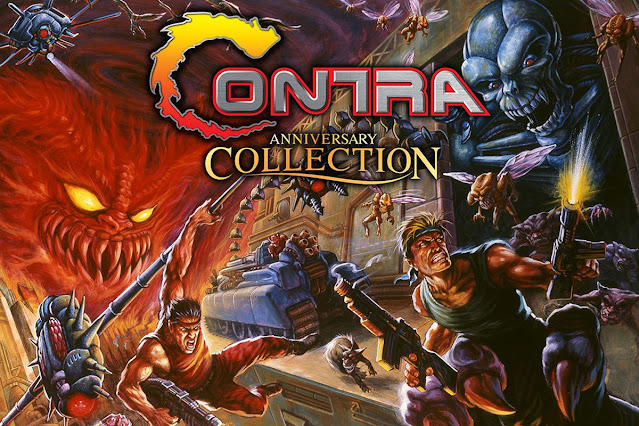
The Anniversary Collection features every game I've mentioned so far.
So far so great. It is easy to see how Contra became one of the most respected video game series. But what I haven't talked about is the elephant in the room, the one that nearly killed every legacy franchise. Yes, I'm referring to the increasingly-maligned 32-bit generation.
This would be considered the darkest era of the franchise's history. In fact, between 1995 and 2002 there were more canceled Contra games than actual series entries. Instalments for the N64, Gamecube, PS2, and Xbox, never managed to get off the ground, while only two PS1 and a single PS2 entry released in that time frame. And only one of these was even good.
For some reason, Konami treated Contra like trash after 1994. It happened to a lot of classic 8 and 16-bit franchises. No one really knows why. The franchise was handed to external teams, b-teams, and had weird ideas attached to them (In no universe does a Contra Online make any sense) and none of it worked out. All of this can be seen in the two PS1 entries that actually did release and were declared non-cannon as fast as could be done.
Instead of fast-paced 2D games, these entries were clunky and slow 3D games that missed everything making the original games such enduring classics. These two PS1 entries came out in 1996 and 1998 and did a lot of damage to the franchise's legacy. Much like the 3D Castlevania games damaged that series, the same was happening to Contra. By the time the PS2 released, it was in danger of being forgotten.
Konami then grew a brain and brought in Nakazato to direct a Contra game in an attempt to salvage this mess, which is exactly what he did. Contra: Shattered Soldier returned the series back to its 2D roots, a fast paced shooter, though this one was more of a boss rush than ever before and the story is typical '00s era Konami silliness filled with stupid retcons to series lore and pointless convolution that would only continue into Neo Contra, the PS2 sequel. While these were good games that did much to re-right the ship, they still had plenty of flaws they shouldn't have had.
All it did was highlight how much gaming had changed. Electronic Boutique's at the time were getting tons of returns on Shattered Soldier because the game was "too hard" and it being in a 2D perspective was a big no-no to game journalists. Because of this, it felt like it was already too late for Contra. The industry wanted it out. the deafening silence on the franchise after Neo Contra seemed to confirm that it was finished. It was time to move on to AAA garbage only.
That is why 2007's Contra 4 for the Nintendo DS was such a surprise. It was against every single thing the modern industry was heading towards. It was a deliberate return to roots, long before the 2D indie onslaught happened.
Konami even got a studio known for quality 2D games to do it! Contra 4 was made by WayForward Technologies, creator of the Shantae series, and was a deliberate attempt to shed all the stupid baggage the series had accumulated since the early '90s. And, boy, was it welcome.
The game is a simple straightforward run and gun game with plenty of platforming. There are some set pieces like in Contra III, and they even included improved weapon stacking and upgrades from that entry, but otherwise the game structure more clearly resembles that of the original two games. In fact, it clearly uses the NES version of the original Contra as its biggest inspiration. It learned all the right tricks. Deliberately calling it Contra 4 was a smart move as it not only harkened it back to the simpler gameplay and aesthetic of the most well known entries, but it allows the game to have a focus the series hasn't had since the 16-bit wars ended.
Contra 4 is possibly WayForward's best game, and one of the best in the series. It is only a shame it has never been re-released in near 15 years. It was the shot in the arm the franchise needed.
Unfortunately, it wasn't too popular. We all know what was happening in gaming during 2007, and a game like Contra 4 was simply not in vogue at the time. Because of this, the series faded from focus as gaming moved away from being about challenge and instead about lackluster D-grade stories. It's a shame, but it is what it is.
And after this point the series more or less became niche, putting out a game every now and then (though sometimes, like with Hard Corps. Uprising, they still manage to be top shelf) not unlike other seminal Konami franchises such as Gradius or Castlevania. Classic gaming was kicked to the curb, but it doesn't matter.
True classics will always be classics.
Hard Corps Uprising is a prequel to Contra: Hard Corps., and manages to live up to it.
So while the original Contra for the NES is one of the best games ever made, so too are most of the other games in the series. There aren't many long-running franchises with as few entries as this that still manage to have near a dozen titles worth playing, but Contra is one of them. Chances are, if it says Contra on the box you are going to have a great time . . . unless it's in 3D, that is. Then your chances aren't so good. Otherwise? It really gets better than this.
Are you a gamer in need of challenge, the likes of which you've never seen before? Then Contra has exactly what you're looking for. Don't sleep on this classic series!
The best games challenge you to better yourself and top new seemingly insurmountable odds one after the other. Few do it as well as this series does. Most of all, this contributes to making the series one of the most fun you can encounter.
After an extremely successful campaign, we are now in the final stretch for Cirsova's Cosmic Courtship crowdfunding kickstarter. It's been quite the run, and now is the last chance to give it a boost!
The kickstarter has smashed every stretch goal, finally reaching the recent $15,000 one to make all the original images available. There is still time to reach the final mystery goal at $20,000, so jump in while you still have the chance!
In case you are in the dark as to what this is all about, the description is below:
The foremost goal of this project is to get an exciting, essentially lost, classic pulp story back into print and into the hands of scifi fans, pulp aficionados, and readers in general!
What do we mean by "essentially lost"? While The Cosmic Courtship is a work in the Public Domain and part of the world's common literary heritage, there's virtually no way for anyone to read it! It has only ever been printed in now very expensive and hard to find pulp magazines. Even if cost were not an object, availability often is.
This is the case for many novels and novellas from the early pulp era. Julian Hawthorne's The Cosmic Courtship is only one example.
The main issues with a project like this are the investment of time and the risk to (often nigh-irreplaceable) physical materials required to reproduce the texts.
It is important that the team be compensated for their time and work that they put into making these texts available.
Physical Reproductions of the Work
The initial goal for this project is to bring The Cosmic Courtship back into print. People who want to read this work will be able to read this novel without having to invest hundreds of dollars into 100+ year old pulp magazines as they infrequently appear on the open collector market.
All backers will be credited in an appendix for helping bring this to fruition.
We are offering both paperback and hardback formats, as well as a novelty magazine format [similar to Cirsova Magazine] and a no-frills pocket paperback edition.
Want to spread the love? Be a super backer and donate a classroom set to your favorite teacher or librarian! Help get this work into people's hands!
As for the stretch goals:
$3,000 - Bonus Materials
Not only will we be including the original text of Julian Hawthorne's The Cosmic Courtship, we will including some additional biographical materials and other works by Julian Hawthorne, including a facsimile version of "Scenes of Hawthorne's Romances," an essay on his father's writings, featuring the text as it was originally presented with numerous illustrated plates.
$8,000 - Digital Copies + Donation of a Public Domain Copy
As mentioned, there is a lot of labor, risk, and costs involved in salvaging these texts--we want to ensure that the team working on this project are compensated: if it is worth everyone's while, this will be the first of many.
The ultimate goal of a project like this is to make these available to the world because they are part of our literary heritage and everyone should be able to discover and analyze these works to better understand the patchwork history of this fascinating era of fiction.
If we raise $8,000, not only will we provide all backers with digital copies of the volume we are creating, we will create and donate a digital text version of the original story to Project Gutenberg.
These will be made available after backers have been sent their physical copies.
Please consider donating to sponsor this project, or order multiple copies, so we can reach this goal!
$10,000 - Ongoing Imprint
Michael Tierney has an impressive pulp library, filled with innumerable stories that are public domain but have never been in print since the early 20th Century. If we raise $10,000, that will show us that there is sufficient interest and support to turn this into an ongoing project where we work with pulp archivists to "rescue" these nearly lost works and make them available both in print and for the general public domain so that they can be preserved and enjoyed by future generations!
$15,000 - Original Images Available
Michael has agreed to release the images we used of the four issues of All-Story to compile this edition. Michael will host these these images, nearly 100 pages of pulp, on his website.
$20,000 - ?????
What will we do for $20,000? I don't know yet, but we'll have to think of something fast, since it looks like it's in the realm of possibility!
As mentioned, it has already achieved every stretch goal but the last one. What could it be? Make it a reality today!
For more info, you can see the campaign page here.
For more Cirsova goodies, the summer issue is now up for preorder! Be sure to put in your preorder for the quality oddness sure to come your way!
Let's talk about something bizarre today. How about an entire anthology of stories about chickens? No, I'm not pranking you, this is an actually collection of stories that really exists.
A bit of background, from the editor:
"This collection of stories is a demonstration of how a crazy but wonderful idea can go from first mention to a call for stories in mere hours. I had a great animal story already written and ready to go, it having been cut from another anthology in the final selection round. The problem? My story had cats instead of chickens. With a quick edit pass to change to chicken names and behaviors, and tie the birds into to the story a little more tightly, I had a submission turned in after a couple of hours. My story, Stray Thoughts, is about bonding in a post-apocalyptic world. And chickens."
And you know what? I'm not going to say anything else about it. Check out this oddball anthology for yourself.
The description:
Chickens Land on Mars... But what happens when authors have too much free time on their hands?
A challenge.
Craft a story featuring our favorite feathered raptors: the CHICKEN.
B'gawk!
Twenty authors deliver in some unexpected ways and live to crow about it.
From chickens in space to cozy murder mystery farm yards to schools of magickal thought...
Includes guardian angels, chicken shifters, aliens, and feathered matchmakers,
Maybe even a non-fiction adventure or two... and more!
These amazing chickens come from the minds of twenty cooped-up authors on the edge of cracking...
Read CRACKED: An Anthology of Eggsellent Chicken Stories.
The 1980s are regularly seen as either a time of optimism or unbridled materialism in the west, while the '90s are looked back on in a multitude of confusing and contradictory ways. It's hard to understand unless you lived through it, but even before Cultural Ground Zero turned everything into a flavorless soup, the decade was a very confused time.
For those of us in Gen Y, we saw our quality video games, movies, TV, and books, as beacons of the oncoming hope of a brighter future. Things were always getting better, and they naturally always would. Boomers were seizing control of the world from their retiring parents and knew exactly how they were going to fix it all. Gen Jones had finally allowed a piece of the pie due to their older brothers finally moving up, albeit a very slim one. Greats were enjoying the fruits of retirement. Millennials were toddlers. So with all this you would be forgiven for thinking everything was hunky dory. The world was about to become an even better place!
However, much like the modern media, you'll notice I'm forgetting someone. They're sort of the key to this.
To truly understand this era you need to approach the elephant in the room, which is Generation X. Looking back at the 1990s out of context, you will see an entire generation of people whose art and entertainment directly contrasted with everything else actually happening at the time. It's a bit much to take in or process unless you were there. Oh, if you were around at the time, you might have remembered how many odd potshots the media took at Gen X.
People like to point to grunge as some sort of definitive statement on Gen X, but that was a cynical cash grab intended to replace hair metal acts from getting too pricey on their record contracts. Nirvana had nothing to say and their sound had nothing original to it. You take the Meat Puppets and Replacements and mash them together; taking away Curt Kirkwood's country twang and hardcore punk leanings, and Paul Westerberg's testosterone and poignant lyrics, gives you the flavorless commercial mush of Nirvana. They had nothing to say aside from mindless nihilism, which made them very easy to sell in the mainstream. It's no wonder Cobain felt imposter syndrome as hard as he did: those that afford him legacy status today are playing right into the hands of the recording industry, and not affording him the solitude he wished for.
But amidst the Gen X dourness that was floating to the top in the 1990s, there were a few albums that were flatly ignored for making the wrong people uncomfortable. Nihilism and hedonism were cool, and no one wanted the public to be reminded of what they truly led to. They still don't. I talked about Urge Overkill's Exit the Dragon a while back, which is one such record. It is an album about bottoming out after indulging in decadence, and slowly finding the way out. The hints as to what those answers might be are uncomfortable to many in a secular setting, so the album was written off and buried.
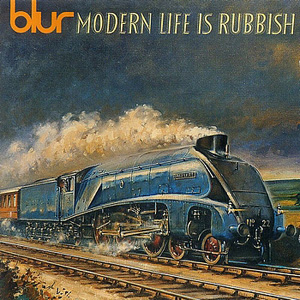
However, there is one album in this mold that did have (limited) success. That would be Modern Life is Rubbish by the alternative rock band Blur, released in 1993. This was the album that came out right before their follow-up, Parklife, became a mega-hit in their home country and brought them incredible fame, an album that is actually the flipside of this one. Many in the industry used that one as a shield to avoid talking about this record.
Modern Life is Rubbish released just as the tidal wave that was Britpop was unleashed on the world, and ended up predicting a few things that would come of it, but to this day is an album resoundingly ignored by everyone except those who listen to the band. There is a reason for that, and it isn't the quality of the album, which is phenomenal.
In fact, I would be so bold as to call it one of the best records of the 1990s. It is certainly on my list of all-time favorite albums. To explain just why, we have to do a bit of a dive into it. Clean out your ears and listen to one of the great overlooked records.
We start with For Tomorrow, the first single and first track, which states the album's uncomfortable thesis up front:
He's a twentieth century boy
With his hands on the rails
Trying not to be sick again
And holding on for tomorrow
London ice cracks on a seamless line
He's hanging on for dear life
And so we hold each other tightly
And hold on for tomorrow, singing
La, la, la-la-la
La-la-la-la-la-la, la-la-la
Holding on for tomorrow
She's a twentieth century girl
With her hands on the wheel
Trying not to make him sick again
Seeing what she can borrow
London's so nice back in your seamless rhymes
But we're lost on the Westway
And so we hold each other tightly
And we can wait until tomorrow, singing
La, la, la-la-la
La-la-la-la-la-la, la-la-la
Holding on for tomorrow
We're trying not to be sick again
And holding on for tomorrow
She's a twentieth century girl
Holding on for dear life
And so we hold each other tightly
And hold on for tomorrow, singing
La, la, la-la-la
La-la-la-la-la-la, la-la-la
Holding on for tomorrow
Jim stops and gets out the car
Goes to a house in Emperor's Gate
Through the door and to his room
Then he puts the TV on
Turns it off and makes some tea
Says, "Modern life, well, it's rubbish"
I'm holding on for tomorrow
Then Susan comes into the room
She's a naughty girl with a lovely smile
Says, "Let's take a drive to Primrose Hill"
It's windy there and the view's so nice
London ice can freeze your toes
Like anyone, I suppose you're
Holding on for tomorrow
The song is about the pursuit of progress amidst the drudgery that is modernism. How can there be hope for a future when the present is so vapid? We still have people today espousing this mindless Star Trek utopianism that isn't based on any human behavior or reality. Blur shows without having to outright say it: there is no future here.
But that is where the twentieth century ended up. And it is where we are right now.
You might have noticed that the lead singer sounds a lot like 2D from the Gorillaz. that's because that is who it is. This is where Damon Albarn got his start, in Blur, and this is the first album where he really showed his talent as a songwriter. If you do like the Gorillaz, you will see a lot of the appeal in Blur, albeit in a more traditional rock setting. Therefore, you can see why they got popular.
But it wasn't easy for the band to get their success.
The English music press were rather hostile and harsh on bands back in the day (not so much now, ironically, when the music is pure shite) and Blur was one to feel their ire early. The band's first album, Leisure, which released in 1991, was not too great, admittedly. It was a fairly generic, by-the-numbers "baggy" album from the Madchester scene, a sort of psychedelic-inspired hard rock dance sound that didn't last too long into the early '90s. They had a hit single in There's No Other Way, but already their fortunes were not looking too hot by 1992.
Blur was looked at as poseurs glomming onto a fad, and it affected their fortunes. They just had an unsuccessful US tour, the music press hated them, and they were looking to be dropped by their label. At the same time as all this, their management ripped them off and left them in debt. Things were looking dire.
To explain the genesis behind Modern Life is Rubbish, and the shift that saved Blur and made their career, one has to look into their experience at the time.
From wiki:
"The 44-date tour of the United States left Blur in "complete disarray", according to writer David Cavanagh. Dismayed by American audiences' infatuation with grunge and the lacklustre response to their music, the group frequently drank, and members often broke into fist-fights with one another. Homesick, the tour "instilled in the band a contempt for everything American", Cavanagh later wrote; frontman Damon Albarn, who "started to miss really simple things [about England]" listened to a tape of the English pop group the Kinks throughout the tour."
In other words, what Blur was seeing was a loss of all the things they thought made the world, and their home, great. Gen X was infamous for destruction, but they were even more infamous for their hatred of tradition, priding themselves on mindless hate of things they didn't understand. That Blur went in the opposite direction is probably what helped them stand out, giving them a drive that few others of the time period actually had: a hatred of the modern world.
the thing is, while it was their terrible experience in the US that set this off, the resulting album is not really about the US at all, at least not solely. They use their own experiences in their home country to show just how fall we've fallen.
But I'm getting ahead of myself.
When they got back to England, they still had a lot of work to do. Early studio sessions were disastrous, including one featuring Andy Partridge of XTC as producer. Finding their groove took a lot of time and effort. Their label fought them the entire way, too. They wanted them to stick with the old sound that was on the verge of killing their career (and ironically that almost led to their label dropping them) which left them adrift.
Basically, it appeared that it was Blur against the world to get their new vision out there. Nothing went their way, and everyone fought them.
"Work resumed on the album due to a chance meeting with producer Stephen Street, who had previously worked with the band on their 1991 single "There's No Other Way". With Street now producing the album, Blur recorded a mix of material spanning both the period immediately after the release of Leisure and their 1992 tour. While the band members were pleased with the recording session results, Balfe, after hearing the songs, told the band they were committing artistic suicide. Although dejected by his response, Blur gave Food the completed album in December 1992. The label rejected the album and instructed the band to record more potential singles. Albarn complied, and on Christmas Day wrote the song "For Tomorrow". Although "For Tomorrow" sated Food's concerns, Blur's American label SBK voiced discontent upon hearing the finished tapes of the album. To appease SBK the band recorded "Chemical World", which Blur thought would increase Rubbish's American appeal. However, Blur refused SBK's demand of re-recording the album with American producer Butch Vig, who was popular at the time for his work with Nirvana."
As you can see, the 1990s was no less better for artistic freedom than any other era. Everything listed in the above quote, aside from asking for singles, was a pretty terrible idea, and would have sunk the band. Including trying to make them sand off their edges with Nirvana's producer.
When Modern Life is Rubbish came out, no one was quite ready for the cultural shock of a band who staunchly rejected the readily-accepted modernity of the time for a pride and hope in a tradition that had been slowly disappearing. They correctly saw the dead end of the music industry ahead, and worked to make something that harkened back to other times. It was completely out of joint with the times. By the late '90s, tradition would be ejected entirely from the industry.
But what "tradition" meant to Gen Xers like Blur in the early '90s is not quite what one would expect at the time. When they meant tradition, they meant ALL of it, including musically. The album is very thorough.
In fact, after hearing the original pop single above, this was the second track on the album:
"Food processors are great!"
It's six o'clock on the dot and I'm halfway home
I feel foul-mouthed as I stand and wait for the underground
And a nervous disposition doesn't agree with this
I need something to remind me that there is something else
You need a holiday somewhere in the sun
With all the people who are waiting
There never seems to be one
Say something
Say something else
Advertisements are here for rapid persuasion
If you stare too long, you lose your appetite
And a nervous disposition doesn't agree with this
You need fast relief from aches and stomach pains
I need a holiday somewhere in the sun
With all the people who are waiting
There never seems to be one
Say something
Say something else
One, two, three, four
Five, six, seven, eight
Nine, ten, eleven, twelve
Thirteen, fourteen, fifteen, sixteen
"You can have a holiday in the sun, yes
Ladies and gentlemen, one week only, on special offer!"
You need a holiday somewhere in the sun
With all the people who are waiting
There never seems to be one
Say something,
Say something else.
That's right, it's a punk song. Surprise! It isn't even the same genre as the first track. This is actually one of those dreaded genre-hopping albums. That's not acceptable! It certainly wasn't acceptable in the early '90s.
You see, the genre trap was already a problem in the music industry just as it is in other ones. People are supposed to make punk albums, metal albums, folk albums, pop albums . . . but never are the streams allowed to cross. Why? Because it's easier to sell a concocted image based on one genre than it is to admit that all the genres are just branches of the same one: that being rock music, in this case. Everyone should instead go to their own corners and never come together.
The band had a field day taking rock tradition and filtering it through their early '90s dislike of modernity. As a result, the eclecticism merges into one strong piece.
Lyrically, however, this is when Damon Albarn came into his own. Before this he was a bit too simplistic and straightforward with his writing, but with Modern Life is Rubbish, he pulls out all the stops. Normally known for detachment and being unemotional, Modern Life is rubbish is the only Blur album where the opposite is true: he sounds very invested and passionate about the subjects. Even in the follow-up albums he uses satire and jokes to carry a lot of the weight of what he was saying. That's not that case here, at all. Modern Life is Rubbish is a very involved album. That helps make it quite unlike any other Blur album.
Below I will list a few of my favorite lyrical turns he uses.
From Colin Zeal:
While sitting in traffic, Colin thinks in automatic He's an immaculate dresser, he's your common aggressor Colin's the modern retard with a love of bombast Keeps his eye on the news, doesn't dwell on the past
The final line of the song:
'Cause Colin Zeal's ill He's Colin Zeal, and he knows
From Villa Rosie:
Across the common every day, you come across the fine line But wearing boots can prevent the leeches in the long grass Eating between meals stifles the appetite, is it healthy? Coming home, that nagging doubt there in your belly
From Pressure on Julian:
Swimming in yellow, pissy water Sand getting in between the ears No blood in head in this bloody weather Irate people with yellow tongues Only the magical transit children Sing-sing a lullaby, bah-bah-bah Falling into walls, well, what is it with you? You'd never know, never know, never know
From Resigned:
I think too much on things I want too much It makes me hateful and I say stupid things Only you can fill my blank heart And I'm resigned to that
I wish the sun could just keep me warm And I'm resigned to that I'll forget to breathe someday I've never stopped to think why
Those are just lyrical samples, but the entire album goes through the gamut of what living in modernity is like. From tracks about using drugs for escapism (Chemical World), prostitution and pleasure obsession (Villa Rosie), crass commercialism disguised as human connection (Advert), unexplainable despair in the quiet moments (Oily Water), coping with the unnaturalness of the fast paced world (Coping), and the lone bright spot on the album (Sunday, Sunday) about the last vestiges of family and tradition during this modern swirl of emptiness, which comes dead center in the album. They shine a light in the darkest corners.
Despite how scattershot it might seem when describing it, the record has a very cohesive feel of one vision. It spans rock genres from punk to classic pop to acoustic to alternative rock to even a bit of weirdness (something Albarn would be known for later), but despite that it remains locked together as a single work with a driving force behind it. The lyrics and general mood and production present a vision of the present as it actually is, without the posing of grunge or the pretension of where alternative would soon go with OK Computer. What you are left with is an honest album of what reality was for people of Gen X in the early '90s, and what it would eventually become for everyone else.
It feels like this album might be nihilistic, and it might be considered that, but Albarn's lyrics contain enough humor and just enough detachment to get it all across as plain honesty. He doesn't set off saying that the world is doomed and that there is no hope: only that this is where the world is right now. It's just the truth. There are no predictions of the future or where it might go, no solutions or messages informing you on how to "be butter", only that the world of the early '90s operates like this. You can infer that it isn't good just by what he gets across.
The real issue with Modern Life is Rubbish is that its follow-up album, Parklife, is the album with positivity, even if it contains plenty of satire, it's still a happier record overall. That is an album about the brighter side of life, even among the silliness of the modern day, centered on normal working class people, much like the ones in this album. It also contains more genre exploring, which gives it a brighter color. As a result, it was far better received, and I would say that if you like Modern Life is Rubbish then you would certainly like it, too. You might even like it more. The press and audiences did. I would even highly recommend it. Parklife is 5 star album.
However, the elephant in the room is the passage of time. Even through the satire, the world of Parklife doesn't exist anymore. Both the good and bad parts of that album's subjects were left behind in the '90s. But the world of Modern Life is Rubbish, in contrast?
Let's use an example:
Wash with new soap behind the collar
Keeps a clean mental state
Don't usually bother in cold weather
But still I'm getting into work late
And I don't need the practice
I've been making plans (For the future)
Become an unconscious man (All for the good)
I feel so unnecessary (We don't think so, you seem star-shaped!)
I have a couple at the weekend
Keeps up camaraderie
And my mind boggles in the muddle
At the possibilities
And I don't need the practice
I've been making plans (For the future)
Become an unconscious man (All for the good)
I feel so unnecessary (We don't think so, you seem star-shaped!)
I wash with new soap behind the collar
Helps keep down the laundry
And now I bother in cold weather
Because it cleans me mentally
And I really don't need the practice
I've been making plans (For the future)
Become an unconscious man (All for the good)
I feel so unnecessary (We don't think so, you seem star-shaped!)
This is still reality today. The drudgery of modern life and living from paycheck to paycheck with nothing to look forward to except being told that it is all for something. But what is that something? You are never told.
We're all special and unique, and have plenty to offer. Now become a cog with everyone else. Remember, you're replaceable! No, you're unique--Star Shaped!
How does that add up? But that's the modern world. A bunch of contradictions held together by those who just don't want to think about what they're actually doing.
Contrast this with Parklife's portrayal of vacationing to Greece that the English no longer do, or the scene from the suburban life of the title track that no longer exists, or snapshots of people that can't even be born in the current world that is England. It might be the more hopeful and positive album, even amidst the laughs, but it's also dated far more than this one has.
Even the "love" songs have a doomed feel to them:
Air-cushioned soles
I bought them on the Portobello Road on a Saturday
I stop and stare a while
A common pastime when conversation goes astray
And don't think I'm walking out of this
She don't mind
Whatever I say, whatever I say
I don't really wanna change a thing
I wanna stay this way forever
Blue, blue jeans, I wear them every day
There's no particular reason to change
My thoughts are getting banal, I can't help it
But I won't pull out hair another day
And don't think I'm walking out of this
She don't mind
Whatever I say, whatever I say
I don't really wanna change a thing
I wanna stay this way forever
If you don't mind
Whatever I say, whatever I say
I don't really wanna change a thing
I wanna stay this way forever
You know it would be with you
And don't give up on me yet
Don't think I'm walking out of this
And she don't mind
Whatever I say, whatever I say
I don't really wanna change a thing
I wanna stay this way forever
If you don't mind
Whatever I say, whatever I say
I don't really wanna change a thing
I wanna stay this way forever
You know it's to be with you.
This is a song carried by the drumming. It's a ballad, yes, but the drums are deliberately set down first to set the tone going forward. It's a heavy, claustrophobic beat, which gives an oppressive air to the song that locks it in place despite the pretty piano and acoustic guitars. This appears to be a love song but has another edge to it if you pay attention the lyrics contrasted with the light sound of the strings and keys and Albarn's delivery and what he emphasizes. It's not about love at all.
The title, Blue Jeans, should be the first clue. Look at how the title is used in the song:
Blue, blue jeans, I wear them every day
There's no particular reason to change
My thoughts are getting banal, I can't help it
But I won't pull out hair another day
It's about the realization of the numbing waking dream that modern life is, how it rewards you for killing your thoughts and molding yourself to be the above cog in the machine from Star Shaped. "Whatever I say, I don't want to change a thing" is about the fear of what it will be like if you stand out, if you are ostracized for sharing your thoughts. In the end, we will do anything to avoid being alone. This is a point that is hammered in with the final line "You know it's to be with you" which closes out the song. He is only doing this so he won't be alone, not because of love.
In essence, it's a song about someone killing himself spiritually and mentally to fit in with a society that has no use for who he really is. What sounds like the final line of a pretty love ballad is smothered, because as the softer side of the music cuts out the only thing that remains is that stifling drum beat that began the song originally. It fades out, continuing forever as the prettiness vanishes. The protagonist cannot escape this realization that he is trapped.
The narrator just doesn't want to be alone, but the track is fairly obvious that there is no way to avoid that reality unless he changes himself to be acceptable to those around him. If not, he has no place in society. He will be destroyed for not having the right thoughts.
That feels pretty close to 2021, to me.
But that's the entire album. Modern Life is Rubbish, while a snapshot of the early '90s, actually manages to be more relevant to today. It is certainly Blur's strongest album thematically, and one that still connects to where we are today. Every subject written about is far more of a problem today than when the album was written, and even the genres the album was written in were completely destroyed. Close your eyes and you'd think it was a future vision like Rush's 2112, except this one came true. We live in Modern Life is Rubbish right now.
As it goes, I think it is one of the best albums ever made. It perfectly snapshots the decay that was the 20th century and offers a perfect kaleidoscope of rock genres to emphasize just how powerful music can be. I believe it should be more listened to than it is today, especially for those who love their concept albums. There are few albums that are both as honest and as good as this one is, nor one that I actually wish was dated, but just isn't.
Here is the tracklist. Yes I am using the US version because it is the one I prefer. The rougher demo feel of this version of Chemical World fits the mood better, and Pop Scene is a brilliant single about the musical climate that fits thematically, as well. Your mileage may vary, especially if you're a purist, but this is the version I prefer.
1. For Tomorrow (4:19)
2. Advert (3:45)
3. Colin Zeal (3:16)
4. Pressure on Julian (3:31)
5. Star Shaped (3:26)
6. Blue Jeans (3:54)
7. Chemical World (3:45)
8. Intermission (2:29)
9. Sunday Sunday (2:38)
10. Oily Water (5:01)
11. Miss America (5:35)
12. Villa Rosie (3:54)
13. Coping (3:24)
14. Turn It Up (3:22)
15. Pop Scene (3:14)
16. Resigned (5:14)
17. Commercial Break (0:55)
It is fairly long, but every track has a place to form the picture that is Modern Life is Rubbish. There is no filler. This is an album about modernity, and what it does to the soul. Does it offer hope to the listener? Perhaps a bit, if you listen closely. There is a reason that Sunday Sunday is the centerpiece of the album and the only real outright positive track on it, even amidst the wrapping of modernity. That said, I don't think I'd call the album Superversive, but it isn't meant to be. It is meant to be a snapshot of what modern life actually is, and there is nothing uplifting about the state of society at the time, or now. It's just a perfectly drawn picture of reality.
Also, the album title can be taken two different ways. The first is obvious, that modern life is terrible; the second is that Modern Life is actually about ridiculous Rubbish and physical objects, because there is nothing else to hope for. Either way the album makes it clear: Modern Life is not exactly something to strive for. And that is something that has only gotten more and more obvious as time has passed. This isn't working.
Blur would eventually go on to have many more albums and hits (You've certainly heard Song 2 before, and Coffee & TV was a big underground hit with that music video featuring the weird traveling milk carton) most of which are looked at more fondly than this album is. Damon Albarn would even go on to form the Gorillaz and achieve international stardom with it, reaching more people than Blur ever did. Basically, for many involved, this album was just a stepping stone to bigger things. As a result, its quality has been overlooked by most.
But still Modern Life is Rubbish stands as one of the definitive rock albums of the '90s, and all time, managing to sum up an entire era and a strong feeling of emotion in one work. It's a work of catchy songs, spanning the gauntlet of rock styles, that manages to have ambition without pretension, and an honesty without succumbing to a nihilism that many others in this genre would. There isn't really anything else like it, even from the band.
Should you be a listener of rock music, I highly recommend Modern Life is Rubbish as one of the best and most overlooked albums of the '90s. Yes, it is up there with the likes of Exit the Dragon, Bandwagonesque, and 1977, as underrated genre classics that should be far more well known among rockers than they are. This is weird to say for an album that defined a popular band and artist that would have successful careers, but it still has to be said. It is a perfect album.
Modern Life certainly is Rubbish, but this album isn't. and eventually things will get better. We can't continue in this path forever. You'll know times have changed when this album finally feels dated. Until then, it stands as good document of its era, and one that is as cautionary is it is aural ear candy. It's got the blues, but it also knows how to rock.
And that's where I'll leave you. The times won't always be rubbish, and that's something we can hope for. For now, let us appreciate what we have.
We just need to look back, and remember what's really important.
In the tradition of weird stories, let us take a look at a particularly weird one today. This one is a fantastical detective story that stars . . . the tooth fairy? I suppose they wouldn't call them weird tales if they weren't weird.
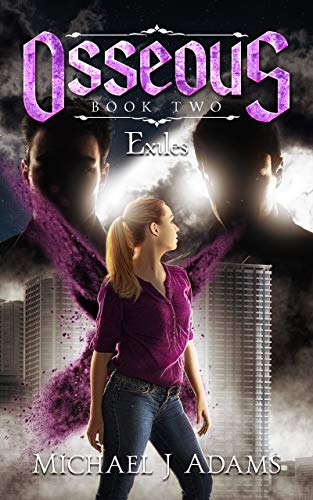
And thanks to NewPub you can get all the bizarre stories you want. There is no one to gatekeep it out any longer. Michael J. Adams' Osseous series is no exception to that rule.
Regardless, here is the description:
Who needs detective skills when you can track down missing children by swallowing their lost teeth?
PI Tiffemory Greenstone treats each missing person case like she would her own child. But when Mallory Sanderson is kidnapped for the second time, Tiff takes it especially personally. It's hard not to when the kidnapping is her fault.
Jeck, the rogue fairy she banished six months prior, has returned and is seeking revenge. In a world that believes the tooth fairy is only a myth, Tiff is the only one who can stop him.
But finding her nemesis will be an uphill battle. And facing a foe who's more than her equal may cost Tiff her life. The other option is watching the city's youths disappear one at a time.
Sounds off the wall, I know. But you won't get fresh ideas like this in OldPub. In fact, if the writing climate wasn't as it was now, there would be no chance for things like this to even have an opportunity to be published.
There's far more to come in NewPub, and I plan to tell you about as much as I can. So strap in, this is going to be a long ride! We've got a ways to go.